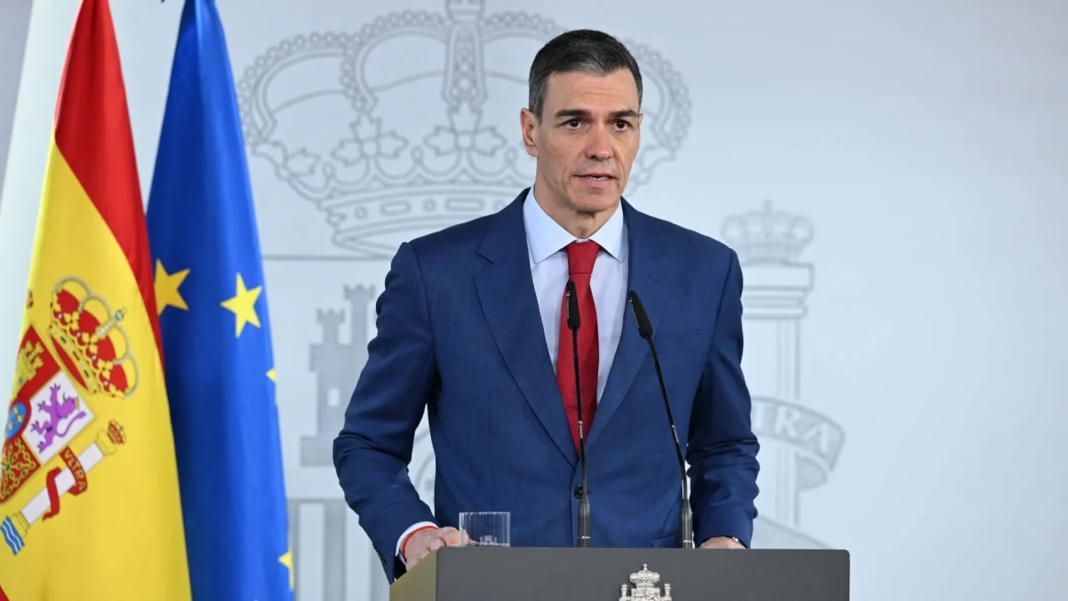
Madrid, Spain — Spanish Prime Minister Pedro Sánchez on Wednesday firmly rejected the escalating Middle East conflict sparked by US and Israeli attacks on Iran, summing up his government’s position in three words: “No to war,” a slogan widely associated in Spain with opposition to the 2003 Iraq invasion.
Speaking in an address from the Moncloa Palace, Sánchez drew parallels between the current crisis and the 2003 Iraq war, warning against repeating what he described as past mistakes.
RELATED NEWS : Israel attacks Iran, several explosions heard in Tehran
He recalled that the US “dragged us” into the Iraq war in 2003, a conflict that, in his view, unleashed “the greatest wave of insecurity” in Europe since the fall of the Berlin Wall.
“That war, which was supposedly launched to eliminate Saddam Hussein’s weapons of mass destruction, bring democracy and guarantee global security, produced the opposite effect,” Sánchez said, arguing that it resulted in greater insecurity, terrorism, and economic instability.
“That was the gift of the Azores trio to Europeans at the time: a more insecure world,” he added, referring to former leaders George W. Bush of the United States, Tony Blair of the United Kingdom and José María Aznar of Spain.
Sánchez also stressed that Spain would not be “complicit in something that is bad for the world,” nor would it support the current war in the Middle East “out of fear of retaliation,” in an apparent reference to threats by US President Donald Trump to cut trade ties with Spain over its stance on the conflict.
He warned that the confrontation could be prolonged and said Spain must prepare “for the possibility that it may be a long war.”
He reaffirmed that his government would maintain the same “clear and firm” position it has taken on Ukraine and Gaza, opposing what he called “the bankruptcy of the international law that protects us all.”
The prime minister said the government is assessing various scenarios and potential measures to shield households, workers, companies, and the self-employed from the economic fallout of the conflict.
“We have the capacity and the political will, and we will act in coordination with social partners, as we did during the pandemic, the energy crisis and, more recently, the tariff crisis,” he said.
Addressing Spaniards currently in the conflict zone, Sánchez assured them that, if they wish to leave, “they can be certain that we will help them and bring them safely home.”
Around 30,000 Spaniards, including residents, tourists and workers, are currently in the region. On Tuesday, a first group returned to Spain, while others are leaving the area by different means.
SOURCE : EFE. | Follow Us: Facebook | Instagram | Twitter | Youtube |