By Derya Soycal
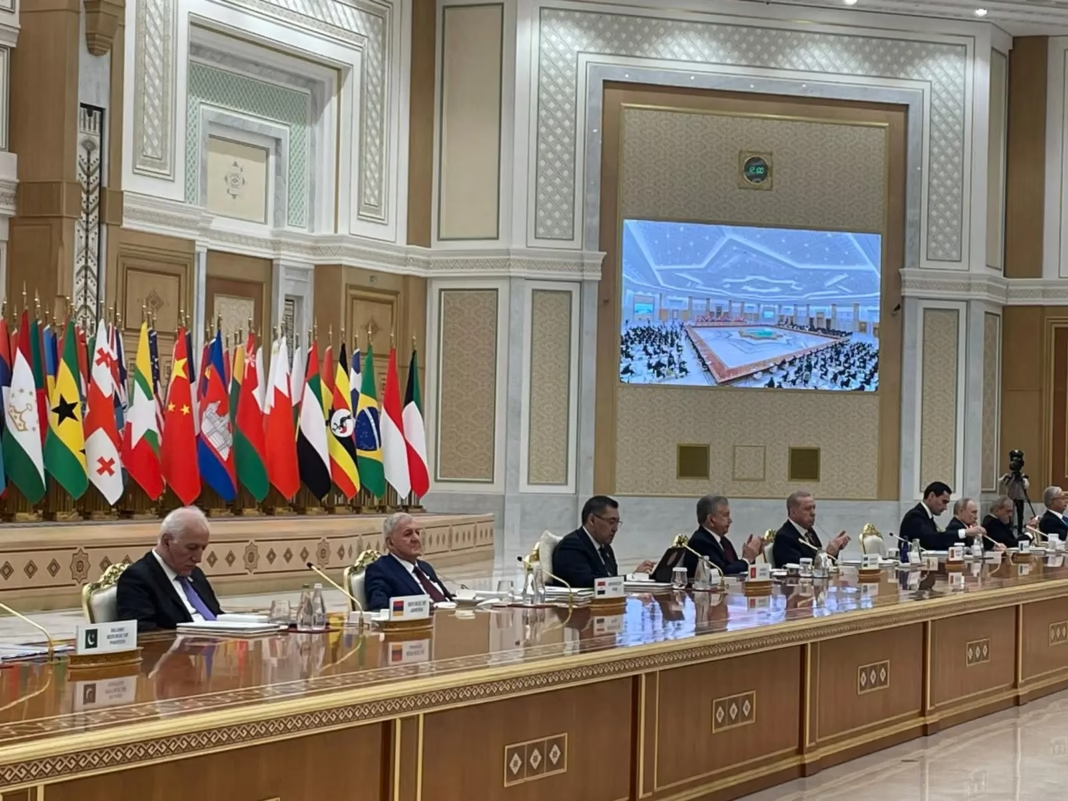
Ashgabat, Turkmenistan — At a critical moment for global diplomacy, the capital of Turkmenistan hosted a high-level International Forum on Peace and Trust, bringing together heads of state, government leaders, and senior representatives of major international organizations to reaffirm the principles of peace, neutrality, and multilateral cooperation.
The forum was organized within the framework of the 30th anniversary of Turkmenistan’s permanent neutrality and the International Year of Peace and Trust proclaimed by the United Nations. It attracted an extensive lineup of global leaders, including Russian President Vladimir Putin, Turkish President Recep Tayyip Erdoğan, Iranian President Masoud Pezeshkian, and the presidents of Central Asian states—Kazakhstan, Uzbekistan, Kyrgyzstan, and Tajikistan.
READ MORE : Jews event at Bondi Beach turns deadly as shooting kills 15, Including Children
Also attending were Azerbaijani Prime Minister Ali Asadov, Georgian Prime Minister Irakli Kobakhidze, Pakistani Prime Minister Shehbaz Sharif, Armenian President Vahagn Khachaturyan, as well as the prime ministers of Myanmar and Eswatini, underscoring the forum’s broad international reach.
Senior representatives from key international and regional organizations—including the United Nations (UN), the Organization for Security and Co-operation in Europe (OSCE), the Shanghai Cooperation Organization (SCO), the Economic Cooperation Organization (ECO), UNESCO, and ISESCO—highlighted the forum’s significance as a global diplomatic platform.
Neutrality as a Model for Global Stability
Against the backdrop of a rapidly evolving multipolar world, rising regional conflicts, and increasing global insecurity, the forum focused on peace, trust, dialogue, and mutual respect as foundations for international relations. Turkmenistan’s permanent neutrality, recognized by the UN General Assembly in 1995, was presented not merely as a national policy but as a functional diplomatic model that supports conflict prevention, mediation, and confidence-building.
Participants noted that neutrality is gaining renewed relevance amid growing military bloc formations, with Turkmenistan’s approach cited as a means of keeping dialogue channels open and fostering reconciliation.
Strong Support from Central Asia
Kazakhstan’s President Kassym-Jomart Tokayev emphasized that Turkmenistan’s “positive neutrality” has played a historic role in maintaining peace and stability in Central Asia. He described neutrality as deeply rooted in cultural traditions and spiritual values, stating that the Ashgabat forum would contribute meaningfully to building a just world order based on trust and cooperation.
Kyrgyz President Sadyr Japarov highlighted the importance of regional connectivity and transport corridors as tools not only for economic growth but also for peace and stability, praising Turkmenistan’s balancing role in regional affairs.
Tajik President Emomali Rahmon described Turkmenistan’s neutrality as a stabilizing reference point at a time when international law is under strain and security challenges are becoming more complex.
Uzbek President Shavkat Mirziyoyev stressed that Turkmenistan’s neutrality has become part of the nation’s modern identity, grounded in historical traditions, tolerance, and good-neighborly relations.
Voices from the Middle East, Caucasus, Africa, and Asia
Armenian President Vahagn Khachaturyan said Turkmenistan’s neutrality contributes to regional peace, emphasizing that peace must be understood as the construction of lasting trust and reconciliation. He praised Turkmenistan’s initiatives at the UN, including the designation of 2025 as the International Year of Peace and Trust.
Iraqi President Abdul Latif Jamal Rashid drew attention to the humanitarian crisis in the Middle East, particularly the situation of the Palestinian people, stressing that dialogue and adherence to UN resolutions remain essential for lasting solutions.
São Tomé and Príncipe President Carlos Manuel Vila Nova underlined the importance of neutrality and multilateralism for small and developing states seeking to safeguard sovereignty and stability.
Pakistani Prime Minister Shehbaz Sharif commended Turkmenistan’s peace initiatives and called for enhanced global solidarity, particularly in Gaza reconstruction, climate resilience, and humanitarian assistance. He also acknowledged mediation efforts by regional countries aimed at easing tensions in Afghanistan.
Strategic Perspectives on Connectivity and Cooperation
Georgian Prime Minister Irakli Kobakhidze described the Middle Corridor as not only a trade route but also a strategic axis for political stability across Eurasia, reaffirming Georgia’s commitment to transforming the ideals of peace and trust into lasting progress.
Azerbaijani Prime Minister Ali Asadov highlighted Turkmenistan’s neutrality as an effective soft power instrument and emphasized the importance of maintaining the Caspian Sea as a zone of peace and cooperation.
Representatives from Eswatini and Myanmar echoed similar sentiments, calling Turkmenistan’s neutrality an inspiring example for the international community.
Turkmenistan’s Vision for a Peace-Based World Order
Turkmenistan’s national leader, Gurbanguly Berdimuhamedov, said the International Year of Peace and Trust offers a historic opportunity to rebuild confidence in international relations, stressing dialogue and mutual respect as the strongest guarantees of peace.
President Serdar Berdimuhamedov reaffirmed that peace, trust, and cooperation must form the cornerstones of a new world order. He emphasized that Turkmenistan’s permanent neutrality is constitutionally enshrined and guided by principles such as non-use of force, peaceful dispute resolution, and respect for human rights.
“The adoption of the UN resolution declaring the International Year of Peace and Trust is a tangible outcome of Turkmenistan’s long-standing efforts to promote peace,” he said, thanking all states and organizations that supported the initiative.
Broad International Endorsement
UN representatives and officials from multiple international organizations expressed strong support for Turkmenistan’s neutrality policy and its contribution to global peace and security. Iran and other participating states thanked Turkmenistan for hosting the forum and for advancing multilateral dialogue.
Turkish President Recep Tayyip Erdoğan also congratulated President Serdar Berdimuhamedov, stating that Türkiye highly values Turkmenistan’s neutrality policy as a constructive and balancing model for regional and global peace.
Conclusion
Marking three decades of Turkmenistan’s permanent neutrality, the International Forum on Peace and Trust delivered a strong global call for dialogue, neutrality, and multilateral cooperation. Participants agreed that peace and trust are essential foundations for sustainable development, regional stability, and a more secure international order.
SOURCE : | Follow Us: Facebook | Instagram | Twitter | Youtube |