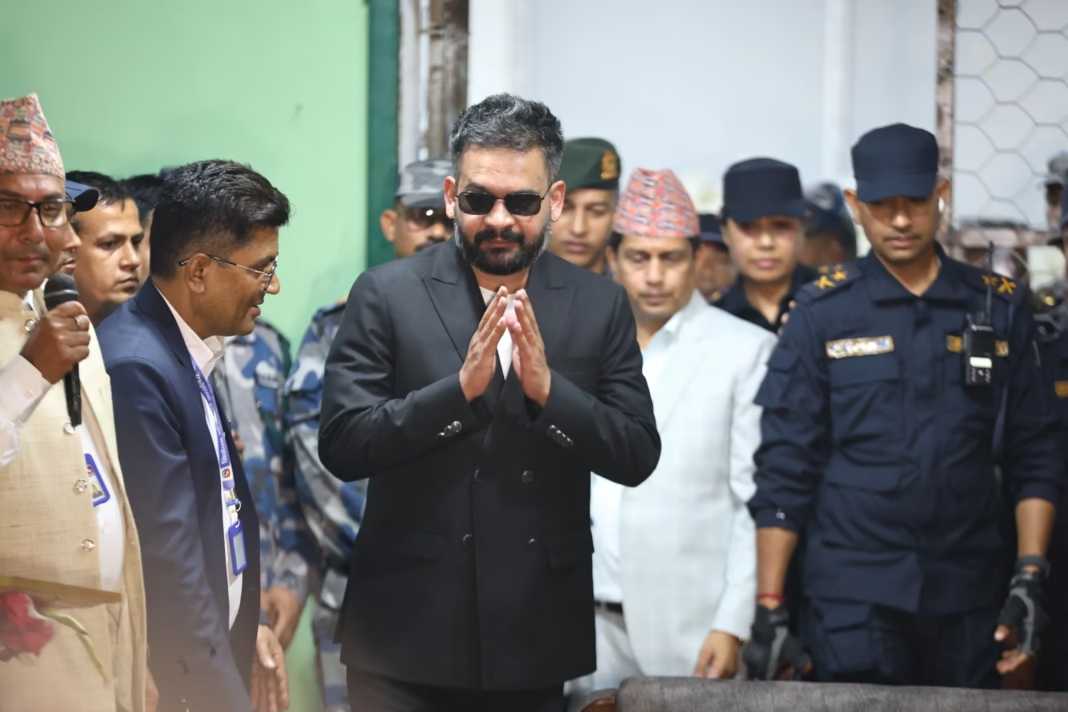
Kathmandu, Nepal — Preliminary and partial results released Saturday showed a new political party led by an ex-rapper is in front in Nepal’s parliamentary election, the country’s first since last year’s youth-led revolt.
The Rastriya Swatantra, or National Independent, party, had already won 60 of 165 directly elected seats and was leading in 61 other constituencies in the results published by Nepal’s Election Commission.
RELATED NEWS : Who is Balen Shah? Media Hails Him as Top Contender for Nepal’s Next Prime Minister
Its prime ministerial candidate is rapper-turned-politician Balendra Shah, who won the 2022 Kathmandu mayoral race and emerged as a leading figure in the 2025 uprising that ousted former Prime Minister Khadga Prasad Oli.
The 35-year-old highlighted health and education for poor Nepalis as a key focus of his campaign, which rode a wave of public anger toward traditional political parties.
Shah, running directly against Oli in a southeastern district, won the seat with a wide margin securing almost four times as many votes as the former prime minister.
The 13 seats announced so far for other parties went to the Nepal Congress party and two communist parties.
Voters are directly electing 165 members to the House of Representatives, the lower chamber of Parliament. The remaining 110 seats in the 275-member body will be allocated through a proportional representation system, under which political parties are allocated seats based on their share of the vote.
Rapper Balendra Shah has defeated the former Nepalese Prime Minister Sharma KP Oli in his parliamentary constituency, as he takes a step closer to becoming Nepal’s next prime minister.
Nepal’s Election Commission confirmed on Saturday that Shah, 35, received 68,348 votes compared to Oli’s 18,734 to unseat the former leader in his constituency.
Thursday’s general election – the first since violent youth-led protests toppled the government in September – pitted the establishment against a new generation of politicians advocating for angry, young Gen Z voters hungry for change.
Shah’s Rastriya Swatantra Party (RSP) is now seemingly on course to win the general election.
The party has a majority in directly elected seats in the general election counted so far, according to partial official results on Sunday, and could be heading for a landslide, official trends suggest.
The 35-year-old is also leading in the proportional representation vote count so far, according to the election commission.
For more than two decades, Nepal has seen a revolving door of coalition governments, largely dominated by three parties, two of them communist.
Ahead of this election, it looked set to test whether Gen Z voters had succeeded in convincing the rest of the country that it is time for a new, untested generation to shape their future, or whether veteran heavyweights – who have dominated for decades – would keep hold of power.
The country’s youth included 800,000 first-time voters, making them a key voter bloc.
Shah, who is popularly known as Balen, has been a member of the Nepali hip hop scene for several years, with one of his songs “Balidan” about sacrifice in the Nepali language cultivating millions of YouTube views.
In September 2025 unrest erupted in Nepal with so-called Gen Z demonstrations, triggered by Oli’s banning of social media platforms.
The demonstrations escalated with protesters criticising Nepal’s political system and the symbolism of class inequality “nepo babies” – children of the country’s politicians.
A total of 77 were killed during the protests, and a BBC investigation revealed the country’s police chief issued an order of lethal fire against thousands of unarmed protesters.
Shah spoke in support of the protesters and at one stage called Oli a “terrorist” who had betrayed his country.
The rapper typically shuns the media, but told the Financial Times while he was on the campaign trail he would be “the candidate for all of Nepal”.
Shah’s RSP released its manifesto in February which vowed to create 1.2 million jobs and reduce forced migration, in an effort to tap into frustration over unemployment and low wages that has pushed millions of Nepalis to move overseas.
The party has also pledged that within five years it would raise Nepal’s per capital income from $1,447 to $3,000, more than double the country’s economy to $100 billion GDP and provide safety nets such as healthcare insurance for the population.
SOURCE : AGENCIES | Follow Us: Facebook | Instagram | Twitter | Youtube |