By Pragatee Gupta
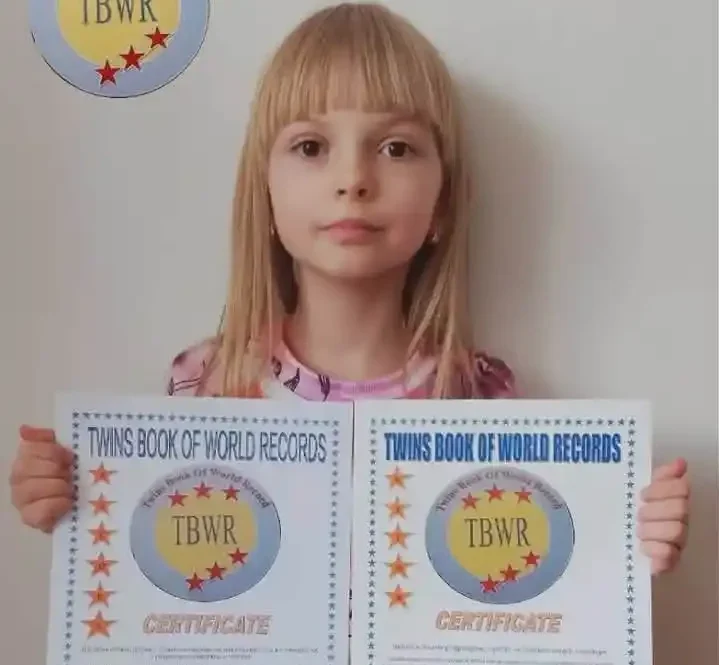
PÚCHOV, Slovakia — At an age when most children are busy playing with toys, riding bicycles, discovering new hobbies and enjoying the carefree moments of childhood, eight-year-old Ema Ďurdíková from Púchov, Slovakia, is already building an extraordinary legacy of her own. With 77 officially recognized records, Slovak Champion and World Champion titles, and achievements acknowledged by 12 international record organizations, Ema has emerged as a remarkable young talent whose story reaches far beyond the numbers printed on her certificates.
Her journey is not simply about balancing objects, winning titles or collecting records. It is a story of childhood curiosity, extraordinary concentration, determination in the face of challenges, and the powerful bond between a daughter and her father. Behind every successful attempt lies hours of practice, countless moments of patience and a family that has supported her ambitions from the very beginning.
From the quiet surroundings of her hometown in Slovakia to the international platforms where her achievements have been recognized, Ema’s journey demonstrates how an ordinary childhood interest can develop into an extraordinary pursuit when talent is supported by dedication, guidance and encouragement.
Yet the story of this young champion began with something much simpler than a world record: a little girl watching her father.
A Childhood Spark That Became an Extraordinary Journey
Born on 13 August 2017, Ema grew up in Púchov, a town in northwestern Slovakia. Like many children, she was naturally curious about the world around her. She enjoyed observing the people closest to her, discovering how things worked and trying activities that caught her attention.
But one person had a particularly powerful influence on her early years: her father, Peter Ďurdik.
Peter is an accomplished record-holder whose balancing skills and record attempts have earned recognition from international organizations. His ability to maintain control over carefully arranged objects and perform unusual balancing challenges fascinated his young daughter.
For Ema, watching her father practise was more than entertainment. It was an opportunity to discover something new. She observed his movements, paid attention to the objects he used and began wondering whether she could perform similar feats herself.
At just three years old, she started experimenting with balancing everyday objects around the house. What initially appeared to be innocent childhood play gradually revealed an unusual level of interest and an emerging ability to control small movements with care.
Most children might try an activity a few times before becoming distracted by something else. Ema, however, repeatedly returned to her balancing experiments. She wanted to understand how objects could remain in position, why some arrangements worked while others collapsed, and what she needed to do differently to achieve success.
Those early experiments became the first steps towards a journey that would eventually take her into the world of record-setting achievements.

Recognizing Talent at an Early Age
By the time Ema was four, Peter had begun to recognize that his daughter possessed exceptional balance, concentration, patience and coordination for her age.
As a father, he had watched her develop from a curious toddler into a child who was increasingly interested in mastering difficult physical challenges. As an experienced record-holder, he also understood the discipline required to perform such feats consistently.
He recognized that natural ability alone would not be enough. Balancing objects in unusual positions requires precise movements, an understanding of body control and the ability to remain calm even when an arrangement appears unstable.
A small shift in posture, an involuntary movement of the hand or a momentary lapse in concentration can cause an entire arrangement to collapse. For a young child, learning to manage these details requires patience and repeated practice.
Peter therefore began guiding Ema more systematically, helping her develop her abilities step by step. His intention was to nurture her interest and give her opportunities to explore her talent rather than simply encouraging her to chase titles.
The experience he had gained through his own record attempts became an important source of guidance. He could explain techniques, demonstrate movements and help Ema understand why certain attempts succeeded while others failed.
Their shared interest gradually became a defining part of their relationship. What began as a father demonstrating his skills to his daughter developed into a partnership built around learning, practice and the pursuit of increasingly demanding challenges.
For Ema, her father was not merely someone who taught her how to balance objects. He was the person who first showed her that a seemingly impossible task could become achievable through patience and persistence.
Training, Discipline and the Art of Balance
As Ema’s skills developed, practice became an increasingly important part of her daily routine.
Her training begins with warm-up exercises, followed by carefully planned practice sessions that can last between one and two hours. During these sessions, she works on balance, coordination, control and concentration, gradually building the skills required for more difficult challenges.
Balancing may look effortless when performed successfully, but the process behind it can be demanding. Each movement must be controlled, and every object must remain in the correct position. The performer must maintain physical stability while constantly adjusting to tiny changes that could otherwise disrupt the arrangement.
For Ema, the challenge becomes even greater when several objects must be balanced simultaneously. Each additional object introduces another element of uncertainty, requiring greater precision and an ability to remain focused for extended periods.
Her practice involves ordinary objects that many people would never consider equipment for a record attempt. Footballs, ping-pong balls, rulers, spoons, apples and pears all feature in her balancing challenges.
These familiar objects provide opportunities to experiment with different shapes, surfaces and arrangements. A spoon, for example, presents a different challenge from a ball, while a pear or apple introduces another set of considerations when used as part of a delicate balancing structure.
The simplicity of the objects makes her achievements particularly fascinating. There is no elaborate machinery involved in many of these challenges. Instead, the outcome depends on the performer’s control, patience and ability to maintain a carefully established position.
Every successful attempt is the result of a process that spectators rarely see: repeated experimentation, adjustments to technique and the willingness to begin again when something goes wrong.
Beyond Balance: Building Strength and Concentration
Ema’s physical preparation extends beyond balancing exercises. She also trains in boxing, kickboxing and karate, activities that help develop strength, coordination, reflexes and concentration.
These disciplines demand control over the body and the ability to respond deliberately to changing situations. They also encourage the development of balance, timing and physical awareness.
For a young athlete working on intricate balancing feats, such qualities can be valuable. Maintaining a difficult position requires more than remaining still; it involves controlling posture, managing movement and responding to small changes without disturbing the overall arrangement.
Her training reflects the importance of developing different physical skills rather than relying on one ability alone.
At the same time, her age makes appropriate training, rest, supervision and attention to her health particularly important. The goal is to nurture her talent while allowing her to continue enjoying the activities that make up a healthy childhood.
Ema’s journey illustrates how a particular interest can encourage a child to develop a broader range of abilities. An activity that began with a few household objects has become an opportunity to learn about discipline, coordination, patience and personal improvement.
The Power of Perseverance
For Ema, not every attempt ends in success.
Sometimes an object slips out of position. Sometimes a carefully arranged structure collapses just before a challenge is completed. At other times, a movement that seemed correct during practice does not produce the desired result.
These moments are an unavoidable part of balancing, where the margin between success and failure can be extremely small.
But according to the account of her journey, Ema does not allow unsuccessful attempts to become a reason to abandon a challenge. Instead, she returns to practice, works on her technique and tries again.
This willingness to continue is one of the most important aspects of her story.
Records and medals often show only the final outcome. They do not reveal the repeated attempts, the adjustments made along the way or the patience required to achieve a result. For every successful performance, there may be many earlier attempts that never make it into the official record.
Learning to accept those setbacks is an important part of developing any skill. In Ema’s case, the process also provides an early lesson in perseverance: progress does not always happen immediately, and failure does not have to be the end of an effort.
Her journey offers a simple but powerful message to other young people. Talent may provide a starting point, but improvement often depends on the willingness to practise, learn and keep trying.
Seventy-Seven Records and Recognition Across Borders
Today, Ema’s achievements include 77 officially recognized records, according to the information provided about her career. Her accomplishments have received recognition from 12 international record organizations, and she has earned Slovak Champion and World Champion titles.
For a child who began experimenting with household objects at the age of three, the scale of those achievements represents a remarkable development.
Each record reflects a specific challenge and the effort required to meet its criteria. Different balancing feats demand different techniques, and the difficulty increases when several objects must be held in position at once or when the performer must maintain an arrangement for a defined period.
The recognition of her achievements across multiple organizations has also helped take her story beyond her hometown. Her name is now associated with a growing collection of accomplishments that showcase a highly unusual skill.
However, the number of records tells only part of the story. It does not fully capture the years of learning, the support provided by her family or the determination required to repeat a difficult performance until it meets the necessary conditions.
For Ema, every new challenge offers another opportunity to test herself, improve her abilities and discover what she can accomplish through practice.
Her Slovak Champion and World Champion titles represent important milestones in that journey. They also reflect the significance of her achievements within the competitive and record-setting activities in which she participates.
As her experience grows, the skills she has developed through balancing may continue to provide a foundation for exploring new challenges.
A Remarkable Challenge Involving Apples and a Ping-Pong Ball
Among Ema’s reported achievements is a particularly demanding balancing feat involving two apples and a ping-pong ball.
The challenge required her to balance two apples with a ping-pong ball positioned on top, maintaining the delicate arrangement for seven minutes and 27 hundredths of a second.
Although the objects themselves are familiar, keeping them balanced in a stable arrangement for such a duration requires considerable control and patience.
Apples have curved surfaces, while a ping-pong ball is lightweight and easily displaced by even a small movement. The performer must therefore maintain the correct position while avoiding sudden movements that could disturb the structure.
The longer the arrangement remains in place, the greater the demand on concentration. A challenge that lasts several minutes requires sustained attention rather than a brief display of coordination.
For a young child, maintaining that focus is particularly noteworthy. It requires her to resist the urge to move unnecessarily and to remain attentive throughout the attempt.
The achievement illustrates one of the defining features of Ema’s balancing skills: the ability to transform simple objects into a test of precision and endurance.
To an observer, the final arrangement might appear almost effortless. Yet the result depends on a combination of preparation, technique and concentration, all developed through practice.
International Recognition Through an Indian Record Organization
Ema’s achievements have also reached beyond Europe, including recognition through an Indian record organization.
One of her reported balancing challenges involved two separate arrangements performed simultaneously. She balanced a spoon in her mouth with a ping-pong ball resting on it while holding a pear in her hand with another ping-pong ball balanced on top.
She maintained the arrangement for one minute and 47.10 seconds.
The feat required her to control two delicate balancing positions at the same time. The arrangement involving the spoon and ping-pong ball demanded careful control of her head position, while the second arrangement required her to keep the pear and ball stable in her hand.
The difficulty lay not simply in balancing each object individually, but in maintaining both arrangements together without allowing one movement to disrupt the other.
Such a challenge highlights the importance of coordination between different parts of the body. Even a small adjustment in one position can affect the stability of the objects involved.
The recognition of this achievement through an Indian organization also demonstrates how record-setting activities can connect people across national boundaries. A young performer from Slovakia can have her abilities assessed and recognized by an organization operating thousands of kilometres away.
For Ema, the achievement represents another milestone in a journey that began in her own home and gradually expanded to international platforms.
The specific record categories, timings and recognition details are based on the information provided for this article.
A Young Champion Who Still Enjoys Childhood
Despite her growing collection of records and the attention surrounding her achievements, Ema remains a child with interests beyond balancing.
She attends school, takes part in her studies and is reported to perform well academically. Among her classmates, she is also known for being one of the fastest runners.
Her interests extend into the digital world as well. She enjoys exploring the internet and developing her online profile, using technology to engage with the world beyond her immediate surroundings.
These everyday activities offer an important reminder that Ema’s identity is not defined solely by her records.
She is simultaneously a student, a daughter, a young athlete and a child discovering her interests. Her balancing achievements form one part of a wider childhood that also includes education, friendships, recreation and family life.
In Slovakia, her growing recognition has reportedly led people to approach her in public, ask about her achievements and congratulate her. According to her father, many affectionately refer to her as “their little princess.”
Such attention can be a source of pride for a young achiever and her family. At the same time, maintaining a sense of normality is important for children who receive public recognition at an early age.
For Ema, the challenge ahead is not simply to add more records to her collection. It is also to continue learning, growing and enjoying the experiences that make childhood meaningful.
A Difficult Chapter: The Tumour Discovered in Her Leg
Behind Ema’s achievements lies a difficult chapter that her family faced when she was very young.
When Ema was three years old, doctors discovered a tumour in her leg. The diagnosis came as a serious shock to her family, turning an otherwise ordinary period of childhood into a time of uncertainty and concern.
For parents, news of a medical problem affecting their child can be deeply distressing. Peter later described those moments as among the most difficult the family had experienced.
The family had to face the uncertainty surrounding the diagnosis and the prospect of surgery. At such a young age, Ema could not fully understand the concerns that surrounded her, but the experience became a significant moment in her family’s life.
Fortunately, the surgery was successful.
Following the procedure and treatment, Ema began her recovery. She initially experienced stiffness in her leg, but, according to the account shared by her family, she gradually regained her strength and returned to sports and training within a month.
Her recovery marked an important step forward after a frightening period.
The experience also placed her later sporting achievements in a broader perspective. Her journey was not simply a matter of developing an unusual skill. It also involved navigating a health challenge at an age when most children have little understanding of the difficulties adults are working to manage around them.
The details of a child’s medical history should always be treated with sensitivity, and her recovery should not be presented as a measure of her worth or determination. Nevertheless, the family’s account provides important context for understanding the challenges they faced during her early years.
For Peter, supporting his daughter through the experience was part of his responsibility as a father. His encouragement continued as she recovered and gradually returned to the activities she enjoyed.
The Father Behind the Young Record-Holder
While Ema performs the balancing challenges, her journey has been closely supported by her father, Peter Ďurdik.
His own experience as a record-holder has given him a practical understanding of the patience and preparation required to develop unusual balancing skills. He knows that successful performances rarely happen by chance and that even apparently simple challenges can require considerable experimentation.
That experience has helped him guide Ema as she learns new techniques, works on difficult arrangements and prepares for record attempts.
Their relationship is central to the story. Peter first introduced Ema to the world of balancing through his own practice, but he also became the person who helped her turn curiosity into a more structured pursuit.
For a young child, having a trusted adult nearby can make the process of learning a new skill more encouraging and manageable. Guidance can help a child understand mistakes, recognize improvement and approach difficult tasks without becoming discouraged.
Peter’s role is therefore about more than demonstrating techniques. It involves supporting his daughter’s development, recognizing her interests and helping her pursue challenges while navigating the responsibilities of school, health and childhood.
The experience also reflects the influence that parents can have on the interests of their children. A hobby shared at home can become an important source of connection, opening opportunities for learning and creating memories that extend beyond the activity itself.
For Ema and Peter, balancing has become a shared pursuit through which they have celebrated achievements, worked through difficulties and continued exploring what is possible.
More Than Medals, Certificates and Numbers
The public often measures achievement through visible milestones: the number of records earned, the titles received and the certificates displayed.
For Ema, those milestones are significant. Her reported 77 records and recognition from 12 international organizations represent an unusual collection of accomplishments for someone who is only eight years old.
But the deeper value of her journey lies in the process behind those numbers.
It is visible in the patience required to repeat an exercise, the concentration needed to maintain a delicate arrangement and the willingness to start again after an unsuccessful attempt.
It can also be seen in the relationship between Ema and her father, whose experience and encouragement have helped her explore an ability that might otherwise have remained a childhood curiosity.
Her story illustrates how a young person’s interests can develop when given time, guidance and opportunities for practice. It also shows that achievement does not have to begin in a professional training centre or with expensive equipment. Sometimes, it begins with an ordinary object, a question and the desire to see whether something difficult can be done.
At the same time, Ema’s age is an important part of the story. Her achievements are remarkable precisely because they are taking place during childhood, a period when learning, play, education and healthy development should remain central.
Her records can be celebrated without placing unrealistic expectations on her future. She deserves the opportunity to continue discovering her interests at her own pace, whether that means attempting new balancing challenges, pursuing other sports or exploring entirely different ambitions as she grows older.
An Inspiration From Púchov to the World
From a little girl copying her father’s balancing exercises to a young champion with dozens of recognized records, Ema Ďurdíková’s journey has developed through a combination of curiosity, practice and family support.
Her achievements have taken her beyond the boundaries of her hometown, bringing recognition from organizations in different parts of the world. Her reported balancing feats demonstrate the concentration and coordination she has developed, while her recovery from an early medical challenge forms another part of the family’s story.
Yet perhaps the most enduring aspect of her journey is the simple way it began.
There was no elaborate plan for an eight-year-old to accumulate 77 records. There was a child who watched her father, became interested in what he was doing and decided to try it herself.
That curiosity grew through practice. Practice developed into skill. Skill opened the door to record attempts, and those attempts gradually became a collection of achievements that now attracts attention far beyond Slovakia.
Ema’s experience offers an encouraging message to children who are discovering their own interests and to parents who are trying to identify and support their children’s abilities. Every child develops differently, and extraordinary accomplishments do not follow a single path. What matters is creating opportunities to learn, providing appropriate guidance and allowing young people to grow without losing the joy of discovery.
For the people of Púchov, Ema’s accomplishments are a source of local pride. For those following her journey internationally, she represents a young achiever whose story combines unusual talent with determination and family support.
Her future remains open, as it should for any child of her age. There may be new records, new interests and new challenges ahead, but her worth will never depend on the number of certificates she collects.
For now, Ema Ďurdíková continues to balance objects, pursue her interests and enjoy her childhood, supported by a father who recognized her potential when she was still very young.
Her story is a reminder that remarkable journeys can begin in the most ordinary places—and that behind every extraordinary achievement is often a series of small steps taken with patience, courage and encouragement.
From Púchov to international record platforms, the young Slovak champion has already shown how far childhood curiosity can travel when it is nurtured with care. And while 77 records make an impressive headline, the story behind them is what truly makes her journey worth telling.
SOURCE : DT/Pragatee Gupta | Follow Us: Facebook | Instagram | Twitter | Youtube