Home Blog Page 49

JD Vance, Meloni Deepen Trade Talks in Rome, VP Attend Vatican Service Amid Papal Speculation

Rome, Italy — U.S. Vice President JD Vance met with Italian Premier Giorgia Meloni in Rome on Friday for a second round of high-stakes talks on tariffs, just a day after their Oval Office meeting with former President Donald Trump. The two leaders later attended Good Friday services at the Vatican, fueling speculation of a potential meeting between Vance and Pope Francis over the weekend.

Greeting Vance at the Chigi Palace, Meloni joked, “I’ve been missing you,” referencing their back-to-back meetings. Their discussions centered on transatlantic trade tensions and the ongoing conflict in Ukraine, with Vance stating that negotiations with the European Union remain a priority.

The White House and Meloni’s office issued a joint statement confirming that Trump would visit Italy “in the very near future,” adding that a broader U.S.-EU meeting is also under consideration.

“This visit is another great opportunity to strengthen our bilateral cooperation,” Meloni said, emphasizing Italy’s vital role as a U.S. partner in Europe and the Mediterranean.

U.S. Vice President JD Vance, and his wife Usha Vance, with their daughter Mirabel, back to camera, and sons Vivek and Ewan, left, attend a Good Friday service inside St. Peter’s Basilica at the Vatican, Friday, April 18, 2025. Photo: AP/Alessandra Tarantino

Vance, a Catholic convert, later attended the solemn Good Friday service at St. Peter’s Basilica alongside his wife and children. Though Pope Francis was absent due to health concerns, Vance is scheduled to meet with Vatican Secretary of State Cardinal Pietro Parolin on Saturday. While no official meeting with the Pope has been announced, Vatican insiders have not ruled out the possibility.

The potential audience with Francis comes against the backdrop of past tensions. Vance has previously criticized the Pope’s stance on migration, clashing with the pontiff’s emphasis on humanitarian care. Francis, in turn, appeared to rebut Vance’s theological justifications for U.S. immigration policies in a February letter to American bishops, urging a more inclusive interpretation of Christian doctrine.

As the Easter weekend unfolds, all eyes remain on Rome, where diplomacy, religion, and politics continue to intersect in complex and symbolic ways.


SOURCE : AP NEWS |  Follow Us: Facebook | Instagram | Twitter | Youtube |
France Hosts Landmark Ukraine Talks With Marco Rubio, Ukrainian and European Leaders Amid Rising Tensions

0

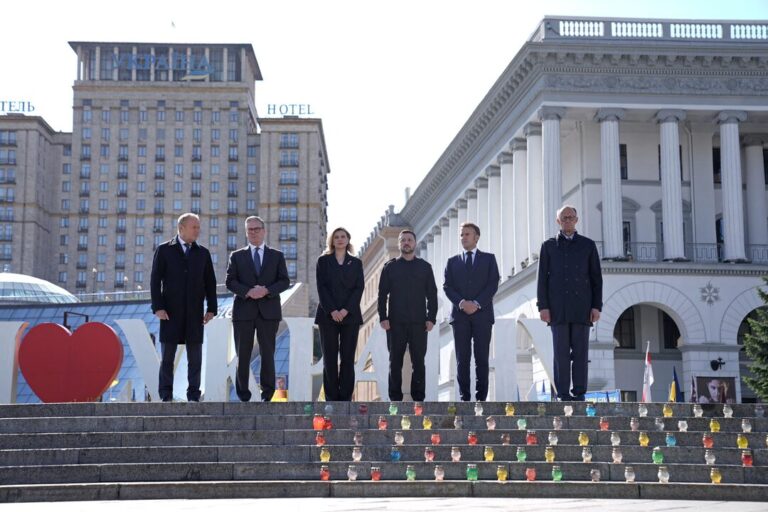
Paris, France — France played host to pivotal high-level talks on Ukraine’s security Thursday, marking the first time since President Donald Trump’s inauguration that top U.S., Ukrainian, and European officials have met together to discuss the ongoing war. The talks, which took place at the French presidential palace, came at a time of mounting concerns about Trump’s stance toward Russia and the stalled efforts to broker a ceasefire in Ukraine.

U.S. Secretary of State Marco Rubio and presidential envoy Steve Witkoff, along with senior Ukrainian and European officials, participated in hours of separate discussions before French President Emmanuel Macron brought them together for a final round of talks. Macron characterized the discussions as an essential “convergence” and announced that the same format would continue next week in London.

French President Emmanuel Macron, left, welcomes US Special Envoy Steve Witkoff, center, and US Secretary of State Marco Rubio for a meeting at the Elysee Palace in Paris, Thursday April 17, 2025. Photo : Ludovic Marin, Pool Photo via AP

The gathering occurred amid rising frustrations in Europe over Trump’s foreign policy decisions, including his rhetoric surrounding NATO, tariffs on key allies, and his attempts to engage with Russia. There is increasing anxiety about Trump’s perceived readiness to align more closely with Moscow, further complicating efforts to end the war.

The American Perspective

Rubio shared on X that the American delegation’s primary goal in Paris was to “secure real, practical solutions to end the Russia-Ukraine war.” He also spoke by phone with Russian Foreign Minister Sergey Lavrov to convey the same message. According to U.S. State Department spokeswoman Tammy Bruce, Rubio relayed that “President Trump and the United States want this war to end, and have now presented to all parties the outlines of a durable and lasting peace.” The U.S. emphasized that the encouraging reception in Paris for their peace framework shows that a resolution is within reach if all parties are committed.

Until now, U.S. efforts have focused on separate negotiations with Ukraine and Russia, with European diplomats largely excluded from the talks. Experts view this meeting as a major shift, particularly since it is believed to be the first time Witkoff, Trump’s chief envoy for Russia, has met with senior Ukrainian officials.

Alina Polyakova, president of the Center for European Policy Analysis, highlighted the importance of involving Europe in the peace process, noting that “this is not just about a swath of territory in Ukraine… this is about broader questions of European security.”

Ukraine’s Priorities

Ukrainian President Volodymyr Zelenskyy, in a statement, emphasized the need for security guarantees and said his delegation was tasked with discussing both full and partial ceasefire proposals, though not touching on Ukraine’s territorial integrity. French officials later confirmed that U.S. negotiators were open to discussing security guarantees but offered few details.

Ukrainian presidential adviser Andrii Yermak stated that the discussions centered on the next steps toward achieving a “just and lasting peace,” including plans for a full ceasefire, the deployment of a multinational military force, and the establishment of an effective security architecture for Ukraine.

A Coalition for Peace

A significant topic was the formation of a coalition of nations, led by the UK and France, to help enforce any future peace agreement with Russia. However, the coalition’s success would require strong U.S. support, particularly in terms of airpower or military assistance, which the Trump administration has yet to publicly commit to.

Polyakova pointed out that peace efforts have so far faltered because Russian President Vladimir Putin seems unwilling to agree to a ceasefire, opting instead to stall negotiations. The Trump administration has mainly offered Moscow incentives, or “carrots,” but has been criticized for lacking sufficient leverage, or “sticks,” to force meaningful change.

The question now is whether these talks will prompt a shift in the U.S. strategy, Polyakova said.

Diplomatic Success for Macron

French President Macron, who has been in frequent communication with both Zelenskyy and Trump, spoke twice with the Ukrainian leader during the day’s talks. Macron’s involvement in these diplomatic efforts has been praised as instrumental in facilitating the convergence of U.S., Ukrainian, and European officials. France heralded Thursday’s discussions as a diplomatic success, reflecting the strength of Macron’s relationships with both Trump and Zelenskyy.

The ongoing meetings are seen as a crucial step in shaping the future of Ukraine and Europe’s security in the wake of the ongoing conflict.


SOURCE : AGENCIES |  Follow Us: Facebook | Instagram | Twitter | Youtube |
Argentine Court Upholds Gender Violence Charges Against Former President Alberto Fernández

Buenos Aires, Argentine – An Argentine appeals court has upheld the indictment of former President Alberto Fernández (2019–2023) on gender-based violence charges, advancing a landmark case that could see the ex-head of state stand trial for the alleged abuse of his former partner, Fabiola Yáñez.

RELATED NEWS : U.S. Sanctions Former Argentine President and Ex-Minister Over Corruption Allegations

The decision, issued Tuesday by the National Criminal and Correctional Appeals Court, confirms a February 17 ruling by Federal Judge Julián Ercolini, which accuses Fernández of committing both physical and psychological abuse against Yáñez between 2016 and August 2024 — a relationship the court described as shaped by a “notorious power imbalance.”

Judges Cite “Marked Power Asymmetry” and Pattern of Abuse

The majority decision by Judges Martín Irurzun and Eduardo Farah, with a dissent from Judge Roberto Boico, affirms that the alleged abuse occurred within a context of gender-based violence, in which Fernández is said to have exploited Yáñez’s vulnerability during their relationship.

The court cited a “marked power imbalance, isolation, psychological abuse, and repeated physical aggression,” noting that several incidents allegedly took place at the presidential residence under conditions of forced isolation.

Judge Farah dismissed the defense’s claim that the charges lacked clarity, stating the allegations were “meticulously described” from the beginning of the relationship to the formal complaint filed in 2024.

Defense Denies Abuse, Asserts Counterclaim

Fernández’s legal counsel, Silvina Carreira, has appealed the indictment, arguing that the former president was not the abuser but rather suffered mistreatment himself at the hands of Yáñez. The court, however, dismissed this claim and upheld charges including minor and serious injuries, coercive threats, and abuse of power — all aggravated by the intimate relationship between the two.

The ruling emphasized that Fernández’s status as both President and a public figure with symbolic authority intensified the imbalance of power, stating he was “not only the President of the Nation, but also a public actor with symbolic power.”

A Legal and Political First

This marks the first time in Argentine history that a sitting or former head of state has been criminally indicted for gender-based violence. If convicted, Fernández faces a potential prison sentence of 3 to 18 years.

The indictment details a sustained pattern of verbal humiliation, threats, guilt manipulation, and physical assault across multiple years — raising broader questions about accountability at the highest levels of government.

With the indictment now upheld, Fernández is just one step away from a public oral trial that could set a significant precedent in Latin American political and judicial history.


SOURCE : EFE. |  Follow Us: Facebook | Instagram | Twitter | Youtube

Peru’s Ex-First Lady Flees to Brazil, Requests Asylum to Escape Prison Sentence

Brasília, Brazil — Nadine Heredia, Peru’s former First Lady and wife of ex-President Ollanta Humala (2011–2016), arrived in Brazil on Wednesday under diplomatic asylum, mere hours after being sentenced to 15 years in prison for her role in a major corruption scandal involving Brazilian construction conglomerate Odebrecht and funding from Venezuela.

RELATED NEWS : Former Peruvian President Humala sentenced to 15 years in prison for money laundering

Heredia, accompanied by her youngest son, Samir, who was also granted asylum, landed in Brasília aboard a Brazilian Air Force jet, following a swift approval of her asylum request and the issuance of a safe-conduct pass by Peruvian authorities.

A Regional Scandal Reignited

Heredia and Humala were convicted Tuesday on charges of aggravated money laundering, accused of receiving illegal campaign donations from Odebrecht and late Venezuelan President Hugo Chávez during Peru’s 2006 and 2011 elections.

While Humala was arrested and sent to Barbadillo prison in Lima — where former presidents Alejandro Toledo and Pedro Castillo are also detained — Heredia fled to the Brazilian Embassy in Lima immediately after the verdict, invoking diplomatic protection under the 1954 Caracas Convention on Diplomatic Asylum.

Diplomatic Ripples Across Latin America

The case has triggered heated political debate in Peru, where Foreign Minister Elmer Schialer has been summoned to explain the government’s decision to allow Heredia’s departure. Congressional President Eduardo Salhuana acknowledged the country’s treaty obligations, emphasizing the need to avoid a diplomatic standoff with Brazil, Peru’s top Latin American trade partner.

“The government had no choice under international law,” Salhuana stated. “Refusal could have escalated into a full diplomatic crisis.”

Brazil, invoking the 1954 Caracas Convention, defended its decision despite Peru’s objections concerning Heredia’s conviction on serious financial crimes. Brazilian President Luiz Inácio Lula da Silva, who himself was imprisoned over charges later annulled, signed off on the asylum — reigniting conversations about the region’s history of politicized justice and Brazil’s legacy of offering refuge to embattled leaders.

Brazil’s Legacy of Political Asylum

Brazil has a long-standing tradition of granting asylum to controversial political figures. Among the most notable were Paraguayan dictator Alfredo Stroessner, ex-President Raúl Cubas, and Ecuador’s Lucio Gutiérrez.

Heredia’s legal team confirmed that her exit from Peru was executed in the early hours of Wednesday morning under military protection. Her future in Brazil remains uncertain — it is still unclear whether she and her son will remain in Brasília or relocate elsewhere within the country.

Meanwhile, Heredia’s conviction remains under appeal, potentially opening another chapter in a saga that continues to entangle power, politics, and justice across Latin America.


SOURCE : EFE. |  Follow Us: Facebook | Instagram | Twitter | Youtube

Russian Court Jailed 4 Journalists to 5.5 Years for Alleged Ties to Navalny’s Anti-Corruption Foundation

Moscow, Russia – In a verdict widely condemned by press freedom advocates, a Moscow court on Tuesday sentenced four journalists to five and a half years in prison for allegedly collaborating with the Anti-Corruption Foundation (FBK), the banned organization founded by the late Russian opposition leader Alexei Navalny.

The journalists — Antonina Favorskaya, Sergei Karelin, Konstantin Gabov, and Artyom Kriguer — were convicted of “extremism” for their alleged involvement in producing journalistic content for YouTube channels associated with Navalny’s movement.

The sentencing took place at Nagatinsky Zaton District Court, where the defendants listened to the ruling from inside a glass courtroom cell. Initially, prosecutors had sought five years and 11 months of imprisonment for each.

Despite the closed nature of much of the trial, dozens of family members, friends, and fellow journalists were permitted to attend the final hearing — many of whom gathered outside the courthouse to show their support.

“To Be Honest Is a Crime in Putin’s Russia”

Following the sentencing, Artyom Kriguer, speaking defiantly through the courtroom glass, told supporters:
“Everything will be fine, guys. Don’t despair. Sooner or later, all this will be over — and those who convicted me will go to jail.”
He added last week that “to be an honest and professional journalist — and not a pitiful propagandist — is a crime and an act of extremism in Putin’s Russia.”

Kriguer’s girlfriend told reporters the verdict would be appealed, affirming that “the struggle is not over.”

Targeted for Covering Navalny’s Work

None of the four journalists were official members of the FBK, which has been labeled an extremist organization by Russian authorities. They were arrested between March and June 2024, accused of producing material covering FBK’s investigations and public campaigns.

Despite their limited journalistic involvement — mostly covering rallies, legal proceedings, and political commentary — prosecutors argued that their reporting alone constituted participation in extremist activities.

Favorskaya, a correspondent for SOTAvision, was the first to be detained in March. In April, Karelin (Associated Press) and Gabov (Reuters) were arrested, followed by Kriguer in June, also from SOTAvision.

Gabov, speaking before the verdict, said, “Even from behind bars, you have to talk about Russian events and problems from Russia. It’s difficult to work in such extreme conditions, but it’s possible.”

Navalny’s Shadow Still Looms

The ruling is the latest chapter in the Russian government’s sustained crackdown on dissenting voices in the wake of Alexei Navalny’s death in February 2024, under murky circumstances while imprisoned in a remote Arctic penal colony. His family, supporters, and Western governments have blamed the Kremlin for his death and accused President Vladimir Putin of thwarting a possible prisoner exchange that might have saved his life.

Tuesday’s sentencing reinforces fears that journalistic activity critical of the Kremlin is now treated as a criminal act under Russian law, particularly if associated with opposition figures.

As the four journalists prepare to begin their sentences, press freedom organizations worldwide have condemned the verdict and called for their immediate release, warning of an increasingly dangerous climate for independent journalism in Russia.


SOURCE : AGENCIES |  Follow Us: Facebook | Instagram | Twitter | Youtube

Former Peruvian President Humala sentenced to 15 years in prison for money laundering

Lima, Peru – Former Peruvian President Ollanta Humala (2011-2016) was sentenced Tuesday to 15 years in prison for money laundering over illegal contributions from former Venezuelan President Hugo Chávez and the Brazilian company Odebrecht to finance his electoral campaigns in 2006 and 2011.

RELATED NEWS U.S. Sanctions Former Argentine President and Ex-Minister Over Corruption Allegations

Humala’s wife, Nadine Heredia, who directed both campaigns, was also found guilty of the same crime and sentenced to 15 years. Heredia’s brother, Ilán, was sentenced to 12 years in prison.

Humala, Heredia and her brother will be sent to a prison to be determined by the National Penitentiary Institute.

Agents of the Peruvian National Police entered the courtroom and arrested the former president.

The court will read the sentence on Apr. 29, but said “we have seen the elements that would constitute the existence of a criminal organization.

The court set the reparations for the case at 10 million soles (about 2.67 million dollars).

The judge said Humala’s 2006 campaign received “contributions for about one and a half million soles” and that “there is an attribution to the country of Venezuela, the Venezuelan embassy is pinpointed as where this money came from.”

“From our point of view of evidence, there is an illegal origin, non-existent and false contributions that have tried to be legitimized through different mechanisms,” he added, noting that “these are typical and characteristic facts of money laundering.”

He added that in the 2011 campaign, which allowed Humala to enter the presidency, “a similar situation” is seen, but with “money coming from Brazil, through the company Odebrecht”, for “almost 3 million dollars.”

“In our conclusion, aggravated money laundering has been committed and in the criminal responsibility of the accused,” he stressed.

Humala assured inFebruary in an interview with EFE that if Odebrecht came to send money to Lima to finance his campaign, it was stolen by the then head of the company in Peru, Jorge Barata.

“If Marcelo (Odebrecht) had arranged for Barata (to send money to his campaign), (…) I don’t think this happened, but, if it happened, Barata stole the money,” he said.

Heredia was prosecuted for her participation in the activities of the Peruvian Nationalist Part, including alleged fundraising, and later for involvement beyond her duties as first lady.

Humala’s wife declared during the trial that she had never received money from the Chávez government, “nor from President Lula in Brazil, nor any Brazilian company”. 


SOURCE : EFE. |  Follow Us: Facebook | Instagram | Twitter | Youtube

El Salvador’s President Bukele Meets Trump in Oval Office to Discuss Deportation and Security Ties

Washington, D.C. – El Salvador’s President Nayib Bukele met with U.S. President Donald Trump in the Oval Office today, marking a high-profile visit focused on strengthening bilateral cooperation on immigration enforcement, gang crackdowns, and regional security. The meeting, which drew significant attention, underscored the growing alliance between the two leaders amid controversial deportation policies.

The discussions centered on El Salvador’s role in housing migrants deported from the U.S., particularly in its notorious CECOT mega-prison, which has been used to detain alleged gang members, including those sent from the United States. Trump praised Bukele’s tough-on-crime approach, calling him a “fantastic leader” who is “helping us solve problems at a low cost.” Bukele, in turn, highlighted his country’s transformation into the “safest in the Western Hemisphere” due to his aggressive anti-gang policies.

A key point of contention during the meeting was the case of Kilmar Abrego Garcia, a Maryland man mistakenly deported to El Salvador despite a U.S. Supreme Court order to facilitate his return. Bukele firmly stated he had no intention of releasing Garcia, describing the request as “preposterous” and asserting that El Salvador would not “smuggle terrorists” into the U.S. Trump appeared to deflect responsibility, emphasizing Bukele’s autonomy in the matter while expressing support for deporting “as many criminals as possible” to El Salvador.

The leaders also touched on trade, tariffs, and El Salvador’s embrace of Bitcoin, with Trump expressing interest in exploring similar financial innovations. Outside the White House, demonstrators, including Garcia’s family, protested, demanding his return and criticizing the lack of due process in recent deportations.

The meeting, which included a handshake and brief remarks to the press, highlighted the deepening partnership between the Trump administration and Bukele’s government, though it raised concerns among human rights groups about the implications of El Salvador’s prison system and mass deportation policies. As Bukele departed, Trump called the talks “tremendously productive,” signaling further collaboration ahead.


SOURCE : AGENCIES |  Follow Us: Facebook | Instagram | Twitter | Youtube

Kazakh President Meets Chevron CEO to Discuss Expanding Energy Cooperation

0

Astana, Kazakhstan – President Kassym-Jomart Tokayev met on Monday with Chevron Chairman and CEO Michael Wirth to discuss the implementation of major investment projects in Kazakhstan’s energy sector, according to an official statement from the president’s office.

During the meeting, President Tokayev acknowledged Chevron’s vital role in the sustainable development of Kazakhstan’s energy industry and congratulated Wirth on the successful completion of the Tengiz field expansion project.

“Particular attention was paid to the further implementation of major investment projects, including those related to gas production and petrochemical development,” the presidential press service reported.

Tokayev also emphasized the need to boost the involvement of domestic companies in the oil and gas sector and reiterated Kazakhstan’s commitment to deepening its long-standing partnership with Chevron.

Michael Wirth, in turn, reaffirmed the company’s strong relationship with Kazakhstan, describing the country as a strategic partner. He highlighted that the Tengizchevroil joint venture, which has operated in Kazakhstan since 1993, has made substantial contributions to the national economy over the past three decades.

The meeting underscores Kazakhstan’s ongoing efforts to attract foreign investment and solidify its role as a key energy player in Central Asia.


SOURCE : EFE. |  Follow Us: Facebook | Instagram | Twitter | Youtube

Deadly Russian Missile Attack on Sumy Claims Dozens of Lives on Palm Sunday

Kyiv, Ukraine — More than 30 people were killed and over 80 injured when Russian ballistic missiles struck the northeastern Ukrainian city of Sumy on Palm Sunday, marking one of the deadliest attacks in recent weeks.

“As of now, 31 people are known to have been killed in Sumy by the Russian ballistic missile strike. Among those killed were two children,” Ukrainian President Volodymyr Zelenskyy wrote on X.

RELATED NEWS : Ukraine claims that over 150 Chinese fighting alongside Russian forces in Ukraine

Expressing condolences to the families, Zelenskyy said at least 84 people have been wounded, including 10 children.

The president condemned the attack, urging the world not to stay silent or indifferent.

“Russian strikes deserve nothing but condemnation. There must be pressure on Russia to end the war and guarantee security for people. Without truly strong pressure, without sufficient support for Ukraine, Russia will continue dragging this war out.”

Zelenskyy recalled how Putin has been ignoring the US proposal for a full and unconditional ceasefire initiated by President Donald Trump.

“Unfortunately, Moscow remains convinced it can continue killing with impunity. Action must be taken to put an end to this,” said Ukrainian officials, urging the international community to respond to the latest deadly assault.

Interior Minister Ihor Klymenko confirmed that the casualties from the Russian missile strike occurred in residential areas. “People were injured in the street, inside vehicles, on public transport, and within their own homes,” he stated.

According to Volodymyr Artiukh, head of the Sumy Regional Military Administration, the city center was struck by two ballistic missiles, launched by Russian forces.

Emergency crews and forensic teams remained at the site, conducting rescue operations and gathering evidence. Authorities described the attack as “a brutal war crime committed by the Russian Federation against civilians.”

“On this bright Palm Sunday, our community suffered a terrible tragedy. The enemy launched a missile attack on civilians,” Sumy’s acting mayor, Artem Kobzar, wrote on Telegram.

Palm Sunday is widely observed in Ukraine, with many residents attending church services.

Moscow intensifies offensive The attack comes amid a renewed Russian spring offensive targeting Ukraine’s northeastern regions, including Sumy and neighboring Kharkiv.

Sumy shares a border with Russia’s Kursk province, where Ukrainian forces advanced in August 2024.

On Apr. 9, Ukraine’s military chief, Oleksandr Sirski, said Russia had intensified operations in the area.

According to Zelenskyy, more than 67,000 Russian troops are now positioned in the Kursk direction, signaling a full-scale buildup for an attack on Sumy.

The escalation comes as the United States attempts to broker a ceasefire between the two sides. While Kyiv accepted a proposed 30-day truce a month ago, Moscow has refused, and partial agreements on maritime and energy ceasefires have so far failed to hold.

The deadly strike in Sumy occurred just a day after President Trump struck an optimistic tone on the conflict.

“I think Ukraine-Russia might be going OK, and you are going to be finding out pretty soon,” Trump told reporters on Air Force One.

“There’s a point at which you just have to either put up or shut up, and we will see what happens, but I think it’s going fine.”


SOURCE : EFE. |  Follow Us: Facebook | Instagram | Twitter | Youtube |
Brice Oligui Nguema Wins Gabon Presidential Election by Landslide

0

Libreville, Gabon – Brigadier General Brice Oligui Nguema, the interim president and leader of Gabon’s military junta, has won the country’s presidential election with an overwhelming majority, according to provisional results released Sunday by the Interior Ministry.

Interior Minister Hermann Immongault announced at a press conference in Libreville that Nguema secured 90.35% of the vote. His closest challenger, former Prime Minister Alain-Claude Bilie-By-Nze, garnered just 3.02%, while the remaining six candidates failed to surpass 1% of the vote.

These preliminary results must still be confirmed by the Constitutional Court, which will also be responsible for adjudicating any electoral appeals in the coming days.

“Now we have to turn the page on the presidential elections. Tomorrow is a working day, and we must go back to work to build Gabon,” Nguema said at his campaign headquarters in the capital, surrounded by jubilant supporters, as reported by EFE.

More than 920,000 registered voters—out of a population of approximately 2.5 million—cast their ballots at around 3,000 polling stations across Gabon’s nine provinces and in embassies and consulates in nearly 30 countries across Africa, Europe, and Asia.

Election day proceeded peacefully and was marked by long lines of voters eager to choose their next leader. According to the Interior Ministry, voter turnout reached 70.04%, a significant increase from the 56.65% recorded during the contentious presidential election of August 2023.

That election had sparked political upheaval: shortly after the authorities declared Ali Bongo the winner, the military intervened, deposing the president. Bongo had first taken office in 2009 following the death of his father, Omar Bongo, who had ruled the country since 1967.

Both the opposition and the military condemned the 2023 vote as lacking transparency, fairness, and inclusivity.

Saturday’s election marks a critical milestone in Gabon’s path toward democratic transition. The military-led ouster of the Bongo dynasty brought an end to more than five decades of family rule in one of Africa’s major oil-producing nations.

Of the five West and Central African countries that have experienced military coups since 2020—namely Mali, Niger, Burkina Faso, Guinea, and Gabon—Gabon is the only one on the brink of restoring civilian governance. It also remains one of the few to maintain strong diplomatic and economic ties with its former colonial power, France.

The country is expected to hold legislative and local elections in the coming months, further solidifying its transition to democratic rule.


SOURCE : AGENCIES |  Follow Us: Facebook | Instagram | Twitter | Youtube