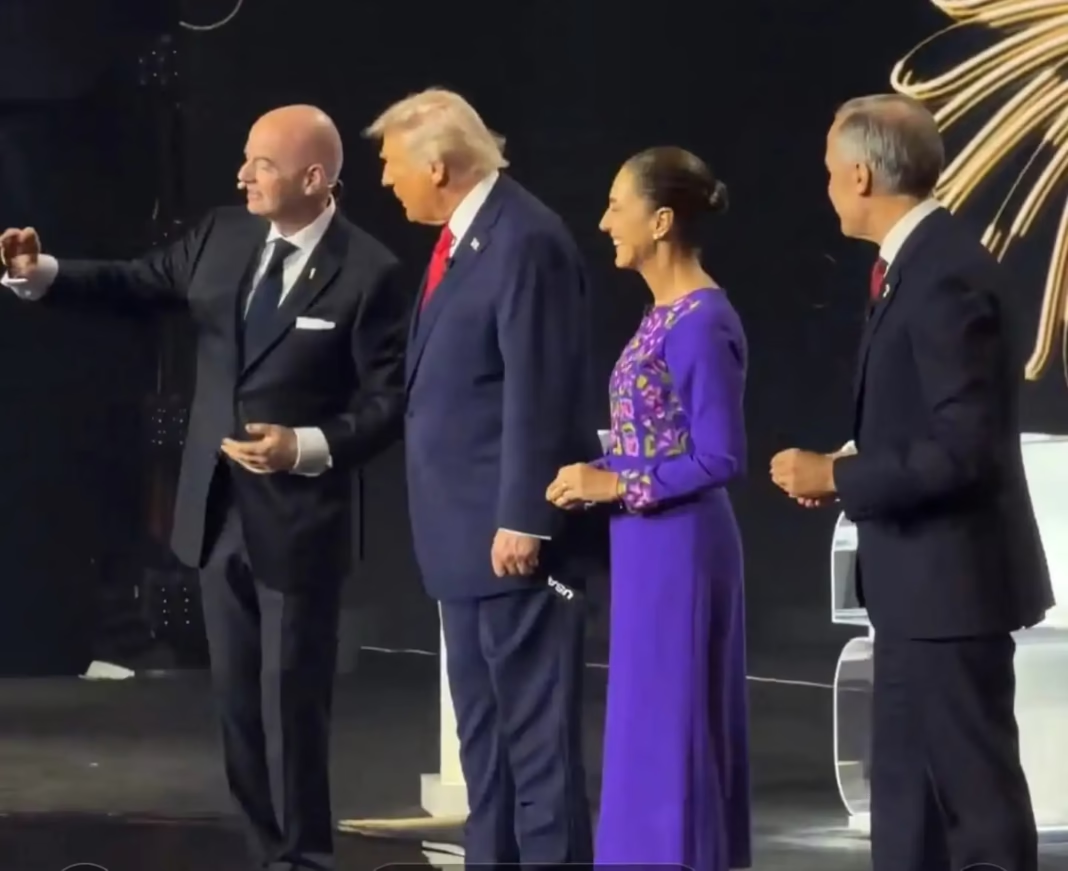
Washington, DC — The leaders of the three host nations of the 2026 FIFA World Cup — the United States, Mexico and Canada — are expected to meet in the U.S. capital on Friday ahead of the tournament draw. The gathering marks the first time all three will come together, and notably, the first in-person meeting between U.S. President Donald Trump and Mexico’s President Claudia Sheinbaum.
Their long-anticipated face-to-face meeting comes nearly a year into Trump’s presidency — a striking delay considering that U.S. presidents traditionally prioritize an early meeting with the leader of America’s southern neighbor. For months, the two governments have communicated primarily by phone, often to discuss trade imbalances, tariffs, or Mexico’s efforts to stem fentanyl trafficking. Yet the political cornerstone of Trump’s agenda — immigration control at the U.S.–Mexico border — is not expected to dominate this encounter.
A Meeting Long Delayed
Trump and Sheinbaum were initially scheduled to meet at the G7 summit in Canada in June, but the session was abruptly canceled after Trump left early amid rising tensions between Israel and Iran. Their meeting on the sidelines of the World Cup draw will therefore serve as the first real test of personal diplomacy between the two leaders.
Despite the delay, Sheinbaum’s standing with Trump does not appear to have suffered. The two leaders spoke by phone in November 2024, shortly after Trump’s election, when Trump declared they had agreed “to stop migration through Mexico.” Sheinbaum, however, maintained that Mexico had long been fulfilling its border responsibilities.
Soccer Takes Center Stage — But Tariffs Cast a Shadow
Friday’s event at the Kennedy Center is technically about football: the draw that will determine the placement of teams for the 2026 World Cup, which the U.S., Mexico and Canada will co-host beginning next June. Canadian Prime Minister Mark Carney is also in Washington for the occasion, completing the trio of leaders of the host nations.
But beneath the festive backdrop, high-stakes economic concerns remain. Before departing Mexico, Sheinbaum said she expected to raise the issue of U.S. tariffs on automobiles, steel and aluminum — remnants of trade disputes that linger despite the U.S.–Mexico–Canada Agreement (USMCA), the revised North American trade pact forged during Trump’s first term.
Trump confirmed shortly after arriving in Washington that he planned to meet Sheinbaum during the draw. Tariffs remain a volatile topic: earlier this year, Trump threatened to impose sweeping 25% duties on Mexican imports unless Mexico took stronger action on fentanyl trafficking. While the White House eventually paused those plans, U.S. Trade Representative Jamieson Greer has begun examining USMCA ahead of a major joint review in July — raising questions about whether another tariff confrontation may be on the horizon.
Security Cooperation Takes Center Stage
Mexico has also extradited dozens of drug cartel figures to the U.S., including Rafael Caro Quintero, long sought in the 1985 killing of a DEA agent. That show of goodwill, and a much more visible effort against the cartels’ fentanyl production, has gotten the Trump administration’s attention.
That’s a significant improvement. Only a few years ago, the DEA struggled to get visas for its people in Mexico, and then-President Andrés Manuel López Obrador accused the U.S. government of fabricating evidence against a former Mexican defense secretary — though he never presented proof for the allegation.
Not everything has gone so smoothly, though. Trump criticized Sheinbaum for rejecting his proposal to send U.S. troops to Mexico to help thwart the illegal drug trade.
A Relationship Defined by Economics More Than Immigration
Ironically, the issue that propelled Trump into office — illegal immigration — has become less central to the U.S.–Mexico relationship in recent months. A sharp decline in migrants crossing the southern border has redirected U.S. attention toward trade and tariff enforcement.
Mexico is now the United States’ largest trading partner, underscoring how deeply intertwined the two economies are. While many goods governed by the USMCA remain exempt from tariffs, Washington’s recent warnings have made economic stability a top priority for both governments.
For Sheinbaum, securing tariff relief is critical to Mexico’s manufacturing sector. In October, she announced that the U.S. had granted Mexico another extension to avoid broad 25% import tariffs — a temporary reprieve that highlighted both the fragility and importance of the bilateral trade relationship.
Diplomacy on Display at a Global Stage
As Trump, Sheinbaum and Carney converge in Washington, the World Cup offers a rare moment of unity between the three neighbors. But beyond the spectacle of the tournament draw, the interactions among the leaders will be closely watched for signs of how North America’s political and economic alliances may evolve during Trump’s second term.
FIFA President Gianni Infantino captured a selfie with Donald Trump, the Canadian prime minister, and the Mexican president, marking a rare moment of unity among the leaders of the 2026 World Cup host nations.
SOURCE : AP NEWS | Follow Us: Facebook | Instagram | Twitter | Youtube |