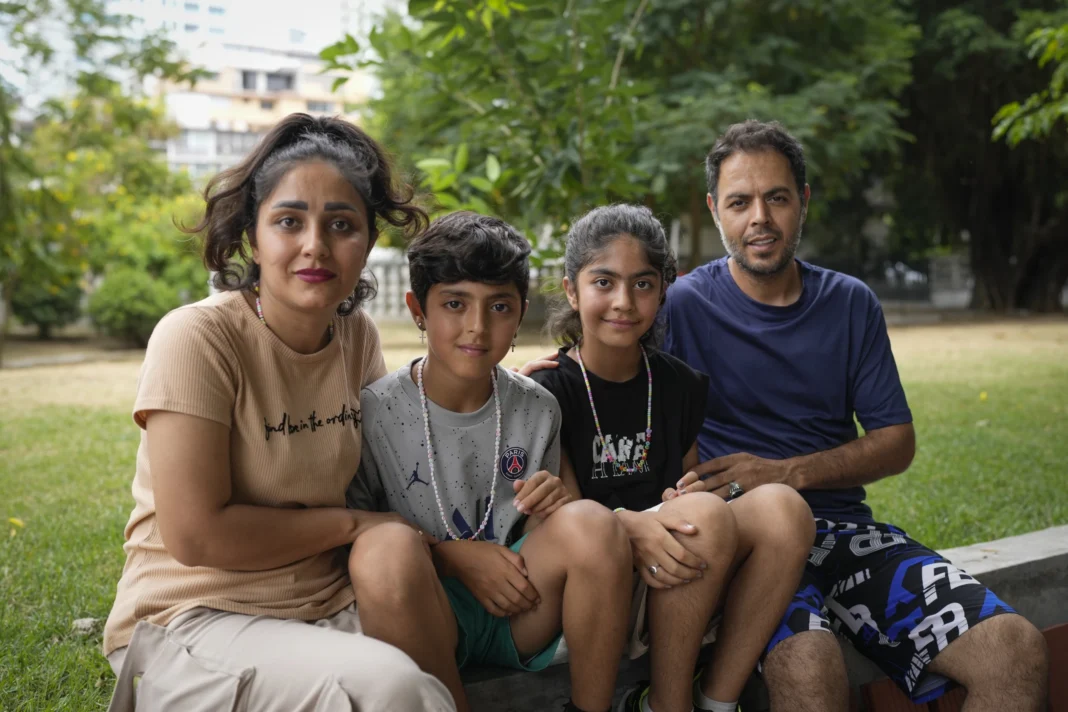
Panama City, Panama — On March 13, 2025, dozens of migrants who traversed oceans and jungles to reach the United States found themselves abandoned at a bus station in Panama’s capital. These individuals, fleeing conflict, religious persecution, poverty, and government crackdowns in countries like Afghanistan, Somalia, Cameroon, China, Pakistan, and Iran, had risked everything to seek safety and opportunity.
After enduring perilous journeys through Central and South America, they were detained by U.S. authorities and deported on military aircraft to Panama as part of President Donald Trump’s accelerated deportation efforts targeting complex destinations.
Originally intended as a temporary stopover, Panama became a dead end for many unwilling to return to their home countries due to well-founded fears of persecution or death. For weeks, they were held in a guarded camp in the Darién jungle—the same treacherous region many had crossed on their northward trek—without access to lawyers or clear information.
Facing mounting legal pressure and human rights criticism, the Panamanian government released them over the past week, giving them just 30 days to determine their next move. Here are the real stories of some of these deportees, shared with The Associated Press:

Isha Len, 29, Cameroon
Isha Len fled her small town in Cameroon when conflict erupted, leaving her life as a schoolteacher behind. She traveled by car and minibus across Cameroon before a fisherman friend smuggled her by boat to Nigeria, a grueling four-hour journey. From there, she flew to São Paulo, Brazil, where authorities detained her for a month at the airport. Undeterred, Len joined other migrants heading north by bus through South America until they reached the Darién Gap.
She spent days walking through the notorious jungle separating Colombia and Panama, battling exhaustion and danger. After emerging, she boarded buses through Central America but was kidnapped by a gang in Guatemala for days before escaping. In southern Mexico, she took a boat along the Pacific coast to avoid authorities, eventually riding eight hours to Mexico City and onward to Tijuana. Crossing into the U.S., she surrendered to authorities, hoping for asylum. Instead, she was deported to Panama.
“It feels like the whole world is crushing down on me,” Len said, her voice heavy with despair. “I risked everything, my life, everything, crossing the Darién Gap, just to be sent back.”
Artemis Ghasemzadeh, 27, Iran
Artemis Ghasemzadeh fled Iran in January 2025 after converting from Islam to Christianity—a choice punishable by death under Iranian law. She first escaped to Dubai, staying two weeks, then flew to South Korea. After securing a flight to Mexico City, she spent three weeks there before traveling to Tijuana. On February 9—her birthday—she crossed the U.S. border, only to be detained for five days.
Deported to Panama, Ghasemzadeh now faces an uncertain fate. “For changing your religion, your punishment is death,” she said, her eyes reflecting fear and exhaustion. “We don’t know what will happen.”
Samin Haider, 21, Pakistan
Samin Haider left Pakistan in 2023 after escalating violence in Parachinar, a region near Afghanistan torn apart by decades of sectarian conflict between Shi’ite and Sunni Muslim communities. He spent a year and a half in Dubai until the United Arab Emirates canceled visas for Pakistanis, forcing him to move on. Haider flew to Mexico and made his way to the U.S.-Mexico border, seeking asylum from the chaos he’d fled.
Now stranded in Panama, Haider clings to his dream of reaching the U.S. “I can’t go back,” he told reporters, his determination unshaken despite the setback.
Hayatullah Omagh, 29, Afghanistan
Hayatullah Omagh fled Afghanistan in 2022 after the Taliban’s takeover, fearing for his life as an atheist and member of an ethnic minority. He first sought refuge in Pakistan, securing a six-month visa, but struggled to renew it with his Afghan passport. Moving to Iran, he worked for a year and a half, but the country refused to recognize him as a refugee. In 2024, he obtained a visa to Brazil, which had opened its doors to some Afghans post-Taliban resurgence, and landed in São Paulo.
Determined to join friends and family in the U.S., Omagh paid smugglers to guide him through Bolivia, Peru, Ecuador, and Colombia. He endured the Darién Gap’s punishing terrain before taking buses through Central America to southern Mexico. Mexican authorities detained and deported him back south multiple times, but he persisted, eventually flying to Mexico City and then to the U.S. border—only to be detained and sent to Panama.
“I don’t know where to go now,” Omagh said, staring blankly at the bustling Panama City bus station. “I’ve been running for years.”
These deportees, among nearly 300 sent to Panama, now face a stark reality: 30 days to find a new destination or risk further displacement. Human rights advocates argue their treatment violates international norms, while Panama’s government insists it’s cooperating with the U.S. to deter migration. For individuals like Len, Ghasemzadeh, Haider, and Omagh, the journey that spanned continents has ended in limbo, their futures hanging by a thread.
SOURCE : AP NEWS | Follow Us: Facebook | Instagram | Twitter | Youtube |