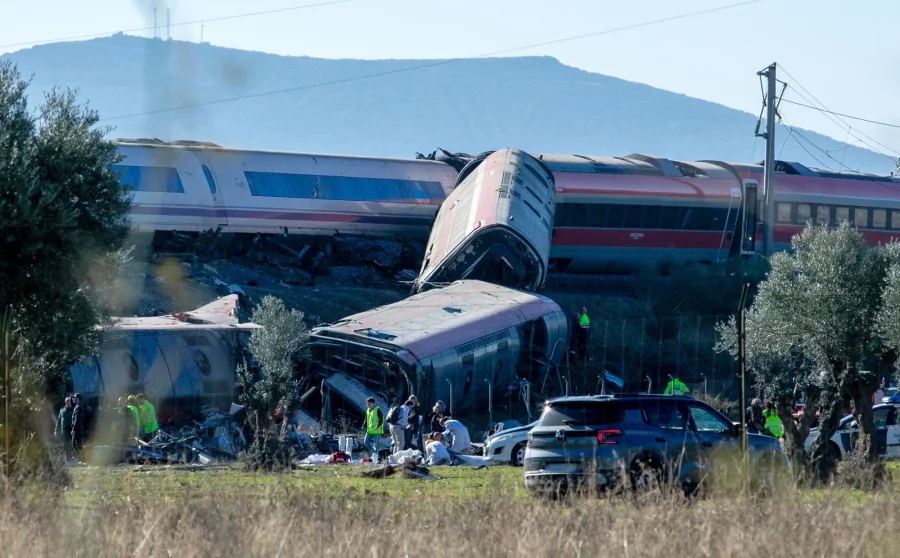
URDA, Spain — At least 68 people were killed after two high-speed trains collided on Wednesday in Spain’s second deadly rail disaster this year, leaving carriages severely damaged and triggering a major rescue operation.
The regional government of Castilla-La Mancha confirmed the death toll and said another 58 people were receiving medical treatment in hospitals. Emergency crews continued searching through the wreckage for survivors and victims.
According to preliminary reports, a train operated by state-owned RENFE struck the rear of a train operated by private company Iryo after the latter had stopped on the tracks. The impact knocked two carriages off the track in a rural area between two villages.
Spain’s rail infrastructure operator ADIF said the accident occurred on Wednesday morning in the province of Toledo. Both trains were carrying hundreds of passengers and travelling in the same direction, from Madrid towards Seville in southwestern Spain.
Transport Minister Details Possible Sequence of Events
Spain’s Transport Minister Óscar Puente said a computer malfunction had disrupted the railway safety system along a 63-kilometre (39-mile) stretch of track at around 8:30 a.m., forcing trains in the affected section to stop.
According to Puente, the central command centre subsequently instructed the RENFE train to resume its journey without speed restrictions. The train collided with the stationary Iryo train at approximately 8:53 a.m.
Puente said the RENFE train should not have been instructed to move while a stop signal remained active. He added that, if it had been permitted to proceed, it should at least have been ordered to travel at a reduced speed.
Authorities were still examining data to establish the train’s speed at the time of the collision. Puente said it might have been travelling at up to 200 kilometres per hour (124 mph) along that section of track.
“I am not attributing responsibility to anyone, I am just stating the facts,” Puente said, stressing that the sequence of events was still being examined.
Bystanders Rush to Help Survivors
David Gómez, a construction worker, was working nearby with his brother and another colleague when they heard the crash and rushed to help, he told Spanish newspaper El País.
“People were trying to get out through the windows … We cut through some fences to access the area and treated people with the first-aid kits we had brought,” Gómez said, describing their efforts before emergency services arrived.
He also recalled a disturbing moment while trying to rescue an injured passenger. “As I was trying to pull a young woman out, there was a piece of a leg,” he told the newspaper.
Passenger Describes Violent Impact
The collision occurred on a flat stretch of railway surrounded by olive groves between the towns of Urda and Los Yébenes. The impact left one carriage torn into twisted pieces of metal and other debris scattered down a gravel slope.
Spanish Health Minister Mónica García said emergency teams were concentrating on rescuing survivors and recovering victims from the two most severely damaged carriages. Injured passengers were being transported to hospitals across the region.
“It was a high-speed impact, so we are expecting this to be a tragedy,” García said.
Ignacio Relaño, a passenger travelling on the RENFE train, told Spanish public broadcaster TVE that the train had briefly stopped before moving again and colliding with the Iryo service.
“We all felt the train abruptly slowing down and then the impact,” he said.
“The car leaned to one side like it was about to tip over. I hit my nose, everything went flying, luggage, cell phones. Everything shook.”
Rail Services Suspended
Rail services were suspended between Madrid, Ciudad Real and Andalusia following the collision, disrupting journeys across parts of central and southern Spain.
Until this year, Spain had recorded no fatal accident on its dedicated high-speed rail lines since the network opened in 1992. The system has long been a source of national pride and a symbol of the country’s modern transport infrastructure.
The collision has revived painful memories of another deadly high-speed rail accident in southern Spain in January, reportedly involving trains operated by the same two companies.
Rescue and recovery operations continued as authorities worked to identify victims, assist survivors and establish the precise circumstances surrounding the disaster. Investigators are expected to examine the safety-system failure, the instructions issued by railway control and the events leading up to the collision.
SOURCE : AGENICIES | Follow Us: Facebook | Instagram | Twitter | Youtube