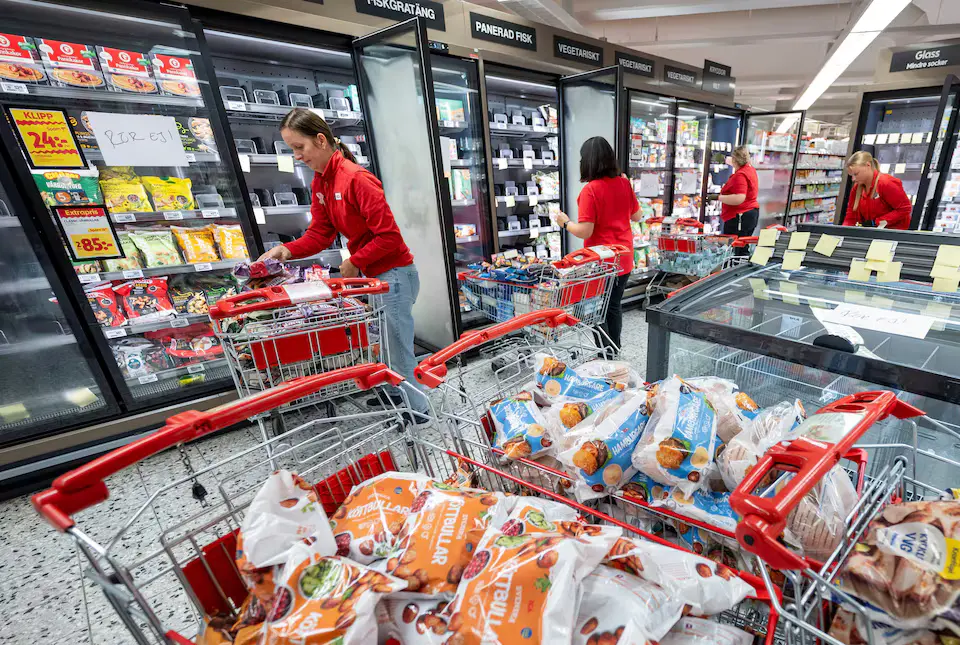
Brussels/Stockholm — Supermarket refrigeration systems in several European countries were hit by a suspected wave of cyberattacks on Monday, leaving refrigerators out of service and forcing stores to dispose of potentially spoiled food, according to local media reports.
Incidents were reported in Belgium, Luxembourg, Sweden, Ireland, the Netherlands and Estonia, raising concerns that the attacks could be linked to a similar series of cyber incidents that targeted French supermarkets last month.
Several supermarket managers told local media that refrigerator temperatures had suddenly surged, in some cases reaching as high as 50 degrees Celsius. The incidents reportedly followed a pattern seen in France, where attackers appeared to remotely manipulate the defrosting mechanisms of refrigeration units, causing them to overheat.
Although authorities have not confirmed whether the latest incidents are connected or exploited the same software vulnerabilities as the attacks in France, a supermarket spokesperson described the incident as a cyberattack “similar to the one in France.”
Cybersecurity experts have criticised supermarkets for failing to adequately secure their refrigeration systems following the earlier incidents.
Ken Munro, a cybersecurity researcher, said supermarkets should have disconnected refrigeration equipment and the devices used to monitor and remotely manage them from the internet.
“I don’t accept any other excuse … particularly in light of the earlier [attacks in France],” he said.
Another cybersecurity researcher, Inti De Ceukelaire, suggested that some supermarket operators had failed to install necessary security updates despite the previous warnings.
“It seems that some of them simply did not get patched, which is quite ridiculous,” he said.
In Belgium, media reports said supermarket refrigerator temperatures had risen unexpectedly on Monday morning, forcing retailers to discard food products to prevent potentially unsafe items from reaching consumers.
A spokesperson for the Centre for Cybersecurity Belgium said the agency was closely monitoring the situation. The attackers remain unidentified, and authorities acknowledged that establishing their identities may prove difficult.
Meanwhile, John Billow, director of Sweden’s National Cyber Security Centre, told POLITICO that the latest incidents showed similarities to the attacks in France. The agency is in contact with affected organizations.
The European Commission also confirmed that it was aware of the incidents and was using the EU-Cyclone network to coordinate responses and share information among member states.
Following the French Attacks
The latest incidents follow a wave of cyberattacks targeting French supermarkets in mid-October, when attackers reportedly exploited vulnerabilities in refrigeration systems manufactured by Danish company Danfoss.
At least some of the refrigeration units affected in Monday’s incidents were also using temperature-control technology supplied by Danfoss. The company said it had been working with customers to implement security fixes following the earlier attacks.
The French incidents had prompted intervention by the country’s prime minister and national cybersecurity authorities, highlighting the growing vulnerability of essential retail infrastructure to digital threats.
The European Commission warned that the latest incidents demonstrated how cyberattacks could increasingly disrupt critical parts of Europe’s food supply chain.
EU Commissioner for Agriculture Christophe Hansen expressed serious concern over the repeated attacks.
“They are a deliberate attempt to disrupt our food supply chain and undermine consumers’ confidence in it – a warning that we must take seriously,” Hansen said.
He added that the repeated occurrence of such cyberattacks was deeply concerning.
The incidents have renewed calls for stronger cybersecurity measures across Europe’s supermarket networks, particularly for internet-connected refrigeration equipment and other remotely managed systems essential to food safety and supply-chain operations.
SOURCE : AGENCIES | Follow Us: Facebook | Instagram | Twitter | Youtube