Home Blog Page 15

World Tourism Day 2025 Focuses On Sustainable Travel: Which Country Leads the Way?

0

United Nations, UNWTO – World Tourism Day 2025 focuses on sustainable travel and raises an important question: which countries are truly leading the way in balancing tourism growth with environmental and cultural preservation? The day is being marked worldwide with conferences, events, and campaigns that highlight the future of responsible travel.

World Tourism Day is observed annually on September 27 to raise awareness about the importance of tourism and its wide-reaching social, cultural, political, and economic impacts. It was established by the United Nations World Tourism Organisation (UNWTO) to commemorate the adoption of the organisation’s statutes in 1970, which laid the foundation for the creation of UN Tourism five years later.

This year, discussions around World Tourism Day have turned toward sustainability as countries seek to reduce the environmental footprint of mass travel. Recent international reports, including the Euromonitor Sustainable Travel Index, placed Sweden at the top of the global ranking for sustainable tourism, with Finland, Austria, Estonia, and Norway following closely. Switzerland, Denmark, and Iceland are also praised for their green policies, renewable energy adoption, and eco-friendly travel infrastructure.

For India, the relevance of sustainable tourism is increasing year by year. Surveys suggest that nearly three out of four Indian travellers now consider sustainability an important factor when planning a trip, whether that means staying in eco-certified accommodations, choosing low-emission transport, or supporting local communities at their destinations.

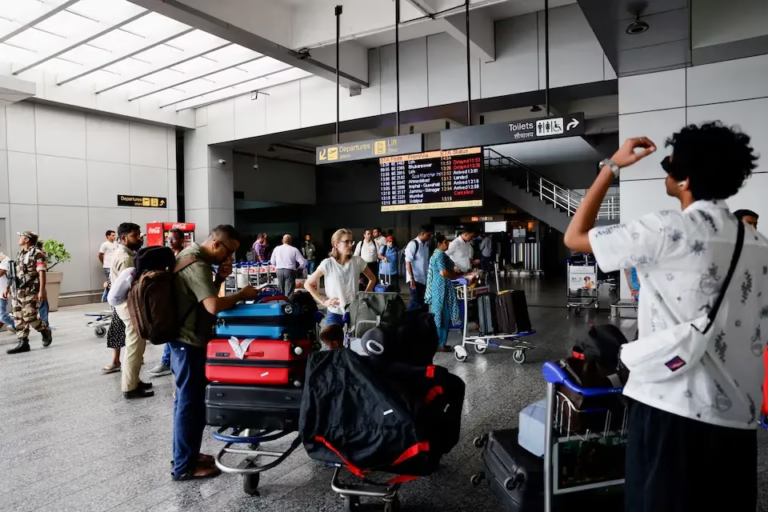
At the same time, accessibility and ease of travel remain major considerations for Indian tourists. A number of nearby countries are considered particularly easy for Indians to visit, thanks to visa-free or visa-on-arrival policies and affordable connectivity. Thailand has extended visa-free travel for Indian citizens until mid-2025 and continues to be one of the top international destinations for short, budget-friendly trips. Sri Lanka has also simplified entry with visa-on-arrival and e-visa facilities, while the Maldives offers visa-free entry for up to 90 days, making it attractive both for leisure and eco-tourism. Nepal and Bhutan remain culturally close and accessible without passports, further boosting their appeal. Indonesia, particularly Bali, offers visa on arrival for Indians and has become increasingly popular among younger travellers looking for a mix of culture, beaches, and sustainability-oriented stays. Island nations such as Mauritius and Seychelles, along with Gulf destinations like Dubai and Oman, are also preferred for their easy visa processes and quick flight connections.

As the global tourism industry recovers from the impact of the pandemic and adapts to new geopolitical realities, the balance between sustainability and accessibility has become crucial. European nations such as Sweden, Norway, and Switzerland are demonstrating how policy, innovation, and community involvement can create world-class sustainable destinations. Closer to home, countries like Thailand, Maldives, and Sri Lanka are combining accessibility with growing investments in eco-tourism.

The future of tourism, as World Tourism Day 2025 underlines, will not only depend on how many people travel but also on how responsibly they do so. For Indian travellers, the intersection of affordability, ease of access, and sustainable options will likely shape the most popular destinations in the years ahead.


SOURCE : UNWTO & DT |  Follow Us: Facebook | Instagram | Twitter | Youtube |

Sonam Wangchuk arrested under NSA after Ladakh statehood protests turn deadly

0

Ladakh, India — Climate activist and Ramon Magsaysay Award winner Sonam Wangchuk was arrested on Friday under the National Security Act (NSA), just days after violent protests in Leh left four people dead and more than 70 injured during a shutdown called to demand statehood and Sixth Schedule status for the Union Territory of Ladakh.

According to official sources, Wangchuk was taken to Leh airport by a police team led by Ladakh Director General of Police S.D. Jamwal, with preparations underway to shift him outside the Union Territory, possibly to Delhi. Internet services in Leh were suspended soon after his detention.

RELATED NEWS : 4 Killed, 50 Injured as Ladakh Statehood Protest Turns Violent in Leh

The 59-year-old activist, widely known for his environmental campaigns in the Himalayas, was scheduled to address the press on Friday afternoon. Instead, he was asked to accompany the police, and permission for his press conference was denied.

Authorities said Wangchuk was detained under the NSA, which allows for extended preventive detention, in connection with the recent violent protests in Leh. Officials stressed the arrest was not tied to other pending cases against him.

Fallout of the Arrest

The Leh Apex Body (LAB), which is spearheading the statehood movement, strongly condemned the detention, insisting that Wangchuk had no role in the September 24 violence.

LAB convener Mr. Lakrook said that no talks could yet be held with the Union Ministry of Home Affairs (MHA) in Leh due to the pending last rites of the four civilians killed during the clashes. According to him, the victims will be cremated on September 28 and 29.

“We will seek early talks on two key issues of Statehood and Sixth Schedule after we travel to Delhi on September 29,” Mr. Lakrook said.

He further rejected claims that Wangchuk provoked protesters:

“This narrative that Mr. Wangchuk provoked protesters is wrong. It was the news of two protesters on hunger strike who were hospitalised on September 24 that caused concern among youth. The next day, around 7,000 people, mostly young people, joined the hunger strike.”

Leh remained under curfew for the second straight day, and dozens of local residents, including Wangchuk’s supporters, were detained in the past 24 hours. In Kargil, authorities imposed Section 163 of the Bharatiya Nyaya Sanhita (BNS), barring gatherings of more than four people. Shops in Leh’s main market also downed shutters in protest against the arrest.

Political Reactions

The detention of Wangchuk has drawn sharp criticism across political lines.

Omar Abdullah, Chief Minister of neighboring Jammu and Kashmir, called the move “unfortunate but not surprising.”

“What’s difficult to understand is why the Centre has failed to fulfil its promises,” he said.

Congress leader G.A. Mir described the detention of the “honourable Gandhian activist” as “unwarranted.”

Former J&K chief minister and Peoples Democratic Party (PDP) president Mehbooba Mufti said Wangchuk’s detention was “deeply disturbing.”

“A lifelong advocate of peace, sustainability and truth is being punished merely for demanding that promises be kept. Today, Leh is under curfew with internet shut down, a grim echo of what Kashmir has long endured. In today’s India, speaking truth to power comes at a heavy cost—or how else could a man who stood for peace and non-violence his entire life end up behind bars?”

Background

The unrest marks a sharp escalation in the long-running agitation in Ladakh. Protesters are demanding full statehood and constitutional safeguards under the Sixth Schedule, which would grant greater autonomy over land, resources, and cultural protections.

The arrest of Sonam Wangchuk—one of the region’s most prominent voices—has further inflamed tensions, raising fears of prolonged unrest in the Union Territory.


SOURCE : DT & THE HINDU |  Follow Us: Facebook | Instagram | Twitter | Youtube |

Moldova Heads to Crucial Parliamentary Vote Amid EU Hopes, Russian Pressure, and Economic Strains

0

Chișinău, Moldova – Moldova is preparing for a pivotal parliamentary election on September 28, a contest that could reshape its political landscape and determine whether the country of 2.4 million stays firmly on the path toward European Union membership—or drifts back into Moscow’s orbit.

At stake is the future of the ruling pro-European Action and Solidarity Party (PAS) of President Maia Sandu, which swept to power in 2021 with a commanding majority. Sandu, re-elected in November 2024, has made EU accession by 2030 the cornerstone of her agenda, framing integration as essential to Moldova’s economic revival and security in the face of Russian influence.

RELATED NEWS : EU eyes deeper India alliance despite concern over Moscow ties

But recent polls suggest PAS may lose its outright majority in the 101-seat parliament, forcing it to negotiate coalitions with smaller parties. Among potential partners are the populist Our Party and the pro-European but marginal Alternative Bloc, though the thresholds—5% for single parties, 7% for blocs—make entry into parliament uncertain.

On the other side, the Patriotic Bloc, an alliance of pro-Russian forces led by the Socialists of former president Igor Dodon, is mounting a stiff challenge. Dodon, who was unseated by Sandu in 2020, has been working to consolidate opposition groups and appeal to voters disillusioned with rising living costs.


Economic Stagnation, Reforms and Internal Polarization

Moldova heads into the September 2025 parliamentary elections in a climate of social and economic tension marked by persistent stagnation. According to the World Bank, after a contraction of 4.6% in 2022, GDP grew by only 1.2% in 2023 and a negligible 0.1% in 2024. Already weakened by structural imbalances, Moldova was battered by an inflationary shock of nearly 30%, triggered by the war in Ukraine.

The early-2025 energy crisis in Transnistria further exposed the fragility of Moldova’s supply system, deepening disparities between regions. Productivity remains low, infrastructure underdeveloped, and foreign investment scarce. At the same time, a massive emigration wave continues to erode the country’s human capital: over one million Moldovans now work abroad—more than a quarter of the total population, including the diaspora. Each year, 35,000 to 40,000 citizens leave, and demographic projections by the Center for Demographic Research warn the population could shrink to 1.9 million by 2040.

These economic woes feed into broader polarization. Supporters of PAS view reforms and EU integration as the only route out of stagnation, while critics argue the government has failed to deliver tangible improvements, particularly in fighting corruption and creating jobs.


Key Issues at Play

For PAS and its supporters, the election is about securing Moldova’s European future. The government argues that closer ties with Brussels will bring economic stability, reduce corruption, and strengthen the country’s independence from Russia. In August, leaders from France, Germany, and Poland traveled to Chișinău to demonstrate EU backing for Sandu’s course.

Yet many Moldovans remain more concerned with day-to-day survival. A 2024 referendum on EU membership barely crossed the 50% threshold, revealing deep divisions within society.


Political Realignment Underway

Beyond the contest between PAS and pro-Russian blocs, the election reflects a broader reorganization of Moldova’s political system. Identity, regional loyalties, and generational divides now shape politics as much as foreign policy.

The autonomous region of Gagauzia and the separatist enclave of Transnistria remain staunchly pro-Russian, while urban centers like Chișinău and Moldovan diaspora communities in Europe lean strongly toward PAS. Rural areas, however, are more receptive to populist and pro-Russian appeals.

The Impreuna (“Together”) Bloc, though struggling to pass the 7% threshold, seeks to capture disillusioned pro-European voters with its “Pact for Europe,” modeled on Romania’s path to EU accession.

Moldovan and European Union flags fly in front of Government House in Chisinau. Photo : Artur Widak/NurPhoto/Getty Images

Europe Watching Closely

For the European Union, the outcome carries weight well beyond Moldova’s borders. Since Russia’s full-scale invasion of Ukraine, Brussels has sought to anchor Eastern European states more firmly in the Western camp. Moldova, sandwiched between Romania and Ukraine, is seen as a frontline state in this struggle.

“The parliamentary elections will be decisive not only for Moldova’s European trajectory but also for Europe’s ability to withstand Russian influence in the region,” said a European diplomat in Chișinău.

With PAS banking on its reformist record and opponents seizing on economic discontent, Sunday’s vote promises to be one of the most consequential in Moldova’s modern history.


SOURCE : CNN & REUTERS |  Follow Us: Facebook | Instagram | Twitter | Youtube |
Paris court jails ex-President Nicolas Sarkozy for 5 years in Libya corruption case

0

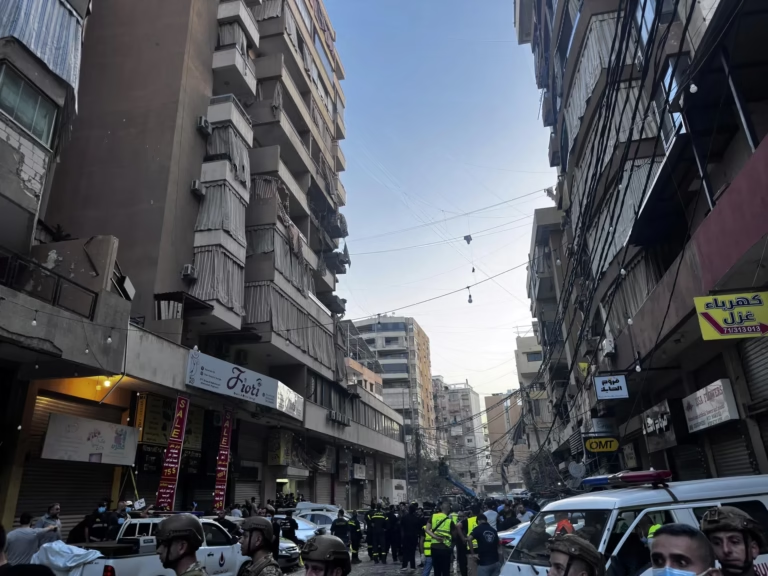
Paris, France — Former French President Nicolas Sarkozy was sentenced on Thursday to five years in prison after a Paris court found him guilty of criminal conspiracy in a scheme to finance his 2007 presidential campaign with funds from Libya. The verdict, which Sarkozy denounced as “a scandal,” makes him the first ex-president in modern French history to face actual jail time.

The court ruled that Sarkozy, 70, will serve three years in prison and two years suspended. Although he has announced his intention to appeal, the judges said his sentence will begin at a date to be determined, sparing him the immediate humiliation of being escorted from the courtroom in handcuffs.

RELATED NEWS : Cyprus Prepares for EU Presidency, Deputy Minister Marilena Raouna Highlights Strong EU-UK Partnership

The case centered on allegations that Sarkozy and his aides conspired with Libyan officials between 2005 and 2007, when he was interior minister, to secure campaign financing in exchange for diplomatic favors. While the court cleared him of three other charges—including passive corruption, illegal campaign financing, and concealing embezzled funds—it concluded that he knowingly allowed close associates to negotiate financial support with Libya.

“There was not sufficient evidence to prove Sarkozy personally received the funds,” Judge Nathalie Gavarino said, but stressed that his role in enabling the conspiracy was enough to warrant conviction. Along with the prison sentence, Sarkozy was ordered to pay a fine of €100,000 ($117,000, £87,000).

Gasps filled the packed courtroom when the sentence was read. Outside, Sarkozy addressed reporters defiantly:

“What happened today is of extreme gravity for the rule of law, and for the trust one can have in the justice system. If they absolutely want me to sleep in jail, I will sleep in jail, but with my head held high.”

The ruling deals a heavy blow to Sarkozy, who remains an influential figure in French conservative politics despite multiple ongoing legal battles. He could be incarcerated in Paris in the coming days, pending the outcome of his appeal.


SOURCE : AP NEWS |  Follow Us: Facebook | Instagram | Twitter | Youtube |
PM Narendra Modi arrives at Greater Noida Trade show, Inaugurates event with CM Yogi Adityanath

0

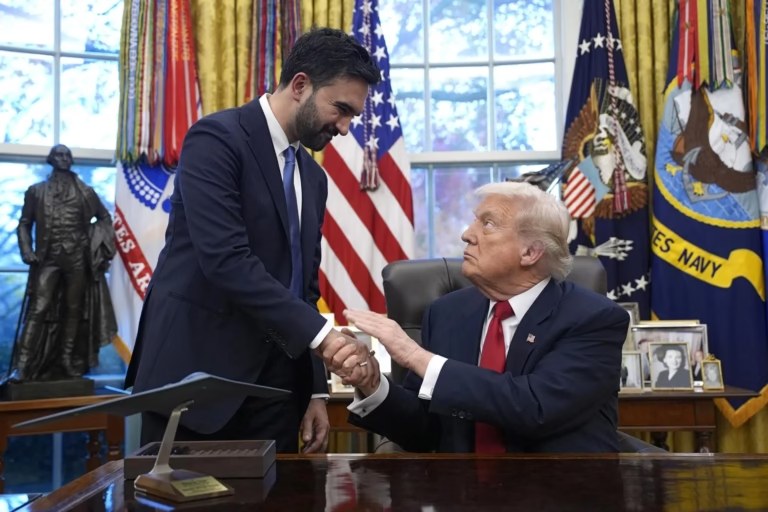
Greater Noida, India — Prime Minister Narendra Modi inaugurated the UP International Trade Show 2025 in Greater Noida on Wednesday, alongside Uttar Pradesh Chief Minister Yogi Adityanath. Highlighting India’s economic ambitions, PM Modi said, “India has to be atma nirbhar so that growth isn’t compromised,” emphasizing the importance of self-reliance alongside innovation and trade.

The event features over 2,250 exhibitors showcasing products and services across sectors, providing a platform for business networking, collaboration, and investment. PM Modi also acknowledged the “time-tested partnership” between India and Russia, noting Russia as the country partner of the trade show.

PM Modi further paid tribute to the legacy of Pandit Deendayal Upadhyaya, marking his birth anniversary, and connected his vision to India’s ongoing push for self-reliance and industrial growth. He emphasized that initiatives like Make in India and the UP Trade Show reflect the nation’s commitment to innovation, entrepreneurship, and sustainable economic progress.

The inauguration comes amid indications of growing diplomatic engagements between India and the United States. A senior US State Department official recently suggested that a meeting between PM Modi and US President Donald Trump could be forthcoming. “I’m sure you’ll see the two meet. They have a very, very positive relationship,” the official said, according to ANI. Plans for the Quad Summit and other bilateral meetings are reportedly in the works, signaling continuous positive momentum in US-India relations.

CM Yogi Adityanath welcomed the Prime Minister and praised the role of entrepreneurs and businesses in strengthening Uttar Pradesh’s industrial and trade capabilities. The trade show, featuring manufacturing, digital technologies, renewable energy, and export-oriented businesses, aims to attract both domestic and international investment.

PM Modi’s address reiterated the government’s commitment to Make in India and self-reliance, underlining that India’s growth trajectory depends on innovation, entrepreneurship, and strategic international partnerships.


SOURCE : DD & DT |  Follow Us: Facebook | Instagram | Twitter | Youtube |
For the first time in almost 60 years, a Syrian president addressed the United Nations

0

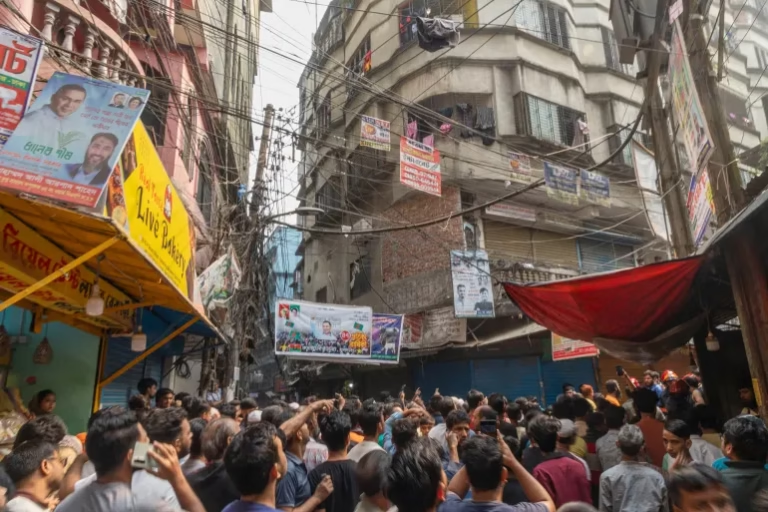
United Nations, New York — Turning the page on decades of distance, Syria’s president addressed the U.N. General Assembly on Wednesday, marking the first time any president from his country has done so in almost 60 years. As he spoke, hundreds of people gathered in front of giant screens in Syrian cities and towns to witness the speech while waving the country’s flags.

After six decades of dictatorship that killed 1 million people and tortured hundreds of thousands, “Syria is reclaiming its rightful place among the nations of the world,” Ahmad al-Sharaa told the international community.

RELATED NEWS : Iran’s President Vows Never to Build Nuclear Bomb Amid UN Sanctions Debate

Al-Sharaa became the first Syrian head of state to speak at the United Nations since Noureddine Attasi gave a speech in 1967 shortly after the Arab-Israeli war, during which Damascus lost control of the Golan Heights. Israel annexed it in 1981.

Since the Assad family came to power in Syria in 1970 in a bloodless coup that overthrew Attasi, relations with the United States have been mostly cold, as Damascus was an ally of the former Soviet Union. Over the past decades, Syrian foreign ministers represented the country at the U.N. General Assembly.

An appearance after the collapse of the Assad family’s regime

The Assad family dynasty’s autocratic, repressive 54-year rule abruptly collapsed in December, when then-President Bashar Assad was ousted in a lightning insurgent offensive led by al-Sharaa. Assad’s fall marked a major shift in the 14-year civil war.

Al-Sharaa blasted Israel in his speech, saying that it did not stop its threats to his country since Assad’s fall and adding that its policies “contradict with the international community’s support to Syria and its people” and endanger the region.

Negotiations have been ongoing for a security deal that al-Sharaa has said he hopes will bring about a withdrawal of Israeli forces and return to a 1974 disengagement agreement. While al-Sharaa said last week that a deal could be reached in a matter of days, Israeli Prime Minister Benjamin Netanyahu on Sunday appeared to downplay the odds of a breakthrough.

Later Wednesday, Netanyahu’s office said in a statement that negotiations are underway, adding that their conclusion “involves ensuring Israel’s interests, which include, among other things, the demilitarization of southwestern Syria and maintaining the safety and security” of the Druze religious minority in the country.

Since assuming power, al-Sharaa has preached coexistence and sought to reassure Syria’s minority communities, but the country has been threatened by outbreaks of sectarian violence that left hundreds dead earlier this year. Gunmen affiliated with the new government were also accused of atrocities against civilians from the Druze and Alawite religious minorities in southern Syria’s Sweida province and the coastal region.

Al-Sharaa said in his speech that the Syrian state has worked on forming fact-finding missions and gave the United Nations the right to investigate the killings.

“I promise to bring anyone whose hands are tainted with the blood of Syrian people to justice,” he added.

The fight against drugs has progressed

Al-Sharaa said Syria’s new authorities have destroyed the drug business that Assad used to fund his government as it was under harsh Western sanctions that, along with the war, paralyzed the economy. Assad’s fall revealed industrial-scale manufacturing facilities of the amphetamine-like stimulant Captagon, also known as fenethylline, which experts say fed a $10 billion annual global trade in the highly addictive drug.

Over the past months, Syrian authorities have closed Captagon factories in different parts of Syria part of their campaign to end the illegal trade.

Al-Sharaa urged Western countries to lift the Assad-era sanctions “so that they are not a tool to shackle the Syrian people.”

U.S. President Donald Trump met with al-Sharaa in Saudi Arabia in May and announced that he would lift decades of sanctions. He followed through by ordering a large swath of them lifted or waived.

However, the most stringent sanctions were imposed by Congress in 2019 and will require a congressional vote to permanently remove them.

Speaking to reporters outside the U.N. after his speech, al-Sharaa said that he hopes that the sanctions would eventually be lifted.

“Syria does not wish the pain it passed through for anyone” and feels “the suffering of war and destruction,” al-Sharaa said, expressing support for Palestinians in Gaza amid Israel’s war there.

Syrian divisions manifest in New York

In Damascus, cheering crowds gathered in the central Umayyad Square to celebrate al-Sharaa’s speech. At Dag Hammarskjöld Plaza near the U.N., members of the Syrian diaspora faced off in dueling demonstrations, one in support of the new authorities in Damascus and one against.

Pro-government demonstrators hoisted the three-starred “revolution flag” that has now become the official flag of Syria. On the other side, many lifted the five-color Druze flag. Some shouted and cursed at each other across the barricades.

On the Druze side, Farah Taki, originally from Sweida, said her aunts there were displaced by the recent violence and she had come from Chicago to protest al-Sharaa’s visit.

“It’s disgrace that New York is welcoming an ex-Qaida member at the U.N., and allowing him even to speak,” she said. The insurgent group that al-Sharaa formerly led was once affiliated with al-Qaida but later cut ties.

On the other side of the barricades, Dina Keenawari, a Syrian American originally from Damascus, had come from Florida to show her support for al-Sharaa.

“We’ve lived under tyranny for the past 50 years, and now we’re turning a new chapter, and we’re looking forward,” she said. “And we’re proud of him.”


SOURCE : AP NEWS & UN |  Follow Us: Facebook | Instagram | Twitter | Youtube |
India reaches Asia Cup final after defeating Bangladesh, Sharma shines again

0

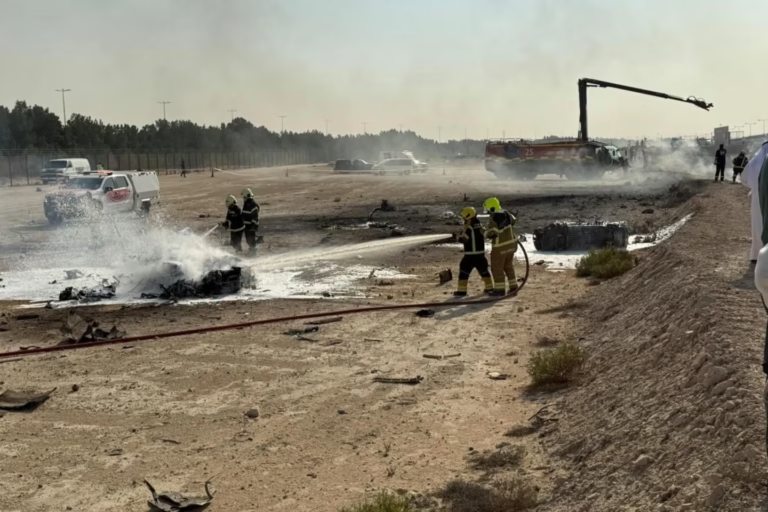
Dubai, UAE — India stormed into the Asia Cup final with a commanding 41-run victory over Bangladesh in their Super Four clash on Wednesday, thanks to Abhishek Sharma’s explosive 75 off 37 balls and Kuldeep Yadav’s brilliant spell of 3-18 at the Dubai International Cricket Stadium.

Opting to field first, Bangladesh paid the price as Sharma smashed five sixes in his fourth T20 half-century, powering India to 168-6 in 20 overs. Hardik Pandya’s 38 off 29 balls provided crucial stability after a mid-innings slump, helping India post a competitive score on a sluggish surface.

RELATED NEWS : No handshakes yet as India defeats Pakistan by 6 wickets in the Asia Cup

Bangladesh’s chase hinged on opener Saif Hassan, who struck 69 off 51 balls for his fourth T20 half-century. However, with little support from the rest of the batting order and a collapse against India’s spinners, they were bowled out for 127. Kuldeep, Varun Chakravarthy, Axar Patel, and Tilak Varma collectively stifled the innings, while Jasprit Bumrah made the early breakthrough.

India’s fielding, however, remained a concern, with five dropped catches giving Bangladesh fleeting hope. Yet Sharma’s explosive start and disciplined spin bowling ensured India booked their place in the final for only the second time in Asia Cup T20 history, after winning the title against Bangladesh in 2016.

Bangladesh will now face Pakistan on Thursday in a virtual semifinal, with the winner set to join India in Sunday’s final. Sri Lanka, the defending champions, were eliminated following India’s win.

Abhishek Sharma shine again

India’s openers began cautiously but quickly shifted gears, smashing 21 runs in the fourth over as Sharma and Gill piled on 77 runs from just 38 deliveries for the first wicket.

The powerplay ended with India cruising at 72 without loss, with Gill contributing a brisk 29 off 19 balls, including two sixes, before falling in the seventh over to Rishad Hossain at long-off.

Hossain struck again soon after, removing promoted batter Shivam Dube for just two, leaving India at 83-2 in the ninth over.

Sharma, however, was unstoppable. Mixing power with timing, he dispatched both spinners and pacers with ease, racing to his second consecutive half-century in just 25 balls.

India crossed the 100-run mark shortly after the halfway stage, with Sharma continuing to dominate. He added 29 runs off 18 balls for the third wicket, though captain Suryakumar Yadav managed only four before departing.

Sharma added a quick-fire 25 off 12 deliveries, but the momentum shifted in the 12th over when Hossain produced a sharp stop and ran him out, leaving the opener stranded mid-pitch. Soon after, skipper Suryakumar Yadav (5) fell cheaply, and India suddenly slipped to 114-4.

Hardik Pandya then steadied the innings, stitching a crucial stand with the lower order. His 38 off 29 balls, laced with four boundaries and a six, guided India beyond 150 in the 18th over. He shared a 39-run partnership with Axar Patel, who remained unbeaten on 10.

However, India couldn’t fully capitalize in the death overs, managing just four runs in the final over and finishing below their target of 180, ending at 168-6.


SOURCE : AP NEWS |  Follow Us: Facebook | Instagram | Twitter | Youtube |
Tehran signs MoU with Moscow on building small nuclear power plants in Iran

0

Moscow, Russia – Iranian President Masoud Pezeshkian told the United Nations General Assembly on Wednesday that Tehran will “never seek to build a nuclear bomb,” amid ongoing diplomatic efforts to avert the so-called “snapback” sanctions over the country’s nuclear program.

The remarks come as a 30-day process launched by the United Kingdom, France, and Germany to restore UN sanctions against Iran approaches its September 27 deadline. The three European powers, known as the E3, accuse Tehran of failing to comply with the 2015 nuclear deal, formally known as the Joint Comprehensive Plan of Action (JCPOA), which aimed to prevent Iran from developing nuclear weapons.

RELATED NEWS : Iran’s President Vows Never to Build Nuclear Bomb Amid UN Sanctions Debate

The E3 have indicated they could delay reinstating sanctions for up to six months if Iran allows UN nuclear inspectors full access, addresses concerns about its enriched uranium stockpile, and engages in talks with the United States.

Iran has previously cited former US President Donald Trump’s 2018 withdrawal from the nuclear deal and the June air strikes on Iranian targets as reasons for scaling back its prior commitments.

In his UN speech, Pezeshkian accused the E3 of acting “at the behest of the United States of America.” He said, “In doing so, they set aside good faith. They circumvented legal obligations. They sought to portray Iran’s lawful remedial measures taken in response to the United States’ withdrawal from the JCPOA and to Europe’s breach and other incapacity as a gross violation.”

In a recorded address on Tuesday, Iran’s Supreme Leader Ayatollah Ali Khamenei reiterated that Tehran is not seeking nuclear weapons but ruled out negotiations with the US, stating, “This is not a negotiation. It is a diktat, an imposition.”

Tensions have escalated following Israeli air strikes in June, which killed more than 1,000 Iranians. Israel claimed the strikes were preemptive measures targeting Iran’s nuclear program, but the attacks have drawn widespread criticism for violating Iranian sovereignty. Israel has previously conducted military operations in several neighboring countries, including Lebanon, Syria, Yemen, and Qatar, with the strikes on Iran marking its largest offensive in recent years and prompting retaliatory threats from Tehran.

The international community remains divided over Iran’s nuclear ambitions, with debates continuing over verification, compliance, and the path to a lasting resolution.


SOURCE : IRNA |  Follow Us: Facebook | Instagram | Twitter | Youtube |
Iran’s President Vows Never to Build Nuclear Bomb Amid UN Sanctions Debate

0

United Nations, New York – Iranian President Masoud Pezeshkian told the United Nations General Assembly on Wednesday that Tehran will “never seek to build a nuclear bomb,” amid ongoing diplomatic efforts to avert the so-called “snapback” sanctions over the country’s nuclear program.

The remarks come as a 30-day process launched by the United Kingdom, France, and Germany to restore UN sanctions against Iran approaches its September 27 deadline. The three European powers, known as the E3, accuse Tehran of failing to comply with the 2015 nuclear deal, formally known as the Joint Comprehensive Plan of Action (JCPOA), which aimed to prevent Iran from developing nuclear weapons.

RELATED NEWS : which nations officially recognized Palestine in UNGA meeting 2025

The E3 have indicated they could delay reinstating sanctions for up to six months if Iran allows UN nuclear inspectors full access, addresses concerns about its enriched uranium stockpile, and engages in talks with the United States.

Iran has previously cited former US President Donald Trump’s 2018 withdrawal from the nuclear deal and the June air strikes on Iranian targets as reasons for scaling back its prior commitments.

In his UN speech, Pezeshkian accused the E3 of acting “at the behest of the United States of America.” He said, “In doing so, they set aside good faith. They circumvented legal obligations. They sought to portray Iran’s lawful remedial measures taken in response to the United States’ withdrawal from the JCPOA and to Europe’s breach and other incapacity as a gross violation.”

In a recorded address on Tuesday, Iran’s Supreme Leader Ayatollah Ali Khamenei reiterated that Tehran is not seeking nuclear weapons but ruled out negotiations with the US, stating, “This is not a negotiation. It is a diktat, an imposition.”

Tensions have escalated following Israeli air strikes in June, which killed more than 1,000 Iranians. Israel claimed the strikes were preemptive measures targeting Iran’s nuclear program, but the attacks have drawn widespread criticism for violating Iranian sovereignty. Israel has previously conducted military operations in several neighboring countries, including Lebanon, Syria, Yemen, and Qatar, with the strikes on Iran marking its largest offensive in recent years and prompting retaliatory threats from Tehran.

The international community remains divided over Iran’s nuclear ambitions, with debates continuing over verification, compliance, and the path to a lasting resolution.


SOURCE : IRNA & UN |  Follow Us: Facebook | Instagram | Twitter | Youtube |
which nations officially recognized Palestine in UNGA meeting 2025

0

United Nations, New York – France, Luxembourg, Malta, Monaco, Andorra, and Belgium have formally recognized a Palestinian state at the 80th session of the United Nations General Assembly.

They join Canada, Australia, Portugal, and the United Kingdom, which announced its recognition on Sunday, as Israel continues settlement expansion in the occupied West Bank and intensifies its military operations in Gaza. The declarations by these major Western powers, long considered close allies of Israel, highlight the country’s growing international isolation amid a conflict that has claimed the lives of more than 65,000 Palestinians.

Currently, the State of Palestine is recognized as a sovereign nation by 157 of the 193 UN member states, representing 81 percent of the international community. In addition, it is recognized by the Holy See, the governing body of the Catholic Church and Vatican City, which holds UN non-member observer status.

The full list of countries recognizing Palestine is detailed in the table below.

What does recognition mean?

Recognizing Palestine strengthens its global standing, boosts its capacity to hold Israeli authorities accountable for their occupation, and increases pressure on Western powers to work towards a two-state solution. Specifically, recognition allows Palestinians to:

  • Open embassies with full diplomatic status
  • Engage in trade agreements
  • Gain support at international forums
  • Approach the International Criminal Court (ICC)

Recognition will not:

  • End the war in Gaza
  • Stop Israel’s military occupation

While recognition has little immediate effect on Israeli policy in the occupied territories, it reflects a surge of international backing for Palestinian statehood.

Martin Griffiths, director of Mediation Group International, told Al Jazeera that recognition is only a first step.

“This is the entry point, but it’s not the end point,” he said, urging countries such as the UK to uphold their obligations under the International Court of Justice by facilitating humanitarian aid, ending arms sales, and easing blockades.

He added that governments must also support reforms to make the Palestinian Authority “fit for purpose,” noting efforts by France, Saudi Arabia, Norway, and Spain.

“It brings hope … but it doesn’t necessarily bring a future yet,” Griffiths said.

Together with Mexico, these countries marked 11 new recognitions in 2025 and the 20th since Israel’s war on Gaza began in October 2023, reflecting a growing wave of international recognition for Palestine.

The UNGA 2025 marked a pivotal moment in international diplomacy concerning the Israeli-Palestinian conflict. The formal recognition of Palestine by several countries, alongside the adoption of the New York Declaration, reflects a collective international effort to advance a peaceful resolution based on the two-state solution. However, the path forward remains complex, with ongoing debates and conditions shaping the future of Palestinian statehood.


SOURCE : AL JAZEERA & UN |  Follow Us: Facebook | Instagram | Twitter | Youtube |