Indian authorities seize $65 mln of property in Jet Airways fraud case
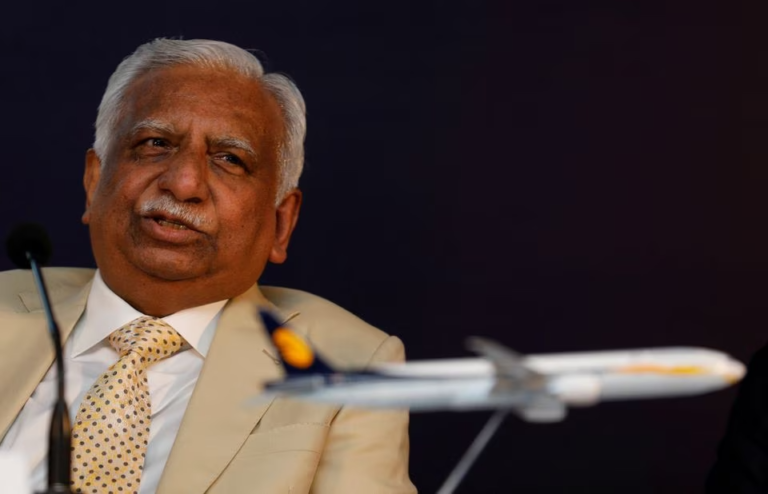
BENGALURU (Reuters) – India’s financial crime agency has seized properties worth 5.38 billion rupees (nearly $65 million) as part of its probe into money laundering allegations against the now-defunct Jet Airways (JET.NS) and founder Naresh Goyal, the agency said on Wednesday.
The Enforcement Directorate (ED) said it has seized 17 residential and commercial properties in London, Dubai and India that were registered in the names of various companies and people, including Goyal, his wife and son.
Goyal has been in judicial custody since September when the ED arrested him in relation to the money laundering that was filed by state lender Canara Bank (CNBK.NS) in May.
Jet Airways had siphoned off loans from a consortium of banks led by State Bank of India (SBI.NS) and Punjab National Bank (PNBK.NS), the ED said.
The agency doubled down on its claim that under Goyal’s leadership, the airline had siphoned off funds under the garb of professional and consultancy fees to overseas entities and towards the expenses of Goyal and his family members.
“Naresh Goyal implemented a massive financial fraud,” it said on Wednesday.
Goyal’s lawyer told Reuters, “We are going through the charge sheet and are currently evaluating our options.”
Goyal founded Jet Airways in 1992 and led it to become India’s second-largest carrier in India by market share. It shut down operations in April 2019 after running out of cash. ($1 = 83.2615 Indian rupees)
Reporting by Indranil Sarkar in Bengaluru; Editing by Savio D’Souza
Princess Leonor of Spain swears oath on 18th birthday, republican ministers boycott ceremony
By Sam Jones
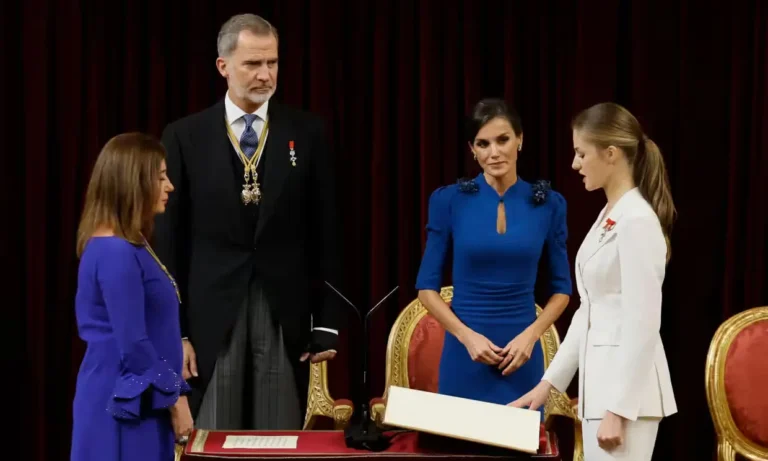
MADRID (Agencies) – Princess Leonor, the heir to Spain’s throne, formally stepped into the spotlight by swearing allegiance to the constitution on her 18th birthday on Tuesday, though boycotts by leftist and separatist politicians underlined divisions over the monarchy.
The ceremony in parliament marked her coming of age, meaning she will now directly become queen after her father King Felipe VI, assuming he does not go on to have any male children.
Princess Leonor, the heir to the Spanish throne, has pledged her allegiance to the constitution in a ceremony that was boycotted by republican government ministers and Catalan and Basque nationalist MPs.
Leonor swore the oath in Spain’s congress as she turned 18 on Tuesday, and was accompanied by her parents, King Felipe and Queen Letizia, her sister, Sofía, and Spain’s acting prime minister, Pedro Sánchez. Her grandfather Juan Carlos, the self-exiled former king, was absent.
Princess Leonor, King Felipe, Queen Letizia and Princess Sofía watch a military parade in Madrid after the ceremony. Photograph: Carlos Álvarez/Getty Images
Leonor’s promise of allegiance to the Spanish constitution came 37 years after her father took the same oath on his 18th birthday on 30 January 1986. Felipe came to the throne in 2014 after his father abdicated amid plummeting popularity.
Juan Carlos, now 85, left Spain for Abu Dhabi in August 2020 after a series of damaging allegations about his business dealings further dented his already battered reputation and embarrassed King Felipe.
Juan Carlos and his wife, Sofía, were expected to be present at a private birthday party for Leonor at the Pardo Palace later on Tuesday.
In a short public speech following her oath, Leonor said she had “solemnly, publicly and formally promised to uphold our democratic principles and our constitutional values”. She added: “On this important day that I’ll always remember with great emotion, I ask you to put your trust in me, just as I have put all my trust in the future of our nation.”
Sánchez, who has been fiercely criticised for considering a possible amnesty for the Catalan separatists behind an illegal push for regional independence six years ago in return for their support in helping him form a new government, welcomed the occasion. He stressed the importance of social harmony and political diversity.
“With Princess Leonor’s oath, Spain today reaffirms the strength of its institutions and of its democracy, which is based on the constitutional principles of coexistence, equality, liberty and political pluralism,” he wrote on X, formerly Twitter.
Some of his ministers, however, did not agree. Ione Belarra, the Podemos leader and acting social rights minister, and her Podemos colleague Irene Montero, the acting equality minister, did not attend the ceremony. Also absent was Alberto Garzón, the United Left MP who is the acting consumer affairs minister.
“Princess Leonor’s constitutional oath today isn’t just another protocol event,” Belarra wrote on X. “The monarchy is looking to perpetuate itself over the coming decades but we are hoping that the institutions of state come under citizen sovereignty as soon as possible.”
Montero was blunter still, appearing to make a thinly veiled reference to the now-shelved corruption investigations that Juan Carlos faced.
“In a democracy, the citizens are the ones who should choose all the institutions that represent them,” she said on X. “The hereditary principle of the institution of the monarchy isn’t just outdated, it’s also incompatible with democracy. As, of course, is corruption.”
The ceremony – which drew crowds and for which huge banners displaying Leonor’s face were draped from lamp-posts in Madrid – was also boycotted by the two main Catalan pro-independence parties, the ERC and Junts, the Basque nationalist parties PNV and Bildu and the Galician National Bloc.
Alberto Núñez Feijóo, the leader of the conservative People’s party (PP), congratulated Leonor on her birthday and said the PP offered its loyalty to the crown – “a symbol of unity, democracy and coexistence” – so that Spain could go on writing “the best years of our history”.
Santiago Abascal, the leader of the far-right Vox party, used the occasion to send a rather less coded message to Sánchez. “Today is a day of celebration on which we have the honour of accompanying the princess as she takes the constitutional oath,” he wrote on X.
“But even today we cannot allow ourselves not to speak the truth, nor to forget the betrayal of an acting prime minister who has delivered himself to the enemies of Spain. While the future queen of Spain swears her respect to the law, the acting prime minister is trampling on that same law. We will stand up to him.”
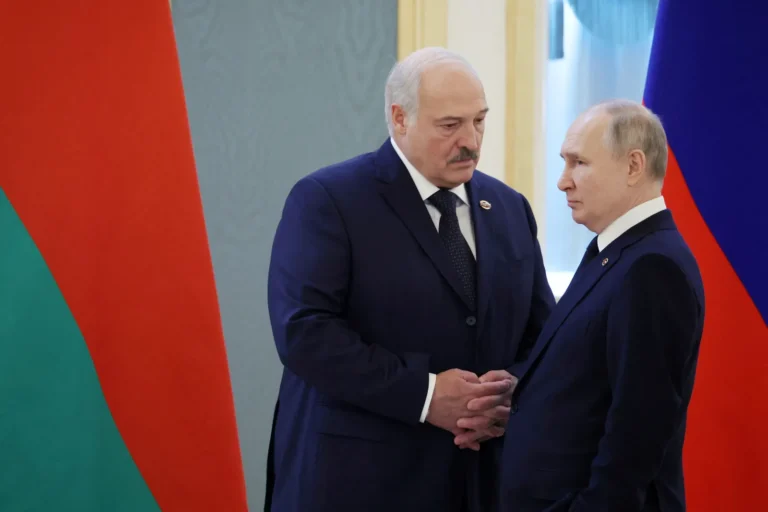
In mid-September, just two days after Russian President Vladimir Putin startled the West by hosting North Korean leader Kim Jong Un for a rare summit, he met with another autocrat who has been even more crucial to his war in Ukraine: Belarusian strongman Alexander Lukashenko. Taking note of the new entente with Pyongyang, Lukashenko proposed that he and Putin could now join in a “three-way cooperation” pact with Kim, presumably to help Russia create a broader autocratic bulwark against the West.
With the United States and much of Europe distracted by a new war in the Middle East, the conflict in Ukraine has for the time being receded from view. But behind the scenes, it has continued to evolve in important ways. One of the most striking, and least noted, may be its unexpected effects on neighboring Belarus. In fact, Lukashenko’s September meeting with Putin is only one of several instances over the past few months in which the Belarusian leader has underscored his country’s special role in the war.
Before Russia’s February 2022 invasion of Ukraine, Lukashenko let tens of thousands of Russian troops mass on Belarus’s soil, thus enabling Putin to attack from the north as well as from the east, vastly shortening the distance to Kyiv. More recently, Lukashenko has allowed Russia to deploy tactical nuclear weapons in Belarus, giving Putin an additional means with which to threaten escalation.
And in June, following the attempted mutiny of Yevgeny Prigozhin, Lukashenko became the public face of negotiations to persuade the Wagner paramilitary company leader to stand down in exchange for safe passage to Belarus, a face-saving solution for Putin that helped avert a more serious crisis in Moscow. In return for these actions, Putin has showered Belarus with a variety of financial supports and provided strong backing for the autocratic Lukashenko regime itself.
Although Western officials have long noted that Putin and Lukashenko are closely aligned, the exact nature of their relationship is poorly understood. Many, noting Minsk’s extensive dependence on Moscow, view Lukashenko as little more than a puppet or stooge of the Russian president, and Belarus as a sort of vassal state. But as Lukashenko’s actions during the war make clear, Belarus has become a crucial military asset in its own right, and Moscow is also to some extent dependent on Minsk. As a result, Lukashenko maintains a certain autonomy, albeit diminishing, which Moscow tolerates because it cannot risk endangering the stability of Belarus.
Perhaps most significant, Lukashenko’s own aims for the war likely differ significantly from Putin’s. For the Belarus regime, a prolonged conflict or stalemate—even if it comes at a high cost to Russia—would be far preferable to an outright Russian victory. For in this unresolved situation, Lukashenko can maximize his own leverage in Moscow while containing threats to his legitimacy both from abroad and from home.
LOOKING BOTH WAYS
On paper, Lukashenko and Putin have always had much in common, starting with their shared background and rise to power. Both were born in the 1950s, and both were shaped politically by the trauma of the collapse of the Soviet Union. On coming to power—Lukashenko in 1994 and Putin in 1999—both set out to clear their domestic political landscapes of any significant competition and turn their governments into full-fledged autocracies. Lukashenko, in this regard, is the more experienced player, having created a dictatorial system much faster and then having held onto power for nearly 30 years.
Until around 2020, however, the two leaders’ foreign policies were somewhat divergent. Whereas Putin positioned Russia and its sphere of influence against the West, a strategy he began hardening in the mid-2000s, Lukashenko played a more intricate game. For many years, he consistently played the West, which was seeking less repression in Belarus, against the Kremlin, which has long attempted to bring his regime directly under its thumb. Notably, after Russia’s 2014 invasion of Ukraine, Belarus was viewed by Western leaders as a credible third party that could host negotiations between Russia, Ukraine, and European powers—the process that led to the Minsk agreements in 2014 and 2015.
With this contrasting orientation, Putin and Lukashenko spent much of the first two decades in constant bargaining. Moscow sought to provide fewer subsidies to the Belarusian economy and tighten its control over its neighbor. In 1999, Russia had launched the Union State project—an attempt to unite Belarus with Russia in a supranational framework—and Putin tried to take this further after he came to power, bringing Minsk directly under Moscow’s control. In theory, the Kremlin should have been able to force Lukashenko to bend: without Russian resources, including billions of dollars’ worth of cut-rate energy, cheap loans, and other subsidies, his Soviet-style economic policies would simply run the country bankrupt in a few years.
Venezuela’s top court suspends results of opposition presidential primary
By Mayela Armas and Vivian Sequera
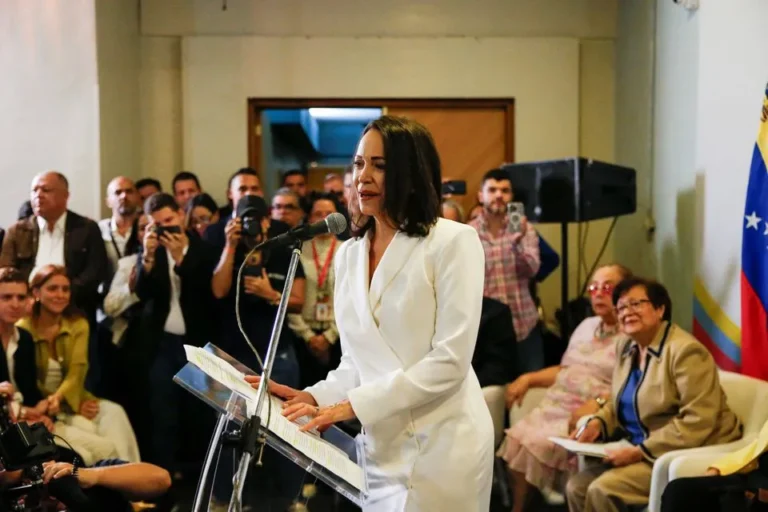
CARACAS (Reuters) – Venezuela’s Supreme Justice Tribunal said on Monday it has suspended the results of an opposition presidential primary that took place this month, despite an electoral deal between the government and the opposition that allows each side to choose its candidate.
The ruling could risk the wrath of the United States, which this month rolled back some oil and gas industry and bond trading sanctions in exchange for the electoral deal.
The U.S. State Department has already said it will reinstate sanctions if the government of President Nicolas Maduro does not lift bans on some opposition candidates and free political prisoners and “wrongfully detained” Americans by the end of November.
The decision by the court, which the opposition considers an arm of the government, comes after the attorney general announced last week that his office is investigating the primary and members of its organizing commission for electoral violations, financial crimes and conspiracy.
Members of the organizing commission were meeting with prosecutors on Monday for interviews related to the case, the commission said on social media.
The opposition and the primary’s winner Maria Corina Machado have insisted repeatedly the Oct. 22 vote was transparent and fair.
The government has decried alleged fraud since the day of the vote, which was organized without state help and which attracted more than 2.3 million voters.
The government of Maduro, in power for a decade, and the opposition signed an electoral deal in Barbados, agreeing to international observers and that each side can choose its candidate according to internal rules.
Venezuela’s President Nicolas Maduro gestures during a meeting with Colombia’s Ambassador to Venezuela Milton Rengifo (not pictured), at Miraflores Palace, in Caracas, Venezuela August 16, 2023. File Photo: REUTERS/Leonardo Fernandez Viloria
“We urge Nicolas Maduro and his representatives to uphold the commitments they made at the signing of the political roadmap agreement,” a State Department spokesperson said. “The U.S. government will take action if Maduro and his representatives do not meet their commitments.”
Both the investigation and the ruling come at the request of lawmaker Jose Brito, who the court said wanted to participate in the primary.
Brito does not belong to any of the parties that took part.
“Following the request of preventative protection and in consequence, all the effects of the distinct phases of the electoral process conducted by the National Primary Commission are suspended,” the tribunal said on its website.
The commission must present all documents related to its creation, candidate registration, voting records and other documents, the tribunal said.
The commission must also account for the participation of candidates like Machado, who is barred from holding public office in a decision the opposition says is illegal.
The ruling “temporarily suspends the primary until there is a final decision from the tribunal,” said lawyer and university professor Jose Vicente Haro. “The tribunal is late to the decision because it comes after the primary. They shouldn’t have accepted the petition.”
Some observers said the opposition parties that participated in the primary should simply recognize Machado once again as their unity candidate, making any ruling on the contest moot.
The opposition this month declined electoral authorities’ offer of help organize the primary, and its request to delay the vote until November, after the authorities took several months to respond to the opposition’s request for assistance.
Reporting by Mayela Armas and Vivian Sequera in Caracas; additional reporting by Matt Spetalnick in Washington; writing by Julia Symmes Cobb; editing by Jonathan Oatis and Bill Berkrot
100 dead or missing in Mexico from hurricane, food and water worries persist
By Josue Decavele and Jose Cortes
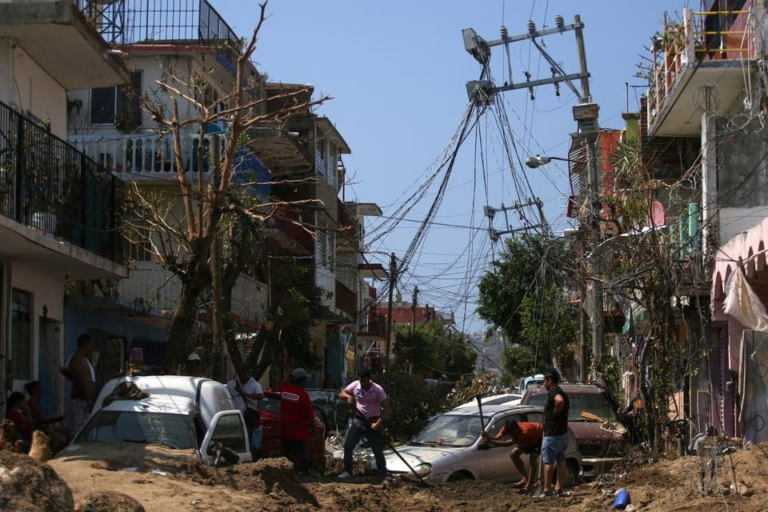
ACAPULCO, Mexico (Reuters) – The number of people dead and missing due to Hurricane Otis, a Category 5 storm which hammered the Mexican Pacific resort city of Acapulco last week, has risen to 100, the government of the southern state of Guerrero said on Monday.
Otis battered Acapulco with winds of 165 miles per hour (266 km per hour) on Wednesday, flooding the city, tearing roofs from homes, hotels and other businesses, submerging vehicles, and severing communications as well as road and air connections.
Many residents of Acapulco were still struggling to pick up the pieces of their shattered lives on Monday afternoon.
Sixty-two-year-old Rumualda Hernandez from the Renacimiento neighborhood a few miles back from the shore, urged the government to send help after walking 10 blocks from her wrecked home to get water from a cistern to wash clothes caked in mud.
“I was trembling with fear,” Hernandez said, recalling how the floodwaters at her house surged above head height as the storm raged. “I thought I was going to die.”
Fishermen and workers on tourism yachts gathered at Acapulco’s Playa Honda on Sunday afternoon to look for missing colleagues and friends, worried officials were not doing enough.
Luis Alberto Medina, a fisherman, said he was searching for six people who worked in the harbor.
“It was really horrible,” Medina said. “We’ve already found the bodies of others.”
FEAR OF ASSAULT
During a regular government press conference President Andres Manuel Lopez Obrador urged local authorities to ensure that basic goods were being delivered to Acapulco’s population.
The cost of damage from the hurricane could climb as high as $15 billion according to estimates, and Mexico has sent some 17,000 members of the armed forces to keep order and help distribute tons of food and supplies in Acapulco.
ATM machines have also been hit in the city.
Two service points will be set up in branches of an armed forces development bank in Acapulco to enable people to withdraw cash, the finance ministry said on Monday.
Access to food and water remains challenging, and retail group ANTAD on Monday urged the government to step up efforts to prevent looting at stores run by its members. Members include Soriana (SORIANAB.MX) and Chedraui (CHDRAUIB.MX).
“We condemn acts of robbery by the population,” ANTAD said in a statement. “There is no justification for it.”
A line of some 150 people waiting for water provided by a local authority snaked down muddy streets in the La Frontera neighborhood on Sunday afternoon, as residents holding empty water containers bemoaned the hours-long wait.
“Look how many of us there are,” said one of them, Emilia Rojas, looking around her in despair. “We’re so many. This water isn’t going to be enough.”
On a nearby street, Perla Rubi said the long wait was uncomfortable, given how desperate people were.
“We’ve been here since dawn, since five in the morning, risking getting robbed, because now they’re assaulting people in the streets,” she said. “Where’s the government help?”
The disaster struck Acapulco barely seven months before Mexico’s next presidential election, and Lopez Obrador on Monday reiterated his claim that critics were attacking his response to Otis and inflating its impact for electoral reasons.
His fiery denunciations sparked criticism that the president was downplaying the gravity of the disaster.
Reporting by Jose Decavele; Additional reporting by Daina Beth Solomon, Diego Ore and Isabel Woodford; Writing by Dave Graham; Editing by Jonathan Oatis, Tomasz Janowski & Shri Navaratnam
India opposition accuses govt of trying to hack lawmakers’ iPhones
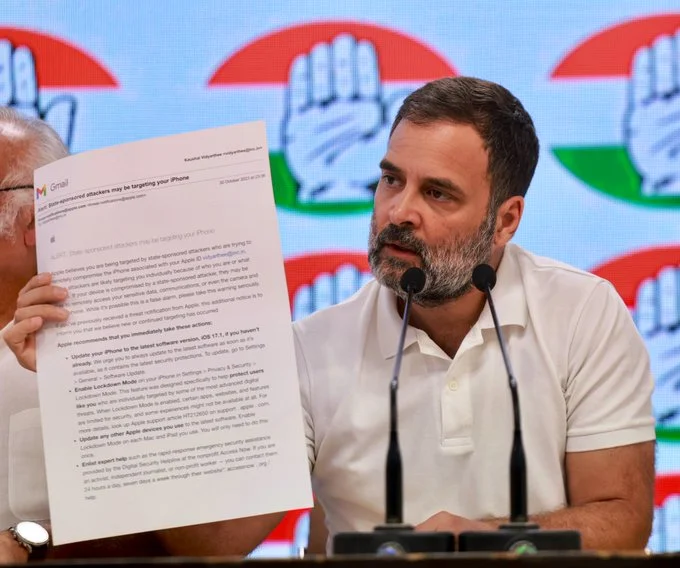
NEW DELHI (Reuters) – Indian opposition leader Rahul Gandhi on Tuesday accused Prime Minister Narendra Modi’s government of trying to hack into senior opposition politicians’ mobile phones, after they reported receiving warning messages from Apple (AAPL.O).
Some of the lawmakers shared screenshots on social media of a notification quoting the iPhone manufacturer as saying: “Apple believes you are being targeted by state-sponsored attackers who are trying to remotely compromise the iPhone associated with your Apple ID”.
Members of Parliament from several opposition parties, including the Trinamool Congress Party, the Indian National Congress and the Aam Aadmi Party, posted screenshots of emails from Apple informing them that their iPhones had been the target of hacking attempts, they said on X, the social media platform formerly known as Twitter.
Several journalists critical of the ruling Bharatiya Janata Party-led government, including reporters from the Organized Crime and Corruption Reporting Project and The Wire — as well as the head of a government-linked think tank in New Delhi — also shared similar notices from Apple.
“Hack us all you want,” Gandhi told a news conference in New Delhi, in reference to Modi. “But we (opposition) will not stop questioning you.”
Information Technology Minister Ashwini Vaishnaw expressed concern at the lawmakers’ statements and said the government had asked Apple to join its investigation into the matter.
In light of such information and widespread speculation, we have also asked Apple to join the investigation with real, accurate information on the alleged state sponsored attacks. (5/5)
The company said it did not attribute the threat notifications to “any specific state-sponsored attacker”.
State-sponsored attacks were evolving over time. Detecting them “relies on threat intelligence signals that are often imperfect and incomplete,” it said. “It’s possible that some Apple threat notifications may be false alarms, or that some attacks are not detected,”
Jairam Ramesh, spokesperson for Gandhi’s Congress party, called Apple’s clarification a “long-winded non-denial” of a security breach.
In 2021, India was rocked by reports that the government had used Israeli-made Pegasus spyware to snoop on scores of journalists, activists and politicians, including Gandhi.
The government has declined to reply to questions whether India or any of its state agencies had purchased Pegasus spyware for surveillance.
Death toll in Mexico from Hurricane Otis reaches 43
MEXICO CITY (Reuters) – The death toll from Hurricane Otis, a Category 5 storm that battered the Mexican Pacific resort city of Acapulco, has risen to 43, said Guerrero Governor Evelyn Salgado in a social media post.
As of Saturday, the Mexican government had reported 39 deaths with 10 people missing.
The new tally of fatalities comprised 33 men and 10 women, Salgado said in a post on the platform X.
She added that electricity had been restored to 58% of Acapulco, and that officials had visited 10,000 families in Acapulco and the nearby city of Coyuca de Benitez for a census to evaluate damages.
“These have been intense days of non-stop work,” Salgado said, noting that officials were working to distribute aid.
Residents in still-flooded areas have criticized the lack of government help, and many people are still searching for family members after losing contact when the storm hit on Wednesday.
With winds of 165 mph (266 kph), Hurricane Otis flooded city, wreaked homes, stores and hotels, and severed communications.
Reporting by Daina Beth Solomon Editing by Marguerita Choy and Lisa Shumaker
On the anniversary of a deadly Halloween crush, South Korean families demand a special investigation
BY HYUNG-JIN KIM
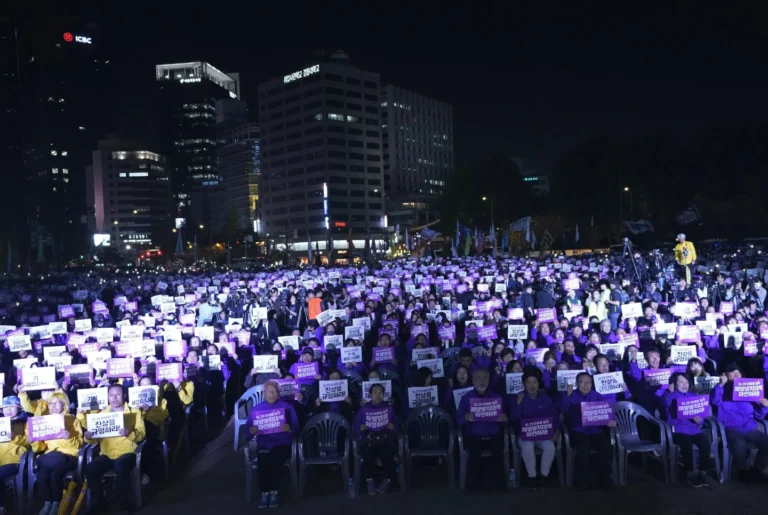
SEOUL, South Korea (AP) — Bereaved relatives of victims of last year’s devastating Halloween crush in Seoul and their supporters demanded an independent investigation of the disaster as they marked the anniversary Sunday with a massive memorial service.
The crush, one of the biggest peacetime disasters in South Korea, killed 159 people, most of them in their 20s and 30s who had gathered in Itaewon, a popular nightlife district in Seoul, for Halloween celebrations.
Commemorating the anniversary, the families visited the Itaewon area, laid flowers and offered condolences at an alley where the crush happened. Some wept near a wall where hosts of post-it notes with condolence messages were plastered.
“I’m sorry. I’m sorry that I couldn’t protect you. I loved you,” Song Jin Young, 55, the father of one of the victims, said.
In Itaewon, accompanied by their supporters, the families also attended multi-faith prayer services for their loved ones. They chanted slogans asking President Yoon Suk Yeol to offer a more sincere apology and Safety Minister Lee Sang-min to resign over the disaster.
“Apologize! Apologize!” they shouted.
The group marched through Seoul before arriving at a square for a memorial service, which drew thousands of people.
In a speech, Lee Jeong-min, a representative for the families, urged President Yoon to support efforts to legislate a special law to open an independent investigation into the disaster.
“We did our utmost to raise our children but we couldn’t even touch them when they vanished all of sudden. Where can we talk about our resentment toward this reality?” Lee said. “The special law would the most important legislation to find the cause of the Itaewon disaster and discuss the prevention of recurrences of similar incidents.”
In speeches, several opposition politicians criticized Yoon for failing to attend the ceremony and vowed to pass the special law to get to the bottom of the tragedy. Some participants reportedly shouted jeers at a ruling party official when he tried to leave after the first half of the ceremony, but there were no reports of major violence.
The memorial ended, with the crowd shouting “We’ll remember you” when names of each of the 159 victims were called. They also placed flowers before the photos of the dead at an altar.
The victims’ families said they had invited Yoon to the memorial ceremony. Instead, he attended a service for the victims at a Seoul church. Yoon’s office didn’t explicitly explain why he missed the memorial, but local media reported it was due to concerns that the event could be used politically by his rivals.
In a speech at the church, Yoon said that the day of the disaster “was the day when I felt the greatest sadness in all my life.” Yoon said he offers deep sympathy to the families and pledged to build a safer South Korea.
In January, a police special investigation concluded that police and municipal officials failed to formulate effective crowd control steps despite correctly anticipating a huge number of people in Itaewon. Investigators said that police had also ignored hotline calls by pedestrians who warned of swelling crowds before the surge turned deadly.
More than 20 police and other officials are reportedly on trial over the disaster. But no top-level officials have been charged or held accountable, a reason why the families and opposition lawmakers call for an independent probe.
This year’s Halloween celebrations in South Korea were largely subdued, with most bars, restaurants and shops avoiding Halloween-themed events in memory of the victims. Only a small number of people dressed in Halloween costumes were seen in Itaewon and other major entertainment zones in Seoul on Friday and Saturday.
___
Associated Press video journalist Yong Jun Chang contributed to this report.
UNWTO Collaborated with Samarkand Academy to promote tourism education
MADRID (DT) – The World Tourism Organization (UNWTO) has further enhanced its status as the global leader in advancing education and skills development for the tourism sector. As one of the top priorities of the Organization’s leadership, and fully endorsed by all Member States, education serves as the foundation for building more resilience and accelerating the shift to greater sustainability.
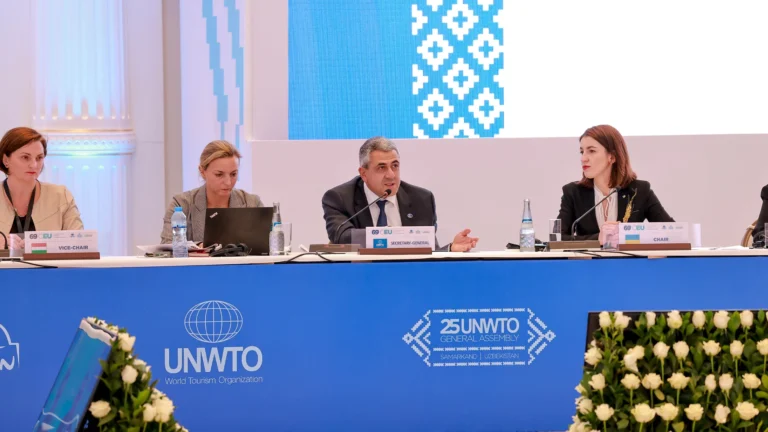
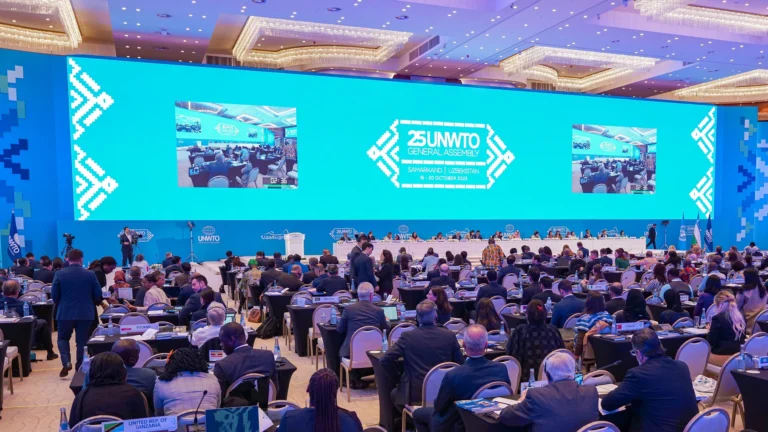
Against the backdrop of the 25th General Assembly (Samarkand, Uzbekistan, 16-20
October 2023), Secretary-General Zurab Pololikashvili visited the new Tourism Academy
Samarkand in Collaboration with UNWTO. The Academy will train students new to the
sector as well as those already working in tourism, giving them the skills they need
to grow their careers.
The Secretary-General praised the commitment of President Shavkat Mirziyoyev and Minister Aziz Abdukhakimov to investing in education and professional training and for recognizing the role both can play outside of the tourism sector itself.
The Samarkand Academy is just the latest in a growing network of education initiatives
spearheaded by UNWTO. Just one month before the General Assembly, against the
backdrop of this year’s World Tourism Day (27 September), the Secretary-General
visited the newly-opened Riyadh School for Hospitality and Tourism in Collaboration
with UNWTO. The school has already welcomed its first students and aims to welcome
many thousands more, both from the Kingdom of Saudi Arabia itself as well as from
across the wider region and the world.
Alongside its Academies, UNWTO is transforming tourism education at every level.
The Education Toolkit, launched out of the UNWTO Regional Office for the Middle
East, is designed to support Member States everywhere introduce tourism as a high
school subject. This stands alongside the growing UNWTO Tourism Online Academy,
the UNWTO Students League and now the Bachelor’s Degree in Sustainable Tourism
Management offered by UNWTO in partnership with the Lucerne University of Applied
Sciences and the Arts of Switzerland, in supporting people at every stage of their
educational journey in tourism.
Education as a priority for the sector will next be highlighted at the Minister Summit
host by UNWTO at the World Travel Market, London, on 6 November, 2023
Guatemala Participated in UNWTO Tourism Event in Uzbekistan to promote tourism
Guatemala City (AGN/UNWTO) – The Guatemalan Tourism Institute -Inguat- announced Guatemala’s participation in the 25th General Assembly of the World Tourism Organization -UNWTO-. This meeting took place from October 16 to 20 in Samarkand, Uzbekistan, as part of the activities developed within the context of this assembly.
Anayansy Rodríguez, Director of Inguat, represented the country on the international panel on the evolution of tourism education and its contribution to sustainable tourism development.
The Education Forum, which aims to discuss key strategies for transforming tourism education systems, mentioned how high-performing countries have reformed their educational programs, focusing on integrating technological resources and constantly updating content.
The Inguat director also stressed the importance of creating programs to promote and strengthen business and creative capacities for a better academic future for the global tourism industry.
The event included activities such as the Global Investment Forum. The main goal of this forum was to promote sustainable investments focused on specific guidelines established by the UNWTO.
Likewise, the 119th session of the UNWTO Executive Council was held. The meeting focused on tourism investments’ different points of view to promote new investment forms. These contemplate strengthening actions in the hotel and infrastructure sectors, turning them into sustainable fields. The meeting also addressed global trends in tourism investments.
The UNWTO Assembly is a meeting for leaders from the public and private sectors related to tourism. This year, under the leadership of Uzbekistan.
The General Assembly’s mission is to promote sustainability and tourism development at the global level, and it functions as a generator of connections between nations.
UNWTO New Regional and Thematic Offices
UNWTO’s commitment to moving closer to its Members and being on the ground in
every region was further emphasized as the Assembly was given an update on work to
establish new Regional and Thematic offices. Members heard:
• The Regional Office for the Middle East, opened in Riyadh, Saudi Arabia, in 2021, is
an established hub for tourism education and tourism for rural development. From
here, UNWTO has opened the Riyadh School for Hospitality and Tourism, launched a
first Education Toolkit for high schools, and also launched the Best Tourism Villages
initiative.
• UNWTO signed an agreement with the Government of Brazil to establish a Regional
Office in Rio de Janeiro, to be focused on investments.
• The planned Regional Office for Africa in Marrakesh, Morocco, will focus on the
priorities of innovation and investments in tourism.
• The hosts of this Assembly, Uzbekistan, presented its proposal to establish a
Thematic Office for Tourism on the Silk Road. The proposal was approved by the
119th session of the UNWTO Executive Council.
World Tourism Day Report
Just three weeks after World Tourism Day 2023, Member States were given an update
on UNWTO’s work growing the sector’s global day of observance. The Secretary of the
Assembly provided a recap of the past two events and looked ahead to the two years
to come.
• World Tourism Day 2022 was hosted in Bali, Indonesia, around the theme of
Rethinking Tourism, with the 2023 celebrations – the biggest to date – held in Riyadh,
Saudi Arabia, around the theme of Tourism and Green Investments. The General
Assembly agreed to adopt the “Tourism Opens Minds” pledge, introduced by
UNWTO that day, and recommends that the Secretariat takes steps to advance the
initiative, including through the funding of relevant programmes and campaigns.
• Members of the General Assembly approved the themes and the hosts for the next
two years. For 2024, the theme will be “Tourism and Peace”, to be hosted by Georgia,
and then Malaysia will host World Tourism Day 2025 around the theme of Tourism
and Sustainable Developments.