Home Blog Page 3

US and China discuss trade in Paris to make way for Trump, Xi summit

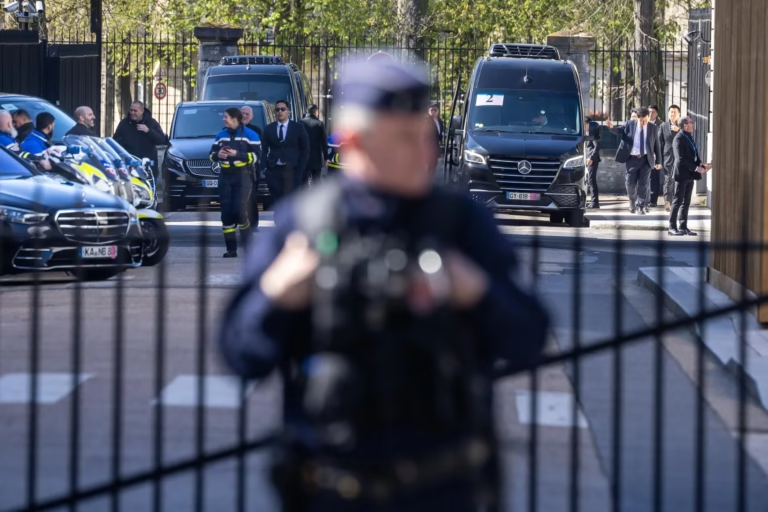
Paris, France — Top officials from the United States and China met in Paris on Wednesday for a new round of talks before the expected summit in Beijing between presidents Donald Trump and Xi Jinping.

​At the end of the two-day negotiations, US Treasury Secretary Scott Bessent described the sixth round of talks as “very good.”

​For the Chinese Vice Minister of Commerce and representative in international trade negotiations, Li Chenggang, the talks in Paris yielded a “preliminary consensus on certain issues.”

​US Trade Representative Jamieson Greer outlined some of the issues to be addressed, including some that have caused friction, such as rare earth elements, whose refining is almost entirely controlled by China, and which are crucial for supplying the US arms industry.

​Another area of great interest to the United States is rebalancing its large trade deficit with China, which it hopes to correct by increasing purchases of agricultural products (such as chicken, beef, and soybeans), energy products, and industrial goods (including aircraft).

​According to the US trade official, the two delegations examined the possibility of establishing a mechanism to manage trade between the two countries, which would serve as a forum to identify products that China could sell to the United States and vice versa.

​The basis for these discussions, which took place at the headquarters of the Organization for Economic Cooperation and Development in the French capital, was part of the agreement that Trump and Xi reached in Busan, South Korea, in late October, marking the end of months of deteriorating relations between the world’s two largest economies.

​The trade war was initiated by the US president shortly after he took office in Jan 2025 for his second term, with the announcement of widespread tariffs on his main trading partners, arguing that they were taking advantage of the United States. However, Beijing did not back down.

China’s position of strength afforded by its size and the control it exerts over certain strategic sectors ensured a power struggle could potentially shatter many macroeconomic balances, and for which the Busan agreement provided a truce.

​Trump’s visit to Beijing is scheduled from Mar 31 to April 2, but it could be postponed.

​Bessent wanted to make it clear that the possible postponement of the US president’s trip has nothing to do with his demand that China participate in reopening the Strait of Hormuz, but rather with the need for Trump to continue directing military operations in the Middle East from the US.

​Another issue on the table at the Paris negotiations was the investigations launched by the United States to assess the economic harm it believes it suffers from the practices of some of its main trading partners. These investigations would replace the tariffs overturned by the Supreme Court.​

The Chinese expressed their displeasure with these investigations, believing they contribute to maintaining uncertainty and deteriorating the atmosphere.


SOURCE : EFE. |  Follow Us: Facebook | Instagram | Twitter | Youtube |
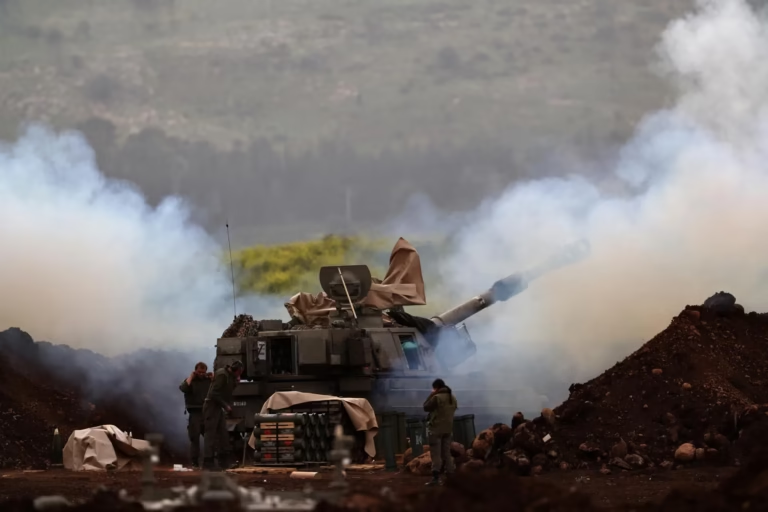
4 Palestinians killed in Israeli airstrike in central Gaza

Jerusalem — Four Palestinians were killed Sunday in an Israeli airstrike in central Gaza, including three members of the same family and a child, according to Al Aqsa Martyrs Hospital in Deir al Balah.

The strike hit the Sawarha area, which lies outside the zone under Israeli control under the current ceasefire agreement.

RELATED NEWS : 9 dead after Iranian missile hits Israeli town near Jerusalem

Hospital officials identified the victims from the Ayash family as Kamel Ayash, the father; Halima Ayash, the mother; and their son Ahmed. A fourth victim, a child, was identified as Ibrahim Hasanat.

The hospital said Halima was pregnant at the time of her death. According to the official Palestinian news agency WAFA, the Israeli aircraft struck an area with a high concentration of civilians in Sawarha, west of the Nuseirat refugee camp.

Although a ceasefire has been in place since October 2025, Israel has continued to carry out occasional airstrikes and drone attacks in western areas of the Gaza Strip outside the perimeter still controlled by Israeli troops and marked by the so-called “yellow line.”

The attacks have continued even after the start of the war between Israel and Iran.

About 660 Palestinians have been killed in Israeli shootings and airstrikes in Gaza during the ceasefire and more than 1,700 wounded, according to Palestinian officials.

More than 72,200 Palestinians in Gaza have been killed in Israeli attacks since Oct. 7, 2023, when Israel launched its military offensive in response to an attack by Palestinian militant groups on Israeli territory. More than 171,800 Gazans have also been wounded.


SOURCE : EFE. |  Follow Us: Facebook | Instagram | Twitter | Youtube |

Serbia becomes first European country with Chinese hypersonic missiles

0

Belgrade, Serbia Serbian President Aleksandar Vučić confirmed that Serbia has purchased Chinese CM-400AKG hypersonic missile systems, making it the first country in Europe to acquire the air-to-ground weapon.

“They are expensive and effective. We received a small discount,” Vučić said in an interview late Thursday with the state broadcaster Radio Television of Serbia.

RELATED NEWS : Pedro Sánchez revives ‘no to war’ slogan as Spain rejects Middle East escalation

During the interview, Vučić also claimed that Croatia, Albania, and Kosovo had formed an alliance that could attack Serbia “at some point in the future,” though he provided no evidence to support the claim.

The nationalist leader, who has dominated Serbian politics since 2012, linked the purchase of the missiles to what he described as potential threats from neighboring countries.

“They will wait for a major conflict between Europeans and Russians to erupt, and for the conflict in the Middle East to worsen even more,” he said.

Vučić added that Serbia has no plans to attack NATO members, such as Croatia and Albania, but suggested that his country’s neighbors might wait for a “favorable moment” of global instability to strike.

“Serbia is strong enough to preserve its sovereignty, its territorial integrity, and the freedom and security of its citizens,” he said, adding that the Serbian military is the strongest among the armed forces of the former Yugoslavia.

According to the president, the Serbian Armed Forces have already integrated the Chinese missiles into Russian-made Mikoyan MiG-29 fighter jets.

“We have a significant number of these missiles and we will have even more,” he said of the weapon, which has a reported range of about 400 kilometers.

Croatian Prime Minister Andrej Plenković responded to the purchase by warning that it could threaten regional stability and said he would raise the issue with NATO allies.

In response, Vučić said that “Zagreb will not decide what Serbia will have.”

Croatia, Albania, and Kosovo, once a Serbian province, signed a declaration of cooperation on defense and security in March 2025, a move Serbia considers a threat to its security.

Vučić also said Serbia, a candidate for membership in the European Union since 2008, will continue to strengthen military cooperation with China.

According to the Stockholm International Peace Research Institute, between 2020 and 2024 Serbia imported most of its weapons from China (57%), followed by Russia (20%) and France (7.4%).


SOURCE : EFE. |  Follow Us: Facebook | Instagram | Twitter | Youtube |
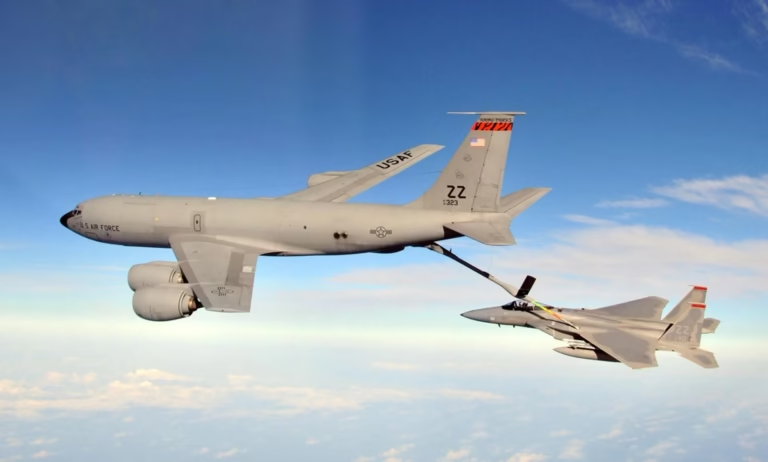
All 6 crew members dead in US aircraft tanker crash in Iraq

Miami, USA — The United States confirmed Friday that all six crew members aboard a Boeing KC-135 Stratotanker that crashed in western Iraq have died.

The United States Central Command (CENTCOM), headquartered in Tampa, Florida, said the “circumstances of the incident are under investigation,” while stressing that the loss of the aircraft “was not due to hostile fire or friendly fire.”

RELATED NEWS : 3 U.S. Troops Killed, 5 Wounded as Iran Conflict Escalates

“All six crew members aboard a U.S. KC-135 refueling aircraft that went down in western Iraq are now confirmed deceased. The aircraft was lost while flying over friendly airspace March 12 during Operation Epic Fury,” CENTCOM said in a statement.

The identities of the service members are being withheld until 24 hours after next of kin have been notified.

With the deaths of the six servicemen, the number of US troops killed since the start of the war against Iran on Feb. 28 has risen to 14.

According to US officials, seven soldiers died in Iranian attacks, one died in a medical emergency in Kuwait, and the remaining casualties occurred in the Iraq crash.

A pro-Iranian militia, the Islamic Resistance in Iraq, earlier claimed responsibility for downing the aircraft, saying it was struck by air-defense systems.

The group said it had also targeted a second US aircraft in western Iraq, which it claimed made an emergency landing at “one of the enemy’s airports,” with the crew unharmed.

CENTCOM has not confirmed those claims and said it has no reports of an attack on a second aircraft.

Iran also said the tanker plane was struck by a missile fired by Iraqi armed groups.

US officials say this is the second incident involving American forces since the war began.

Earlier this week, a fire aboard the USS Gerald R. Ford, the largest aircraft carrier in the US fleet, injured two Marines. CENTCOM said that incident was also not caused by enemy action.


SOURCE : CENTCOM/EFE. |  Follow Us: Facebook | Instagram | Twitter | Youtube |
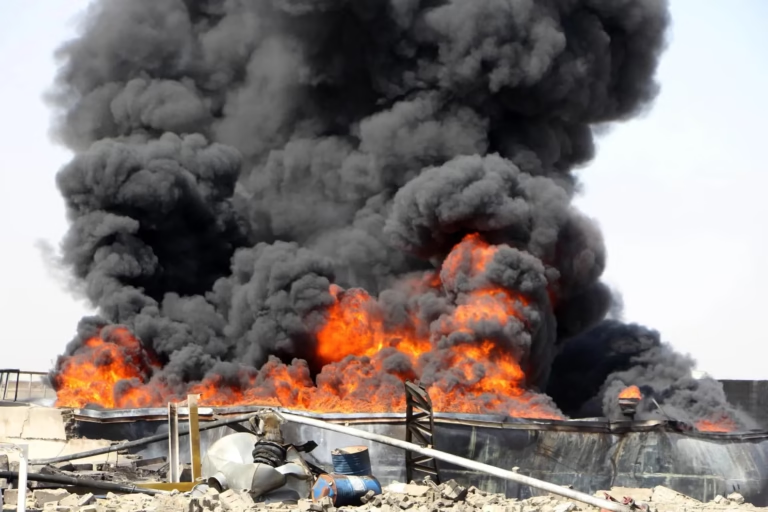
Pakistan airstrikes in Afghanistan kill 4, injure 15 as tensions escalate

Kabul/Islamabad — Pakistani airstrikes on Afghanistan killed at least four people and injured 15 in Kabul and other areas on Friday, Afghan authorities said, as Islamabad confirmed targeting Taliban-linked facilities and alleged militant hideouts in a new cross-border offensive.

Kabul police spokesperson Khalid Zadran said in a post on X that the strikes hit a residential area of the Afghan capital, leaving at least four people dead and 15 injured, including women and children.

The Taliban government said Pakistan also bombed several locations across Afghanistan, including Kabul, Kandahar, Paktia and Paktika.

“The Pakistani army once again bombed Kabul, Kandahar, Paktia, Paktika and other areas. In some places it targeted civilian homes, resulting in the deaths of women and children,” Zabihullah Mujahid, spokesperson for the Taliban administration, wrote on X.

According to the Taliban, one of the strikes in southern Afghanistan hit a fuel depot belonging to the private airline Kam Air near Kandahar Airport.

The facility, which Kabul says supplies fuel to civilian airlines and United Nations aircraft, is located in the city where the Taliban’s supreme leader, Hibatullah Akhundzada, resides.

Pakistan confirmed the operation, saying its armed forces carried out airstrikes against Afghan Taliban military infrastructure and alleged terrorist hideouts.

Security sources in Islamabad said Pakistani forces targeted infrastructure of the Taliban’s 313 Corps in Kabul and destroyed the fuel depot at Kandahar airfield along with nearby logistical facilities.

The offensive also struck camps in Tarawo and Shirinaw, including in the eastern province of Paktia.

According to the same sources, the strikes were directed against positions linked to the Afghan Taliban and “Fitna al-Khawarij,” a term Islamabad uses to refer to the Tehreek-e-Taliban Pakistan (TTP), or Pakistani Taliban.

Pakistani officials said the cross-border campaign, dubbed “Operation Ghazab Lil Haq,” would continue “until the objectives are achieved.”

The Taliban government condemned the attacks and warned they would not go unanswered.

“The Islamic Emirate condemns this crime and this blatant aggression in the strongest terms, and, God willing, this injustice will not go unanswered,” Mujahid said.

The strikes come amid growing tensions between the two countries. Pakistan has repeatedly accused the Afghan Taliban of allowing the TTP to operate from Afghan territory and launch attacks inside Pakistan, an allegation Kabul has consistently denied.

The latest escalation follows Pakistani airstrikes carried out on Feb. 27, which marked the start of the current surge in cross-border hostilities that has already left dozens dead on both sides.

Earlier this week, Taliban Defense Minister Mohammad Yaqoob Mujahid warned that Kabul would retaliate if Pakistan bombed the Afghan capital again, adding that Afghan forces were prepared for a prolonged conflict.


SOURCE : EFE.|  Follow Us: Facebook | Instagram | Twitter | Youtube |
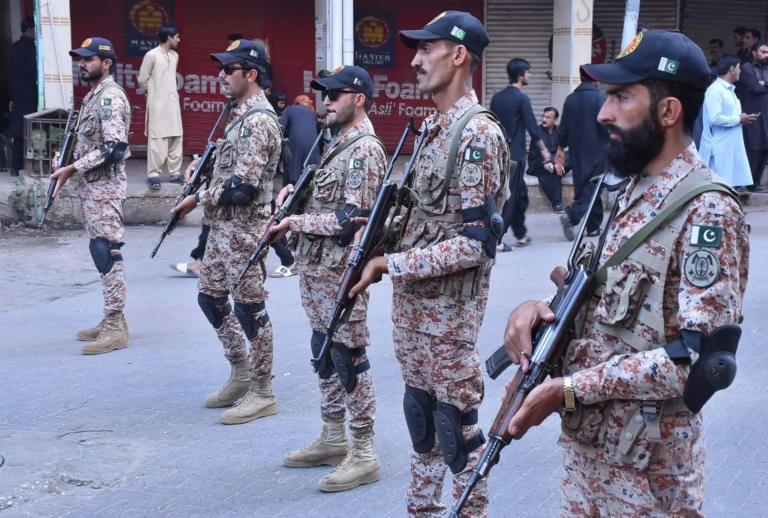
Bomb blast kills 6 police officers in Pakistan

Islamabad, Pakistan — At least six police officers were killed and another injured Friday when a bomb struck a police vehicle in northwestern Pakistan, the deadliest attack in the country since tensions with Afghanistan escalated late last month.

Police said the vehicle was targeted with an improvised explosive device (IED) in the Shadi Khel Bettani area of Lakki Marwat, in Khyber Pakhtunkhwa province.

“Six policemen, including the station house officer (SHO), were martyred and another policeman was injured,” Haseeb Ullah, an officer at the Lakki Marwat police control center, told EFE.

No group immediately claimed responsibility for the attack.

However, the Tehrik-i-Taliban Pakistan (TTP), also known as the Pakistani Taliban, has been active in the district and frequently targets security forces and police.

The TTP earlier this month announced a fresh offensive against Pakistan amid the ongoing border clashes between Islamabad and Kabul.

Pakistan has witnessed a sharp rise in militant violence since the Taliban returned to power in Afghanistan in August 2021.

Islamabad has repeatedly accused Kabul of harboring and supporting the TTP, saying the group operates from Afghan territory and benefits from safe havens provided by the Afghan Taliban. Kabul denies the allegations.

The two neighbors have clashed along the border since late last month, when Afghanistan launched a border offensive in response to earlier Pakistani airstrikes.

Pakistan has retaliated with artillery and additional airstrikes targeting several sites in Afghanistan, including the former Bagram Air Base, as well as locations in Kabul and the southern city of Kandahar, a traditional stronghold of the Afghan Taliban.

Pakistani security sources said in a statement released to the media Friday that the military had carried out “successful” airstrikes inside Afghanistan as part of Operation Ghazab Lil Haq.

“On the night of March 12–13, four terrorist hideouts were targeted, including military installations linked to the Afghan Taliban and Fitna al-Khawarij,” the sources said, using a term commonly used by Pakistani authorities to refer to the TTP.

According to the statement, the strikes hit infrastructure belonging to the 313 Corps in Kabul, as well as the Tarawo militant camp. An oil storage facility and logistics infrastructure at Kandahar Airfield were also destroyed.

In a separate strike, Pakistani forces targeted what they described as the “Shirinaw terrorist camp” in Paktia Province, the sources added.

“Operations under Operation Ghazab Lil Haq will continue until the objectives are achieved,” the statement said.


SOURCE : EFE.|  Follow Us: Facebook | Instagram | Twitter | Youtube |
Death toll rises to 687 due to Israeli air campaign in Lebanon

Beirut, Lebanon The Lebanese Public Health Emergency Operation Center reported on Thursday that the death toll from the Israeli offensive initiated on Mar. 2 rose to 687, and the number of injured went up to 1,774.

According to the latest report from the government office in the last 24 hours, 53 people were killed, and 188 were injured in attacks perpetrated by Israel against the south and east of the country, as well as Beirut and its surroundings.

RELATED NEWS : One week of Israel-Hezbollah clashes leave 400 dead in Lebanon

98 of the 687 fatalities since the start of the bombings are children, and 304 of the 1,774 injured are also minors, according to the office’s data.

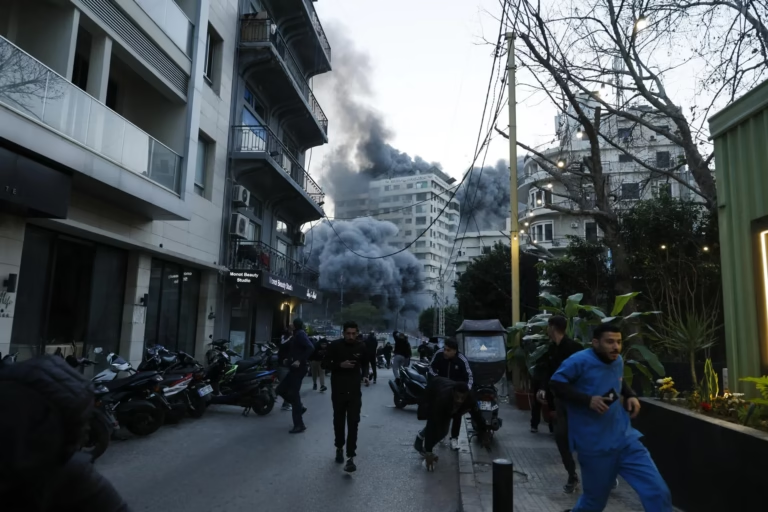
In a second attack, Israel bombed a building in central Beirut on Thursday. The building had been ordered evacuated earlier that day, coinciding with a warning to evacuate a third area of the city.

According to EFE, the building, located just 200 meters from the Cervantes Institute and just over 600 meters from the iconic Mohammad al Amin Mosque, was hit three times in a short period of time, an attack preceded by a first warning explosion.

After the second impact, neighbors in the area began firing into the air to warn of the continuing threat and call for the evacuation of citizens in the vicinity.

Shortly before, Avichay Adraee, the Israel Defense Forces’ Arabic-language spokesman, ordered the evacuation of the Bachoura neighborhood area, later followed by an evacuation warning for another building in the nearby Zuqat el Blat area.

These are the first two official evacuation orders for the Lebanese capital, however, the city has already been the target of three surprise attacks.

Israel has maintained an intense air offensive against Lebanon since Mar. 2, when the Lebanese group Hezbollah also began a series of limited-range attacks against northern Israel, intensified on Wednesday night with the launch of dozens of projectiles and drones.

The United Nations Interim Force in Lebanon expressed concern about the “serious escalation” that occurred overnight, including the launch of approximately 120 projectiles toward Israel and an equal number of artillery attacks against Lebanese territory, as well as seven Israeli airstrikes.

Early Thursday morning, the deadliest attack yet took place in Beirut, killing 12 people and injuring 28 more in the capital’s Ramlet al-Baida beach area.


SOURCE : EFE. |  Follow Us: Facebook | Instagram | Twitter | Youtube |
Death toll rises to 49 as massive floods batter Kenya

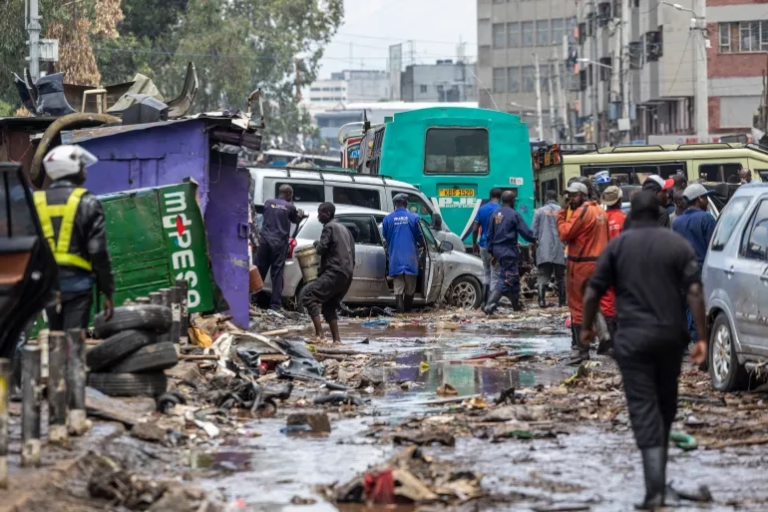
Nairobi, Kenya — At least 49 people have died, thousands displaced, and property destroyed, since March 6 when heavy downpour triggered massive flooding in more than a dozen Kenyan counties, including the capital, Nairobi.

As of Tuesday, flooding had killed 49 people, displaced over 2,600 families, and claimed more than 600 livestock countrywide, while the search for the missing had intensified, according to a multi-agency response secretariat.

Kenya Meteorological Department clarified that though the rains will subside this week, the risk of flooding remained high during the onset of the March-to-May rain season amid saturated soils.

Deborah Mulongo Barasa, cabinet secretary in the Ministry of Environment, Climate Change and Forestry, said in a televised interview on Monday that Kenya remains a global warming hotspot, as evidenced by prolonged and recurrent dry spells, flooding, and habitat loss.

To boost the country’s resilience to climatic stresses, Barasa said the government and bilateral partners have prioritized expanding tree cover, regenerating wetlands, and promoting the adoption of clean energy. 


SOURCE : AGENCIES |  Follow Us: Facebook | Instagram | Twitter | Youtube |
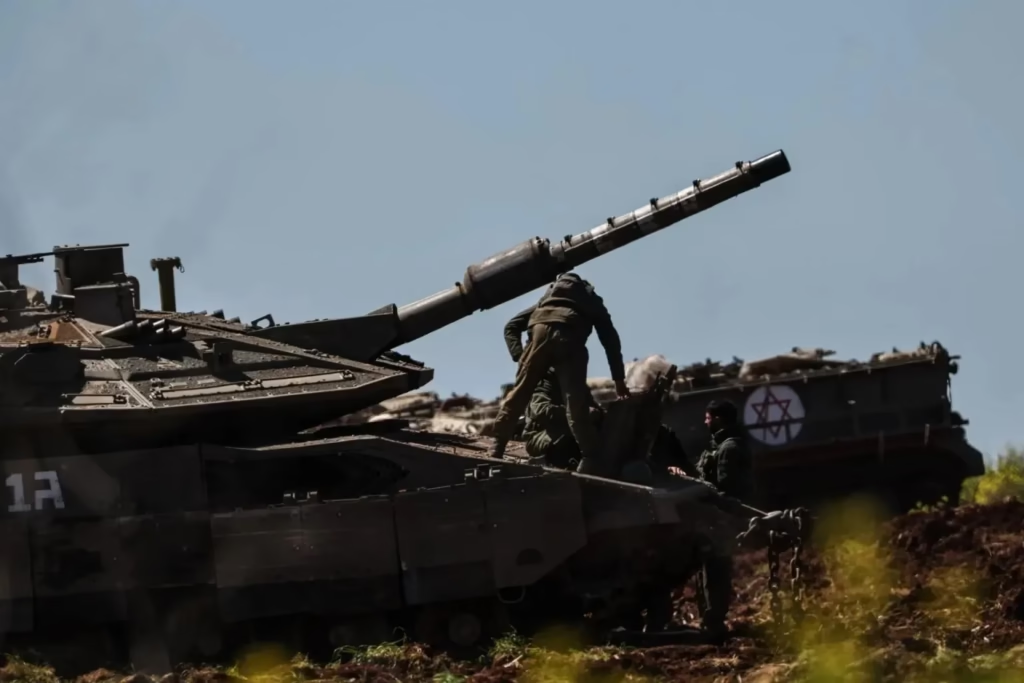
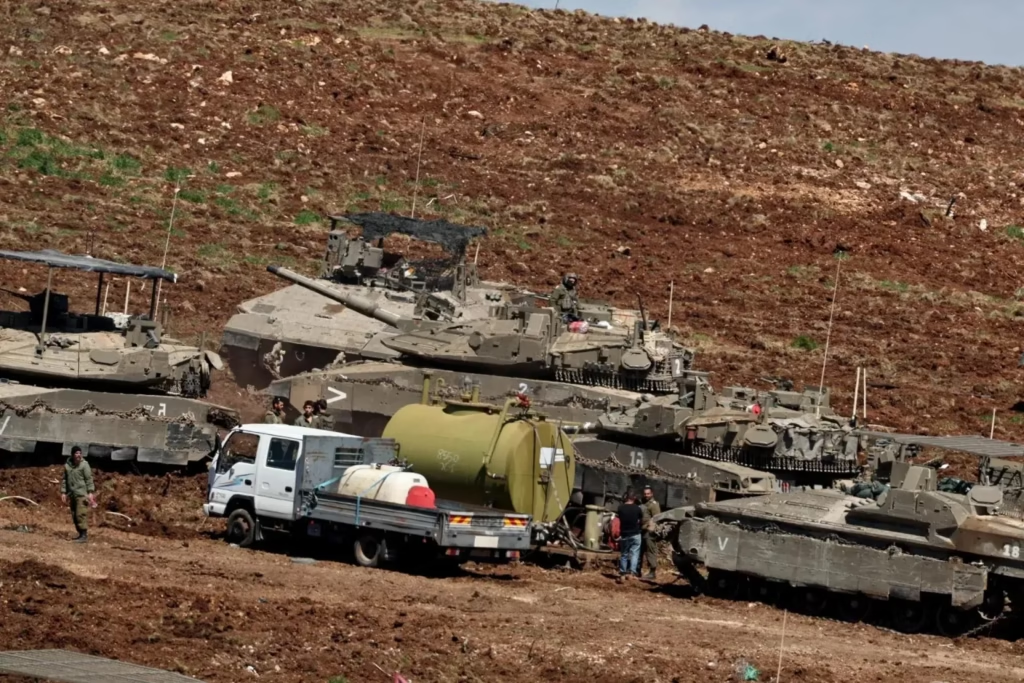
One week of Israel-Hezbollah clashes leave 400 dead in Lebanon

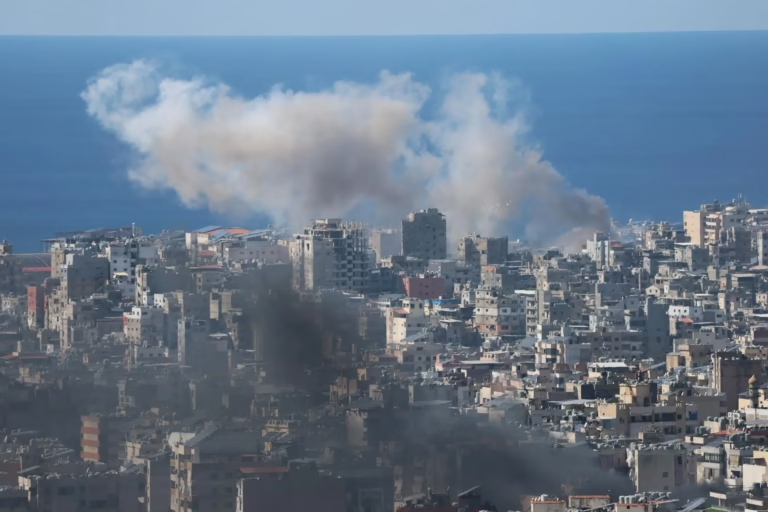
Beirut, Lebanon — Lebanon completed one week on Monday under a devastating Israeli bombing campaign, the second in just 15 months, triggered by a Hezbollah attack launched in support of Iran and exposing deep tensions between the Lebanese government and the powerful Shia militant group.

In its first seven days, the air offensive has left more than 400 people dead, about 1,100 injured, and nearly half a million displaced, according to Lebanese authorities, while causing further destruction in a country that was still awaiting international funds for reconstruction after the previous war.

RELATED NEWS : Erdoğan reiterates warnings to Iran after NATO intercepts another missile in Turkey

Here are some keys to understanding the renewed outbreak of violence and the context in which it is unfolding:

1. Iran’s war front The 2023–2024 conflict in Lebanon began after Hezbollah launched a largely symbolic attack on northern Israel in support of Gaza the day after the start of the war in the Palestinian enclave. It then took nearly a year of escalating clashes before turning into open warfare.

This time, hostilities erupted after Hezbollah launched another largely symbolic attack in support of its ally Tehran, two days after Israel and the US began their war against Iran. Israel’s response against Lebanon came almost immediately.

Beyond their shared hostility toward Israel, Hezbollah, a Shia movement, and the Palestinian Islamist group Hamas, which is Sunni, are both part of an informal alliance led by Iran that also includes Iraqi militias and Yemen’s Houthi rebels.

2. The stalled disarmament After the last conflict, Hezbollah halted its armed activity along the border with Israel in accordance with the ceasefire agreement.

Under pressure from the US, the Lebanese government tasked the army with implementing a plan to disarm the group across the country.

The initiative progressed unevenly and was completed only in the southernmost region, from which Hezbollah withdrew voluntarily. However, authorities have been reluctant to disarm the group by force in other areas due to fears of triggering internal violence.

Last week, as Israeli airstrikes resumed following Hezbollah’s attack, Lebanon’s Council of Ministers banned all armed activity by the group and pledged to enforce its disarmament.

3. The new conflict As in 2024, the current Israeli bombing campaign is focused mainly on Hezbollah’s areas of influence: southern and eastern Lebanon, as well as the southern suburbs of Beirut.

Israel had continued to carry out strikes against alleged Hezbollah targets throughout the 15 months following the ceasefire, another reason cited by the group for launching its latest attack a week ago.

For its part, Hezbollah had not fired a single projectile since the ceasefire until the recent escalation. It has now resumed limited daily attacks with short-range weapons.

The group has reported at least one direct confrontation between the two sides in southern Lebanon. Israel says its forces have established positions at several points near the border, from which the Lebanese army has withdrawn.

4. Lebanon caught between powers Lebanon, caught between the strategic interests of Iran and those of the US, had long feared a new escalation.

Authorities were aware that Israel was growing increasingly impatient with the slow pace of Hezbollah’s disarmament and that the group remains closely tied to the broader regional confrontation involving Iran.

For the past week, Lebanon’s government and presidency have engaged in intense diplomatic efforts to halt the conflict, seeking particularly the support of France and advocating negotiations in exchange for an immediate ceasefire.

“Hezbollah is a party with representatives in parliament, a wide popular base and control over dozens of municipalities. If it were to fully transform into a political party and cease its military activities, we would have no problem with it,” Prime Minister Nawaf Salam suggested in an interview published Monday by the local newspaper L’Orient-Le Jour. 


SOURCE : EFE. |  Follow Us: Facebook | Instagram | Twitter | Youtube |
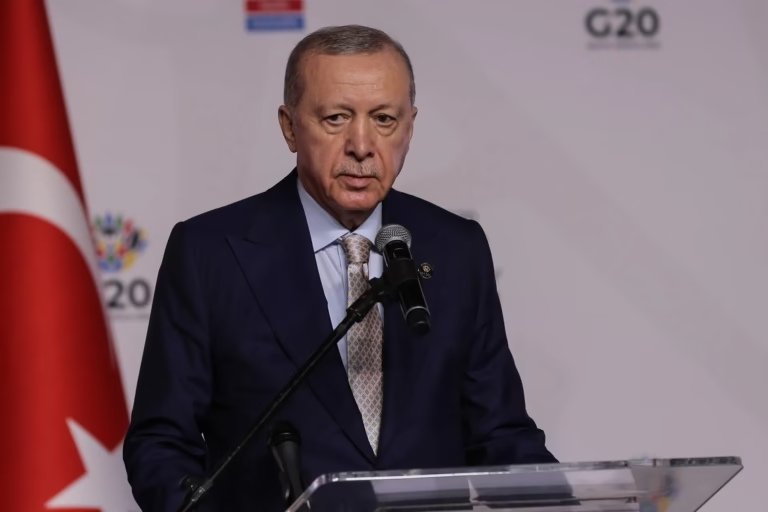
Erdoğan reiterates warnings to Iran after NATO intercepts another missile in Turkey

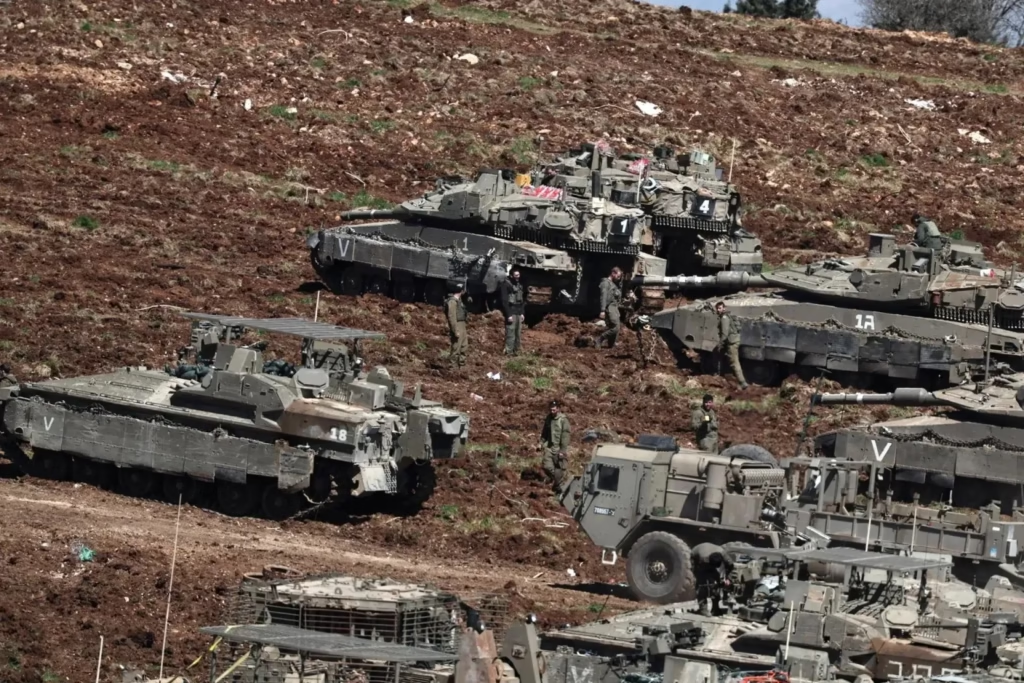
Istanbul, Turkey — The Turkish President Recep Tayyip Erdoğan, reiterated his warnings on Monday to Iran not to extend the conflict, hours after NATO intercepted an Iranian missile in Turkish airspace, the second such interception since Mar. 4.

“Despite our sincere warnings, extremely wrong and provocative steps continue to be taken that test Turkey’s friendship,” Erdoğan warned.

RELATED NEWS : 3 U.S. Troops Killed, 5 Wounded as Iran Conflict Escalates

“Attitudes that cast shadows on a thousand years of neighborhood and brotherhood and that open deep wounds in the heart and mind of our nation should not be adopted,” Erdoğan said in a speech broadcast live by Turkish broadcaster NTV.

The head of state said that Turkey is doing everything possible to prevent the conflict from spreading further and to stop the spilling of more blood, and that Turkey is closely collaborating with the other NATO members and other allies to follow the course of the conflict.

Erdoğan also emphasized that, thanks to the Central Bank of Turkey’s reserves, his government is preventing the war-caused rise in oil and gas prices from being passed on to citizens in the form of higher inflation.

He recalled that a fiscal staggering system was established last week to limit the increase in fuel prices.

Furthermore, tariffs on the import of fertilizers were eliminated to encourage importation, the arrival of which to world markets has been greatly affected by the closure of the Strait of Hormuz. 


SOURCE : EFE. |  Follow Us: Facebook | Instagram | Twitter | Youtube |