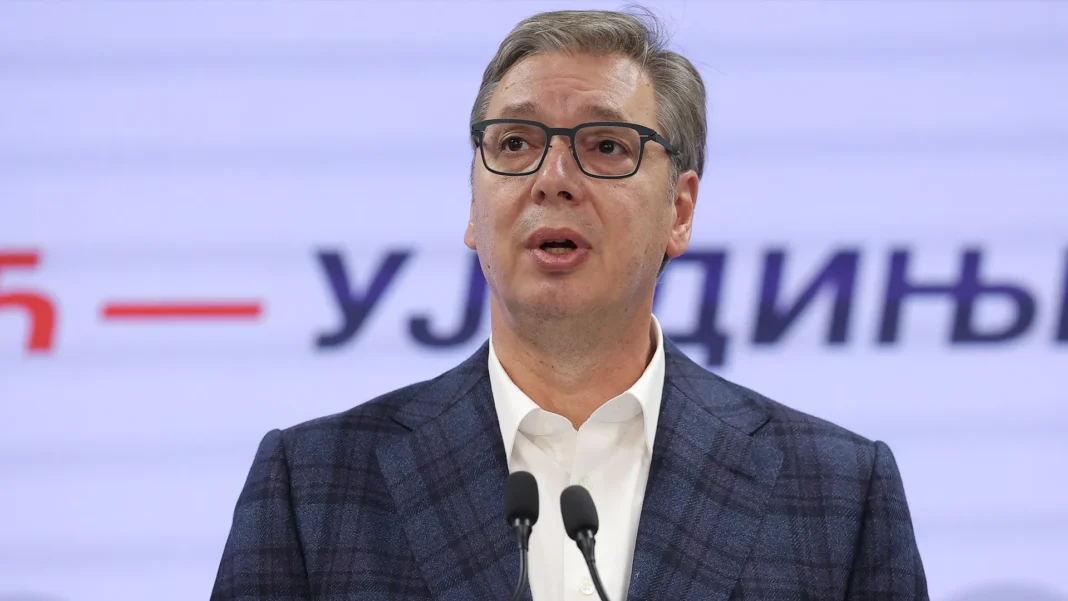
BELGRADE, Serbia — Serbian President Aleksandar Vučić has conceded defeat in Sunday’s snap parliamentary election, with preliminary projections indicating a major breakthrough for a student-backed movement that emerged from anti-corruption protests, potentially ending the Serbian Progressive Party’s (SNS) 14-year dominance of national politics.
Initial projections from polling agencies Ipsos and CeSID showed the “Student List — Students Win” securing approximately 52 per cent of the vote, ahead of the SNS-led coalition, “Aleksandar Vučić — United Serbia,” which received an estimated 39.3 per cent.
Speaking at his campaign headquarters in Belgrade before the release of final official results, Vučić acknowledged that his coalition had lost the election. Citing a stratified sample of the results, he estimated that the student-backed list would win between 135 and 140 of the National Assembly’s 250 seats, compared with approximately 105 for his coalition.
“I want to inform you that based on the stratified sample, it is clear that we have lost these elections,” Vučić said. “The student-backed list has won. They will have between 135 and 140 seats, and we will have around 105.”
According to his projections, the student-backed movement received approximately 2.2 million votes, while his coalition secured around 1.72 million.
Student Movement Celebrates Breakthrough
Celebrations erupted at the Student List’s headquarters as supporters welcomed the preliminary results. Radomir Šačić, a prominent candidate described as a University of Belgrade professor and member of the Serbian Academy of Sciences and Arts, hailed the outcome as a historic victory for Serbian citizens.
“Tonight the voice of the people is heard,” Šačić said, pointing to preliminary figures indicating that the movement was leading across polling stations.
“This is a victory of courage over fear, a victory of hope over apathy, a victory of faith that Serbia can and must be different,” he said. “This victory is no one’s personal trophy. It belongs to all of us.”
Emphasising that the public’s electoral choice must be respected, Šačić urged supporters to celebrate peacefully and responsibly, warning against provocations and confrontations.
The election determined all 250 seats in Serbia’s unicameral parliament, with 126 seats required to secure an outright majority.
Approximately 6.45 million voters were eligible to cast ballots at 8,392 polling stations, with 18 electoral lists competing. Polling stations closed at 8 p.m. local time, although voters already waiting in line were permitted to vote.
Anti-Corruption Protests Reshape Serbian Politics
The projected outcome marks a significant potential turning point in Serbian politics, where Vučić and the SNS have maintained a dominant position since 2012.
The student-backed movement gained prominence through anti-corruption demonstrations and university blockades following the collapse of a railway station canopy in Novi Sad in November 2024, a tragedy that killed 16 people and intensified public anger over alleged corruption, government accountability and institutional oversight.
The protests developed into a broader challenge to the ruling establishment, bringing together students and citizens demanding political accountability and institutional reform.
The movement’s electoral list, reportedly headed by Novi Sad university professor Ilija Srđanović, campaigned on an agenda centred on combating corruption and strengthening public institutions. It also challenged established opposition parties, including the Socialist Party of Serbia and other pro-European and right-wing political groups.
Its projected parliamentary majority would give the movement a potentially decisive role in shaping Serbia’s next government and advancing its reform agenda.
Vučić Acknowledges Defeat but Vows to Continue
In his concession speech, Vučić said he had decided to announce the preliminary projections before the official results were released to prevent uncertainty among supporters and counter speculation that he would refuse to acknowledge defeat.
He attributed his coalition’s projected loss partly to foreign support for the protest movement, describing the outcome as a “verification of a revolution”.
Vučić thanked his supporters and pledged that his political movement would remain united and continue its political activities from the opposition benches.
The final outcome, however, remains subject to confirmation by Serbia’s electoral authorities.
Implications for Serbia and Europe
If confirmed, the result would represent the most significant electoral setback for the SNS since it came to power in 2012 and could fundamentally reshape Serbia’s political landscape.
A student-backed parliamentary majority would create an opportunity to pursue anti-corruption measures, institutional reforms and greater accountability. However, translating the movement’s protest-driven support into effective governance could present substantial challenges.
The election could also carry implications for Serbia’s relations with the European Union, regional stability in the Western Balkans and the country’s broader foreign policy direction.
For Serbia, the immediate challenge will be to ensure a peaceful political transition, respect the final electoral results and address the public concerns that fuelled the protest movement.
The coming weeks will determine whether the projected victory develops into a lasting political transformation or becomes the beginning of another period of political confrontation.
SOURCE : AGENCIES | Follow Us: Facebook | Instagram | Twitter | Youtube