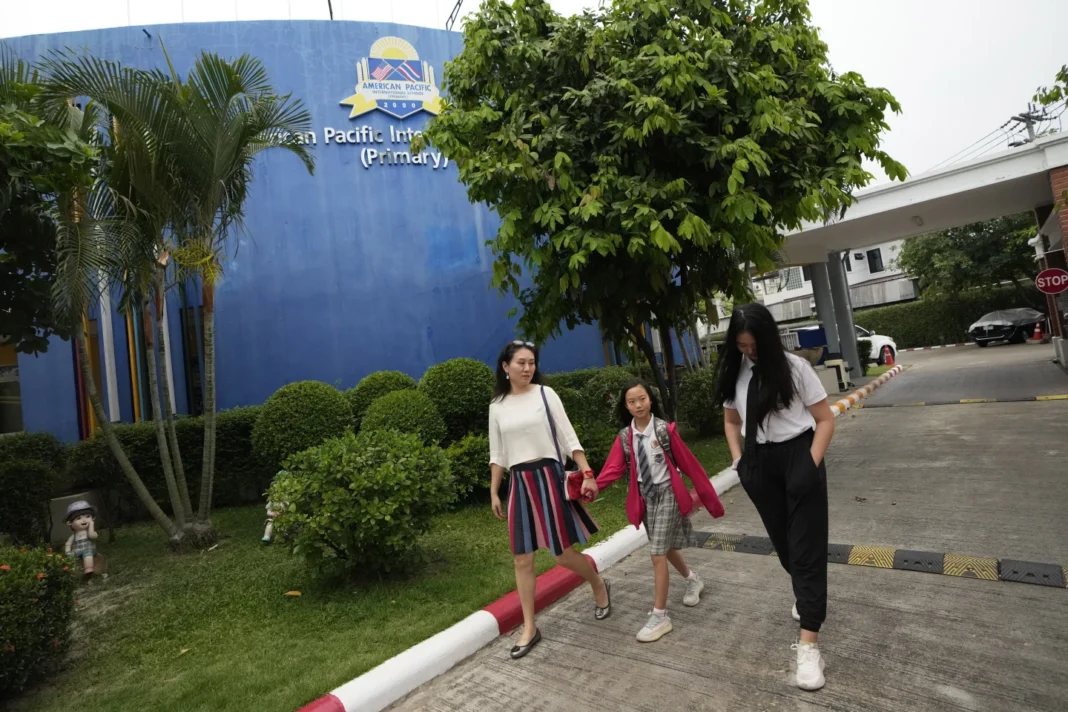
Chiang Mai,Thailand (AP) — The competition started in second grade for DJ Wang’s son.
Eight-year-old William was enrolled at a top elementary school in Wuhan, a provincial capital in central China. While kindergarten and first grade were relatively carefree, the homework assignments started piling up in second grade.
By third grade, his son was regularly finishing his day around midnight.
“You went from traveling lightly to carrying a very heavy burden,” Wang said. “That sudden switch, it was very hard to bear.”
READ MORE : China to raise defense budget by 7.2 percent this year
Wang, who traveled often to Chiang Mai in northern Thailand for his job in tourism, decided to make a switch, moving his family to the city that sits at the base of mountains.

The family is among a wave of Chinese flocking to Thailand for its quality international schools and more relaxed lifestyle. While there are no records tracking how many are moving abroad for education, they join other Chinese expats leaving the country, from wealthy entrepreneurs moving to Japan to protect their wealth, to activists unhappy with the political system, to young people who want to opt out of China’s ultra-competitive work culture, at least for a while.
Jenson Zhang, who runs an education consultancy, Vision Education, for Chinese parents looking to move to Southeast Asia, said many middle-class families choose Thailand because schools are cheaper than private schools in cities like Beijing and Shanghai.
“Southeast Asia, it’s within reach, the visa is convenient and the overall environment, as well as people’s attitude towards Chinese people, it allows Chinese parents to feel more secure,” Zhang said.
A 2023 survey by private education company New Oriental found Chinese families also increasingly considering Singapore and Japan for their children’s overseas study. But tuition and the cost of living are much higher than in Thailand.
Within Thailand, the slow-paced city of Chiang Mai often ends up being the top choice. Other options include Pattaya and Phuket, both popular beach resorts, and Bangkok, though the capital is usually more expensive.
The trend has been ongoing for about a decade, but in recent years it’s gathered pace.
Lanna International School, one of Chiang Mai’s more selective schools, saw a peak of interest in the 2022-2023 academic year, with inquiries doubling from a year earlier.
“Parents were really in a rush, they wanted to quickly change to a new school environment” because of pandemic restrictions, said Grace Hu, an admissions officer at Lanna International, whose position helping Chinese parents through the process was created in 2022.
Du Xuan of Vision Education says parents coming to Chiang Mai fall into two types: Those who planned in advance what education they want for their kids, and those who experienced difficulties with the competitive Chinese education system. The majority are from the second group, she said.
In Chinese society, many value education to the point where one parent may give up their job and rent an apartment near their child’s school to cook and clean for them, and ensure their life runs smoothly. Known as “peidu,” or “accompanied studying,” the goal is academic excellence, often at the expense of the parent’s own life.
That concept has become twisted by the sheer pressure it takes to keep up. Chinese society has come up with popular buzzwords to describe this hyper-competitive environment, from “neijuan” — which roughly translated means the rat race that leads to burnout — or “tang ping,” rejecting it all to drop out, or “lie flat.”
The terms reflect what success looks like in modern China, from the hours of cramming required for students to succeed on their exams to the money parents spend hiring tutors to give their kids an extra edge in school.
The driving force behind it all is numbers. In a country of 1.4 billion people, success is viewed as graduation from a good college. With a limited number of seats, class rank and test scores matter, especially on the college entrance exams known as the “gaokao.”
“If you have something, it means someone else can’t have that,” said Vision Education’s Du, whose own daughters attend school in Chiang Mai. “We have a saying about the gaokao: ‘One point will topple 10,000 people.’ The competition is that intense.”
Wang said his son William was praised by his second-grade teacher in Wuhan as gifted, but to stand out in a class of 50 kids and continue to get that level of attention would mean giving money and gifts to the teacher, which other parents were already doing before he was even aware of the need.
Back in Wuhan, parents are expected to know the material covered in extracurricular tutoring classes, as well as what is being taught in school, and ensure their child has mastered it all, Wang said. It’s often a full-time job.
In Chiang Mai, freed from China’s emphasis on rote memorization and hours of homework, students have time to develop hobbies.
Jiang Wenhui moved from Shanghai to Chiang Mai last summer. In China, she said, she had accepted that her son, Rodney, would get average grades because of his mild attention deficit disorder. But she could not help thinking twice about her decision to move given how competitive every other family was.
“In that environment, you’ll still feel anxious,” she said. “Should I give it another go?”
In China, her energy was devoted toward helping Rodney keep up in school, shuttling him to tutoring and keeping him on top of his coursework, pushing him along every step of the way.
In Thailand, Rodney, who’s about to start 8th grade, has taken up acoustic guitar and piano, and carries around a notebook to learn new English vocabulary — all of it his own choice, Jiang said. “He’d ask me to add an hour of English tutoring. I thought his schedule was too full, and he told me, ‘I want to try and see if it’s OK.’”
He has time to pursue hobbies and hasn’t needed to see a doctor for his attention deficit disorder. After bonding with one of his teachers about snakes, he is raising a pet ball python called Banana.
Wang says his son William, who is now 14 and about to enter high school, finishes his homework well before midnight and has developed outside interests. Wang, too, has changed his perspective on education.
“Here, if he gets a bad grade, I don’t think much of it, you just work on it,” he said. “Is it the case that if he gets a bad grade, that he will be unable to become a successful adult?”
“Now, I don’t think so.”
By HUIZHONG WU FOR AP