Home Blog Page 5

China’s BYD overtakes Tesla to become the world’s top electric vehicle maker

New York, USA – Tesla has lost its position as the world’s bestselling electric vehicle (EV) manufacturer, after a second consecutive year of falling sales driven by intensifying global competition and a customer backlash linked to the political views of its chief executive.

Tesla said it delivered 1.64 million vehicles in 2025, a decline of 9% compared with the previous year. The drop marks another setback for the company as it faces slowing demand in key markets and growing pressure from lower-cost rivals, particularly in Asia and Europe.

Chinese competitor BYD sold 2.26 million vehicles last year, overtaking Tesla to become the world’s largest EV maker. BYD’s rise highlights China’s expanding dominance in the global EV sector, supported by aggressive pricing, a broad model lineup, and strong domestic demand.

Tesla’s fourth-quarter performance also disappointed investors. The company delivered 418,227 vehicles during the period, well below the roughly 440,000 expected by analysts surveyed by FactSet. Analysts said sales were likely hit by several factors, including the expiration of a $7,500 U.S. federal tax credit that was phased out by the Trump administration at the end of September, making Tesla vehicles more expensive for some buyers.

Despite the weaker sales figures, Tesla’s stock finished 2025 with a gain of around 11%. Investor confidence has been supported by expectations that CEO Elon Musk can steer the company toward new growth areas beyond traditional car sales. Shares rose nearly 2% ahead of Friday’s market open, reflecting continued optimism about Tesla’s long-term strategy.

During the fourth quarter, Tesla began selling stripped-down, lower-cost versions of its Model Y and Model 3, which Musk unveiled in early October as part of an effort to revive demand. The new Model Y is priced just under $40,000, while the cheaper Model 3 costs under $37,000. These models are expected to help Tesla compete more effectively with Chinese EVs, particularly in Europe and Asia, where price sensitivity is higher.

Looking ahead, analysts expect Tesla’s fourth-quarter earnings report, due in late January, to show a 3% decline in sales and nearly a 40% drop in earnings per share, according to FactSet. Many analysts, however, believe the downward trend could begin to reverse as 2026 progresses, especially if interest rates ease and new products gain traction.

Investors have largely shrugged off the recent decline in vehicle sales, choosing instead to focus on Musk’s pivot toward other parts of the business. Musk has repeatedly said that slowing car sales matter less to Tesla’s future, arguing that the company’s long-term value lies in its driverless robotaxi ambitions, its growing energy storage business, and the development of humanoid robots designed to perform basic tasks in homes and factories.

Musk recently received another boost after a court decision revived his massive 2018 compensation package, potentially worth $55 billion. He has also fueled speculation that he could become the world’s first trillionaire if his rocket company SpaceX goes public later this year in what analysts expect would be a blockbuster initial public offering.

For now, Tesla faces a challenging transition period, balancing near-term pressure on its core EV business with ambitious bets on emerging technologies that could redefine the company’s future.


SOURCE : AP NEWS |  Follow Us: Facebook | Instagram | Twitter | Youtube |

Thousands join Mamdani during his inauguration in New York​

0

New York, US – Thousands of people, including political figures, joined the new mayor of New York, Zohran Mamdani, in his inauguration in front of City Hall, despite the frozen streets and temperatures below zero.

​The ceremony, which began around 1:30 pm local time, included the investiture of Mamdani and two other elected representatives: the NYC Public Advocate, Jumaane Williams, and the city comptroller, Mark Levine.

​Around 4,000 people were officially invited, but the new mayor’s team, who held a private swearing-in on Wednesday night, decided the event should be a community celebration in which citizens could participate.

​Mamdani, 34, was the last of the three politicians to be invested, guided by Senator Bernie Sanders.

​Congresswoman Alexandria Ocasio-Cortez was in charge of the opening.

”I also ask that we consider today an inauguration for each one of us, to the nearly 8.5 million New Yorkers who make up the greatest city on earth, because it is the people of New York City who have chosen historic, ambitious leadership in response to untenable and unprecedented times,” she said.

Ocasio-Cortez, who is similar in age to Mamdani and also belongs to the more leftist wing of the Democratic Party, highlighted that he is the first Muslim mayor, the first immigrant in nearly a century, and the youngest in several generations, but he aspires to be “a mayor for all of us.”​

During his speech, Mamdani pledged to improve the condition of the most vulnerable people in the city.

​“We may not always succeed, but we will never be accused of lacking the courage to try,” he pledged.

​The new mayor also refused to scale back promises of free child care and expanded bus service, insisting he will work to deliver.

​“I ran on an agenda, and I plan on making it happen,” he said.

​Mamdani closed his intervention asking: “Who does New York belong to?”

​To which he answered that for too long the city has served “the wealthy and well connected,” and promised his administration would confront the imbalance.

​Among the political figures attending the event were the two previous mayors, Eric Adams and Bill de Blasio.

​Senator Chuck Schumer, State Attorney Letitia James, or Harlem Councilman Yusef Salaam were also seen during the retransmission of the event.

​The event began with an interpretation of the American anthem by actor Javier Muñoz, known for his starring role in the Broadway musical “Hamilton.”

​It also included a recital by the poet Cornelius Eady, who expressly composed a piece titled “Proof.” 


SOURCE : EFE. |  Follow Us: Facebook | Instagram | Twitter | Youtube |

Maduro open to US talks on drug trafficking, but silent on CIA strike

0

Caracas, Venezuela — Venezuela is open to negotiating an agreement with the United States to combat drug trafficking, the South American country’s President Nicolás Maduro said in a pretaped interview aired Thursday on state television, but he declined to comment on a CIA-led strike last week at a Venezuelan docking area that the Trump administration believed was used by cartels.

Maduro, in an interview with Spanish journalist Ignacio Ramonet, reiterated that the U.S. wants to force a government change in Venezuela and gain access to its vast oil reserves through the monthslong pressure campaign that began with a massive military deployment to the Caribbean Sea in August.

RELATED NEWS : Venezuela Ready to Face Any U.S. Military Action, Says Defense Minister

“What are they seeking? It is clear that they seek to impose themselves through threats, intimidation and force,” Maduro said, later adding that it is time for both nations to “start talking seriously, with data in hand.”

“The U.S. government knows, because we’ve told many of their spokespeople, that if they want to seriously discuss an agreement to combat drug trafficking, we’re ready,” he said. “If they want oil, Venezuela is ready for U.S. investment, like with Chevron, whenever they want it, wherever they want it and however they want it.”

Chevron Corp. is the only major oil company exporting Venezuelan crude to the U.S. Venezuela has the world’s largest proven oil reserves.

The interview was taped on New Year’s Eve, the same day the U.S. military announced strikes against five alleged drug-smuggling boats. The latest attacks bring the total number of known boat strikes to 35 and the number of people killed to at least 115, according to numbers announced by the Trump administration. Venezuelans are among the victims.

President Donald Trump has justified the attacks as a necessary escalation to stem the flow of drugs into the United States and asserted that the U.S. is engaged in an “armed conflict” with drug cartels. The strikes began off Venezuela’s Caribbean coast and later expanded to the eastern Pacific Ocean.

Meanwhile, the CIA was behind a drone strike last week at a docking area believed to have been used by Venezuelan drug cartels, according to two people familiar with details of the operation who requested anonymity to discuss the classified matter. It was the first known direct operation on Venezuelan soil since the boat strikes began, a significant escalation in the administration’s pressure campaign on Maduro, who has been charged with narco-terrorism in the U.S.

Asked about the operation on Venezuelan soil, Maduro said he could “talk about it in a few days.”


SOURCE : AP NEWS |  Follow Us: Facebook | Instagram | Twitter | Youtube |
Indonesia halts rice, sugar, corn imports in 2026

Jakarta, Indonesia — The Indonesian government announced a total ban on the import of rice, table sugar, and corn for 2026, citing a significant rise in domestic production and a strategic pivot toward national food self-sufficiency.

The government has even shelved plans for industrial rice imports, which are typically used for manufacturing, Tatang Yuliono, a senior official at the Coordinating Ministry for Food Affairs, stated on Thursday.

He stated that the country has successfully achieved self-reliance in these strategic commodities for household consumption, following a comprehensive review of the 2026 National Commodity Balance.

Agriculture Minister Andi Amran Sulaiman emphasized that the policy follows direct instructions from President Prabowo Subianto to prioritize the welfare of local farmers and livestock breeders.

By halting the import of industrial-grade rice, the government intends to compel domestic businesses to source raw materials from local farmers, thereby encouraging improvements in yield quality and processing standards.

“We hope that locally sourced raw materials can meet standards for amylose content, hygiene, viscosity, and hardness,” Sulaiman said, noting that the policy is designed to strengthen the domestic supply chain.

The ban is supported by optimistic production forecasts.

Table sugar production for 2026 is projected to reach 3 million tonnes, exceeding the annual demand of 2.836 million tonnes, especially when combined with a carryover stock of 1.437 million tonnes from the previous year.

Similarly, the government expects a corn yield of 18 million tonnes, which comfortably surpasses the national demand of 17.055 million tonnes.

Government officials believe these surpluses provide a sufficient buffer to ensure price stability and food security without relying on international markets.

The 2026 National Food Balance will serve as the primary roadmap for implementing these measures and monitoring the transition to full agricultural independence.


SOURCE : ANTARA |  Follow Us: Facebook | Instagram | Twitter | Youtube |
Scholar-diplomat Abhay Kumar assumes charge as India’s Ambassador to Azerbaijan

0

New Delhi, India – Shri Abhay Kumar, Indian Foreign Service (IFS), has been appointed as India’s Ambassador to the Republic of Azerbaijan, marking a new chapter in his distinguished diplomatic career. Widely regarded as a scholar-diplomat, his appointment is seen as recognition of his long-standing contributions to India’s global engagement and cultural diplomacy.

Shri Abhay Kumar is also known for his scholarly work, particularly his widely acclaimed book Nalanda: How It Changed the World. The book, noted for its lucid narrative and global outlook, explores the far-reaching influence of Nalanda on education, philosophy, science, and cross-cultural exchanges across Asia.

RELATED NEWS : Dr. Hifzur Rahman appointed as the Ambassador of India to Libya

It has been extensively discussed in academic forums, literary festivals, and cultural diplomacy platforms, earning praise from scholars, diplomats, and general readers alike for reviving global awareness of Nalanda’s civilisational legacy. The book was launched at the Indira Gandhi National Centre for the Arts, where several eminent scholars participated in the event.

A 2003-batch IFS officer, Shri Abhay Kumar has served India in several key diplomatic roles, including as Ambassador to Madagascar and the Union of Comoros, and as Deputy Ambassador to Brazil. He is currently serving as Deputy Director General at the Indian Council for Cultural Relations (ICCR), New Delhi, where he has played an important role in strengthening India’s cultural outreach and people-to-people ties worldwide.

Beyond diplomacy, he is an accomplished poet, translator, and artist. His literary contributions have earned him several prestigious honours, including the SAARC Literary Award (2013), the Kalinga Literature Festival Award (2022), and the Bharat Shiksha Samman (2025). His recent work, Hanuman Chalisa in English, has further expanded the global reach of India’s spiritual and literary heritage.

Observers express confidence that Shri Abhay Kumar’s unique blend of diplomatic expertise, literary sensibility, and cultural vision will contribute significantly to deepening India–Azerbaijan relations and enhancing mutual understanding between the two countries.


SOURCE : MEA |  Follow Us: Facebook | Instagram | Twitter | Youtube |
Indonesia may extend search for three Spaniards missing after shipwreck

0

Labuan Bajo, Indonesia — Indonesian authorities said on Wednesday they expect to extend the search for three Spaniards missing after a shipwreck off eastern Indonesia, beyond the seven-day period stipulated by law.

Speaking at a meeting at the command post in Labuan Bajo, from where part of the operation is coordinated, the local navy chief, Stephanus Risdiganto, said he “expects” the search to continue as additional resources are being deployed to the area to locate the missing Spaniards.

The sixth day of the operation, carried out on Wednesday, “did not yield any results,” Fathur Rahman, an official from the National Search and Rescue Agency (BASARNAS) coordinating the mission, told EFE at the end of the day.

Rahman said a decision on whether to extend the operation will be taken on Thursday “after assessing the results” of the seventh day of searches.

BASARNAS expanded the search area on Wednesday to 34.96 nautical miles, focusing mainly north of the site where the tourist boat sank last Friday near Padar Island, close to Komodo National Park.

The vessel went down after being hit by three large waves, Risdiganto previously told EFE.

Wednesday’s operation involved teams from BASARNAS, the police, the coast guard, the navy and the army, along with a dozen professional volunteer divers searching both the surface and seabed.

The search is set to resume at first light on Thursday, with sonar equipment to be used during the seventh day to scan the seabed.
If potential remains are detected, divers will attempt visual confirmation, officials said during Wednesday night’s meeting.

Locating the wreckage remains a key objective, as rescuers believe the bodies of the missing may be trapped inside the vessel.
Of the 11 people on board at the time of the accident, seven, two Spaniards, four Indonesian crew members and an Indonesian guide, were rescued.

The body of a Spanish minor was recovered on Monday.

The governor of East Nusa Tenggara province, where Labuan Bajo is located, Emanuel Melkiades Laka Lena, visited the area of the accident on Wednesday.

He travelled by boat with local religious leaders to pray for the swift recovery of the missing.

Laka Lena also met on Tuesday night with the families of the three Spaniards, including Andrea Ortuño, one of the survivors of the shipwreck and the mother of the rescued minor and of the child whose body was found two days ago.

“We are going to find them,” the governor said during an emotional meeting attended by the father of the deceased child.

The three Spaniards still missing are Fernando Martín, a former footballer and coach of Valencia CF’s women’s B team, and two minors, one son of Martín and one son of Ortuño. The two adults were recently married.


SOURCE : EFE. |  Follow Us: Facebook | Instagram | Twitter | Youtube |
UN official reaffirms Somalia’s sovereignty after Israeli recognition of Somaliland

0

United Nations – Khaled Khiari, United Nations Assistant Secretary-General for the Middle East, Asia and the Pacific, called on the Security Council on Monday for respect for Somalia’s sovereignty and territorial integrity following Israel’s announcement that it recognizes Somaliland as an independent state.

In a session dedicated to the situation in Somalia, Khiari recalled that the Security Council has repeatedly reaffirmed respect for the sovereignty, political independence, and unity of the African country.

Khiari also urged Somalia and Somaliland to resume a “peaceful and constructive dialogue,” recalling the 2023 Djibouti Communique as a framework for negotiations between the two parties.

“We call on both parties to refrain from any action that could further aggravate the situation,” he added.

Somalia’s representative, Abukar Osman, condemned Israel’s action, which he considers “null” as it “violates the principles of the UN.”

“They seek to fragment the territory; we must reject this announcement in the clearest terms,” said Osman, who called on member states to unite in rejecting this action, which he described as an “attack on the international legal order.”

Israel officially recognized Somaliland as an “independent and sovereign state” on Dec. 26, according to Israeli Prime Minister Benjamin Netanyahu.

Israel’s recognition, the first country in the world to take this step, has met with widespread international rejection, especially from Africa, the Islamic world, China, and the European Union.

The Arab League (formed by 22 countries, including Somalia) said on Sunday that the recognition constitutes an “attack” on regional security, urging the application of “legal, economic, political, and diplomatic measures” against Israel.

The Federal Government of Somalia also categorically rejected the measure, stating that no external actor has the authority to modify its unity or territorial configuration.

The Somali statement noted that any recognition of Somaliland by Israel or other countries lacks legal and political validity and that actions of this type can destabilize the region and increase international tensions.

On Dec. 27, both chambers of the Somali Parliament also condemned the Israeli recognition, considering it “illegal” and without international legal effect.


SOURCE : EFE. |  Follow Us: Facebook | Instagram | Twitter | Youtube |
Protests over economic deterioration in Iran spread to several cities

0

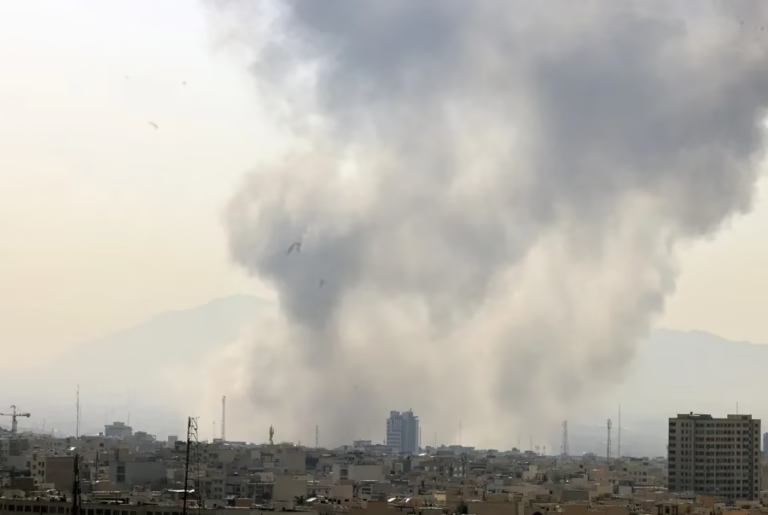
Tehran, Iran – Protests in Iran over the deteriorating economic situation continued Monday for a second day, spreading from Tehran to other areas of the country.

The demonstrations were surrounded by security forces, who in some cases fired tear gas to disperse the demonstrators.

On Monday, merchants in the Grand Bazaar in southern Tehran closed their businesses and staged a demonstration, according to official media outlets including IRNA.

Those dissatisfied with the economic situation chanted slogans such as “close, close,” urging other stores that were open to join the protest.

Videos released by activists on social media showed the presence of security forces at the scene, and an image of a man sitting on the ground in front of them, covering his head with his coat, has gone viral.

The demonstrations spread to other parts of the city, including the Alaeddin and Charsu mobile phone shopping centers, the Amin Hozur appliance market, and the Delevarán furniture market, among others.

Other images showed people shouting slogans against the authorities at a Tehran subway station.

Rallies were also reported in Malard (Tehran province), Karaj (north), Kerman (southeast), Zanjan and Hamadan (northwest), and the island of Qeshm (south).

Protesters chanted slogans against the Islamic Republic, such as “death to the dictator,” but also pro-monarchy slogans, such as “This is the last battle, Pahlavi will return,” in reference to the Pahlavi dynasty overthrown by the Islamic Revolution of 1979.

Some videos showed the authorities firing tear gas to disperse the protesters.

On the second consecutive day of protests, the Revolutionary Guard warned that it would oppose “any attempt at sedition, chaos, or threat to security.”

The Tasnim agency, linked to the Revolutionary Guard, claimed that “anti-Iranian media and foreign security organizations, through some of their internal agents, have been present at some rallies to turn the protests into riots.”

Even so, it is reported that merchants will continue their protests for a third day on Tuesday, while the student website Amirkabir announced that students from Shahid Beheshti and Amirkabir universities in Tehran will also hold a rally.

Demonstrations began on Sunday at several shopping centers in Tehran due to the volatility of the national currency, which has been falling against foreign currencies, especially the dollar.

Merchants believe it is not in their best interest to sell their goods, as replacing them would be more expensive.

The Iranian currency hit a new all-time low of 1,440,000 rials per dollar on Sunday, but recovered on Monday, trading at 1,360,000 rials.

In addition, recent data from the Iranian Statistics Center indicate that point-to-point inflation exceeded 52% between November and December, which has drastically reduced the population’s purchasing power.


SOURCE : EFE. |  Follow Us: Facebook | Instagram | Twitter | Youtube |
Indonesia, US reach agreement on reciprocal trade deal substance

0

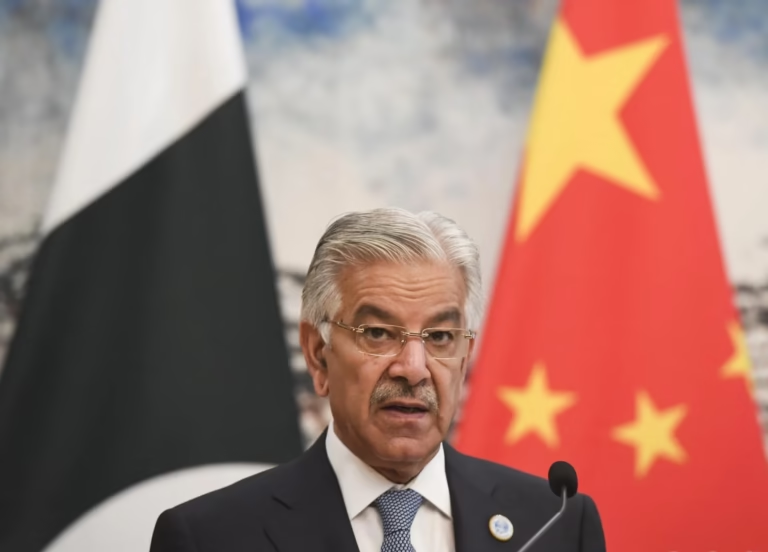
Jakarta, Indonesia  — Indonesia and the United States (US) have agreed on the substance of the Agreements on Reciprocal Trade (ART) negotiations, Coordinating Minister for Economic Affairs, Airlangga Hartarto said.

The agreement was reached after an official meeting between Hartarto and the United States Trade Representative (USTR), Ambassador Jamieson Greer, on Monday (December 22) in Washington, D.C.

“This agreement is both commercial and strategic and will benefit the economic interests of both countries. Regarding the content and substance, discussions were held from December 17 to 22, and all aspects have been agreed upon by both parties,” Hartarto said during an online press conference on Tuesday.

Since the Liberation Day announcement on April 2, 2025, when the US government imposed reciprocal tariffs, the Indonesian government has conducted intensive negotiations with Washington to address various trade issues between the two countries.

A joint statement issued on July 22, 2025, announced a reduction in reciprocal tariffs imposed on Indonesia from 32 percent to 19 percent.

Following the issuance of the statement, both countries continued intensive negotiations to finalize a comprehensive trade agreement.

Under the reciprocal trade agreement, Indonesia committed to providing market access for US products, addressing non-tariff barriers, and strengthening cooperation in digital trade and technology, national security, and commercial relations.

Meanwhile, the US committed to granting tariff exemptions for Indonesia’s leading export products that it does not produce domestically, such as palm oil, cocoa, coffee, tea, and other commodities.

During the meeting with Ambassador Greer, Minister Hartarto encouraged the resolution of all key and technical issues to ensure mutual agreement. After extensive discussions, both parties agreed on all key issues forming the substance of the ART.

The agreement is scheduled to be signed by President Prabowo Subianto and US President Donald Trump at the end of January 2026.

Following the agreement, technical teams from both countries will meet in Washington, D.C. in the second week of January 2026 to finalize technical aspects, with completion targeted within one week.

By the third week of January 2026, the ART document is expected to be finalized by both parties.

Currently, the US is coordinating with the US National Security Agency (NSA) to determine the most appropriate timing for the planned meeting between the two heads of state.


SOURCE : ANTARA |  Follow Us: Facebook | Instagram | Twitter | Youtube |
India and New Zealand finalize a free trade agreement, eyeing growth as global uncertainties persist

0

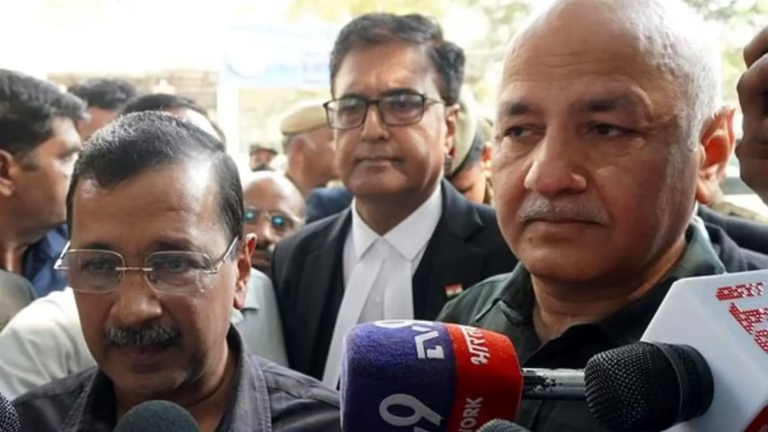
New Delhi, India – India and New Zealand announced Monday they have reached a free trade deal, seeking to deepen economic ties and shore up growth at a time of mounting global trade uncertainties.

The move comes as New Delhi accelerates efforts to diversify export destinations as part of a broader strategy to offset the impact of steep U.S. import tariffs.

A formal signing of the agreement between India and New Zealand is expected in the first quarter of next year after legal scrubbing of the negotiated text, India’s chief negotiator Petal Dhillon told reporters.

The India-New Zealand trade agreement, negotiated over nine months, aims to lower tariffs, ease regulatory barriers and expand cooperation across goods, services and investments.

It underscores India’s push to lock in trade partnerships beyond traditional markets as global commerce faces strains from unpredictable tariffs and geopolitical tensions, slowing growth and raising protectionism.

As part of the deal, India would get zero-duty-export access for all its goods to New Zealand while Wellington would get duty concessions and market access for about 70% of New Delhi’s tariff lines, covering 95% of its exports in a phased manner, Indian officials said.

India’s major sectors that will gain from tax free exports include textiles, apparel, engineering goods, leather and footwear, and marine products, while New Zealand’s major gains will be in horticulture, wood exports, coal, and sheep wool and meat, among others.

New Zealand has committed investments worth $20 billion in India over a period of 15 years as part of the agreement, India’s Trade Ministry said.

New Delhi has excluded from the deal dairy imports such as milk, cream, whey, yoghurt, and cheese, along with animal and vegetable products, including goat meat, onions and almonds, citing “domestic sensitivities.”

Bilateral trade between India and New Zealand remains modest compared with New Delhi’s bigger partners, but officials said the deal has strong growth potential. Two-way trade that includes merchandise goods and services stood at $2.4 billion in 2024, which the two sides hope to double in about five years, Trade Secretary Rajesh Agarwal said.

“Given the limited scale of bilateral trade, the agreement is less a trade breakthrough than a framework for deeper cooperation,” trade analyst Ajay Srivastava said.

New Zealand Prime Minister Christopher Luxon said in a post on X Monday that he spoke to his Indian counterpart Narendra Modi on conclusion of the talks. He said New Zealand’s exports to India are forecast to increase by $1.1 billion to $1.3 billion annually over the coming two decades as a result of the agreement.

“Boosting trade means more Kiwi jobs, higher wages and more opportunities for hard working New Zealanders,” he said.

New Zealand Trade Minister Todd McClay said the agreement gives the country access to markets that India has not provided to any other country.

“New Zealand is the first country to secure any access for apples and honey into India in an FTA. We have secured the best access for kiwi fruit into India of any country in the world,” he said.

Indian Trade Minister Piyush Goyal said the agreement demonstrates India was “rapidly expanding” its trade relations with countries that complement the Indian economy rather than competing with it.

India is betting that a wider network of trade agreements will help cushion external shocks and anchor its export ambitions. In recent months, New Delhi has accelerated a push to finalize several free trade agreements. The country is in advanced talks with the European Union and Chile, among others, and hopes to finalize terms of reference soon to negotiate a pact with Canada.

The stepped-up negotiations come as Indian exporters face pressure from higher U.S. import tariffs, which went into effect in August. The tariffs include an additional 25% levy on India for its unabated purchases of discounted Russian oil, bringing the combined tariffs imposed by the United States on its ally to 50%.

India has been the second biggest importer of Russian crude after China, drawing criticism from Washington that it was helping finance Moscow’s war machine against Ukraine.

While India and the U.S. have been negotiating a bilateral trade agreement, the tariffs have weighed on sectors such as textiles, auto components, metals and labor-intensive manufacturing.

India signed comprehensive economic cooperation and trade agreements with the United Arab Emirates and Australia in recent years, lifting bilateral trade with both countries. In May, Britain and India announced a hard-wrought FTA that will slash tariffs on products including Scotch whisky and English gin shipped to India, and Indian food and spices sent to the U.K.

Last week, India signed a comprehensive economic partnership agreement with Oman.


SOURCE : AP NEWS |  Follow Us: Facebook | Instagram | Twitter | Youtube |