Home Blog Page 8

Trump says he’ll raise tariffs to 15 percent after Supreme Court ruling

0

Washington, USA — President Donald Trump said Saturday that he wants a global tariff of 15%, up from 10% he had announced a day earlier after the U.S. Supreme Court struck down many of the far-reaching taxes on imports that he had imposed over the last year.

Trump’s announcement on social media was the latest sign that despite the court’s check on his powers, the Republican president still intends to ratchet up tariffs in an unpredictable way. Tariffs have been his favorite tool for rewriting the rules of global commerce and applying international pressure.

RELATED NEWS : US Supreme Court invalidates tariffs imposed by Trump

The court’s decision on Friday struck down tariffs that Trump had imposed on nearly every country using an emergency powers law. Trump now said he will use a different, albeit more limited, legal authority.

He’s already signed an executive order enabling him to bypass Congress and impose a 10% tax on imports from around the world, starting on Tuesday, the same day as his State of the Union speech. However, those tariffs are limited to 150 days unless they are extended legislatively.

The White House did not immediately respond to a message inquiring when the president would sign an updated order to peg the tariffs at 15%.

He wrote on social media that he was making the announcement “based on a thorough, detailed, and complete review of the ridiculous, poorly written, and extraordinarily anti-American decision on Tariffs issued yesterday.”

By a 6-3 vote, the justices ruled that it was unconstitutional for Trump to unilaterally set and change tariffs because the power to tax lies with Congress.

In addition to the temporary tariffs that Trump wants to set at 15%, the president said Friday that he was also pursuing tariffs through other sections of federal law which require an investigation by the Commerce Department.

He wrote on Saturday that “during the next short number of months, the Trump Administration will determine and issue the new and legally permissible Tariffs, which will continue our extraordinarily successful process of Making America Great Again.”

After the Supreme Court decision, Trump made an unusually personal attack on the justices who ruled against him in a 6-3 vote, including two of those he appointed during his first term, Justices Neil Gorsuch and Amy Coney Barrett. Trump, at a news conference on Friday, said that the situation is “an embarrassment to their families.”

He was still seething Friday night, posting on social media complaining about Gorsuch, Coney Barrett and Chief Justice John Roberts, who ruled with the majority and wrote the majority opinion. On Saturday morning, Trump issued another post declaring that his “new hero” was Justice Brett Kavanaugh, who wrote a 63-page dissent. He also praised Justices Clarence Thomas and Samuel Alito, who were in the minority, and said of the three dissenting justices: “There is no doubt in anyone’s mind that they want to, MAKE AMERICA GREAT AGAIN!”

Tariffs have been central to Trump’s economic policies, which he has said address a host of ills, from reviving trade imbalances and reviving U.S. manufacturing to forcing other nations to action, whether it be stepping up efforts to combat drug trafficking or ceasing hostilities with each other.

He also regularly claimed despite evidence to the contrary that foreign governments would pay the tariffs—not American consumers and businesses.

Federal data shows the Treasury had collected more than $133 billion from the import taxes the president has imposed under the emergency powers law as of December, and Trump has made many promises about what that money might go toward, such as paying down the national debt and sending dividend checks to taxpayers. The Supreme Court decision did not address what happens to the funds that have already been collected from tariffs.

Democrats spoke out quickly on Trump’s new tariff threat. Democrats on the House Ways and Means Committee accused Trump of “pickpocketing the American people” with his newly announced higher tariff.

“A little over 24 hours after his tariffs were ruled illegal, he’s doing anything he can to make sure he can still jack up your costs,” they wrote on social media.

California Democratic Gov. Gavin Newsom, a Trump nemesis, added that “he does not care about you.”


SOURCE : AP NEWS |  Follow Us: Facebook | Instagram | Twitter | Youtube |

India, Brazil forge rare earths pact to safeguard strategic supplies

0

New Delhi, India – Indian Prime Minister Narendra Modi and Brazilian President Luiz Inácio Lula da Silva signed a cooperation and technical investment agreement on Saturday to jointly explore and develop critical minerals, aiming to secure strategic supplies of rare earths, lithium, and niobium essential for their technological ambitions.

The agreement, signed in New Delhi, seeks to strengthen supply chains for key raw materials used in renewable energy, semiconductors, artificial intelligence, and advanced digital infrastructure, sectors both nations consider vital to their economic sovereignty.

“Increasing investments and cooperation in matters of renewable energy and critical minerals is at the core of a pioneering agreement that we have signed today,” Lula said in a statement after meeting Modi.

“Our countries are ensuring that these technologies have their rightful place on the global climate and energy agenda.”

The pact aligns with New Delhi’s Critical Minerals Mission, which exempts 25 strategic minerals from import duties to reinforce supply chains as India seeks to reduce dependence on China.

Modi stressed the urgency of establishing a secure supply corridor to power what he described as India’s technological revolution, noting that companies announced $300 billion in digital infrastructure investments this week alone.

“The critical minerals agreement will help shape a new and resilient supply chain,” Prime Minister Narendra Modi said.

“We are also prioritizing our cooperation in areas such as Artificial Intelligence, supercomputers, semiconductors, and blockchain. We both believe that technology must be inclusive and become a bridge for shared progress.”

Under the framework, Indian companies will be able to acquire mining assets in Brazil and import raw materials at zero tariff, positioning Latin America as an alternative source of strategic minerals amid China’s dominance in processing and supply.

Brazil, which controls about 90 percent of global niobium production and holds the world’s third-largest reserves of rare earth elements, is emerging as a key mining partner for India’s industrial expansion.

During the meeting, both leaders raised their bilateral trade target to $30 billion by 2030, after trade surpassed $15 billion in 2025.

They also agreed to extend the validity of tourist and business visas from five to 10 years to facilitate commercial ties.

Meanwhile, New Delhi is in the final stages of expanding its trade agreement with Chile to secure preferential access to lithium, further consolidating its outreach to Latin America.

India’s broader strategy aims to provide regional economies with an alternative investment partner while ensuring a steady flow of raw materials to fuel its growing industrial and technological base. 


SOURCE : EFE. |  Follow Us: Facebook | Instagram | Twitter | Youtube |
Israeli airstrikes in eastern Lebanon kill 8 Hezbollah members, officials say

0

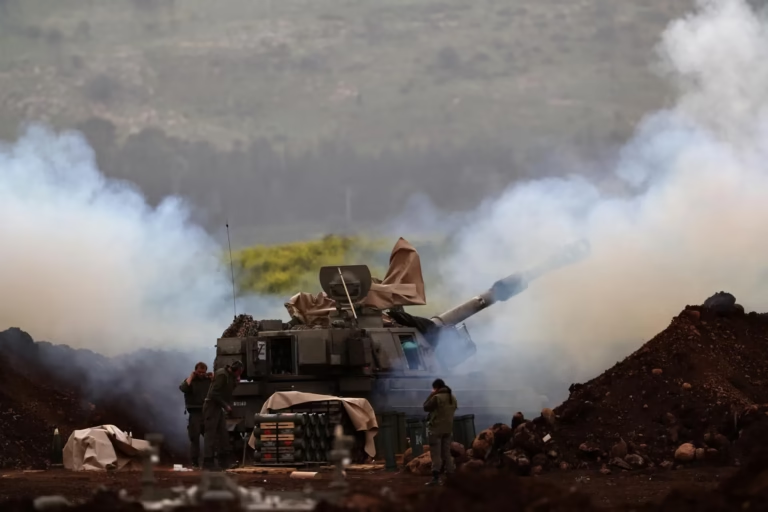
Rayak, Lebanon — Israeli airstrikes on eastern Lebanon have killed eight members of the militant Hezbollah group, including several local officials, two officials with the group said Saturday.

The Lebanese Health Ministry put the death toll at 10, but did not distinguish between militants and civilians.

The Hezbollah officials told The Associated Press that the eight militants were killed in strikes near the village of Rayak in northeast Lebanon late Friday. They spoke on condition of anonymity because they were not authorized to speak to the media about such details.

An Associated Press team that visited the scene of the strike Saturday morning saw that the top floor of a three-story building was knocked out.

The Israeli military said Saturday that several members of Hezbollah’s missile unit, in three different command centers in the Baalbek area in Lebanon, were “eliminated.”

The Israeli army added that the Hezbollah members killed were identified “as operating to accelerate readiness and force build-up processes, while planning fire attacks toward Israel.”

One of the Hezbollah officials said that three of the dead were local commanders and identified them as Ali al-Moussawi, Mohammed al-Moussawi and Hussein Yaghi.

Yaghi was the son of prominent Hezbollah official and one of its founders, Mohammed Yaghi, who died in 2023. Mohammed Yaghi was also a close aide to late Hezbollah leader Hassan Nasrallah who was killed in an Israeli airstrike in September 2024.

Lebanon’s Health Ministry said Saturday that Israeli strikes on eastern Lebanon killed 10 people and wounded 24, including three children.

Ali Abdullah, executive director of Rayak Hospital, told the AP that the strike occurred after sunset, adding that they have received 10 bodies and 21 wounded. He added that the dead included two non-Lebanese — a Syrian man and an Ethiopian woman. The wounded included five Syrians and three Ethiopians.

Ethiopians often come to Lebanon as migrant domestic workers.

A funeral was held Saturday afternoon in the eastern village of Nabi Chit for two Hezbollah members who were killed in the strikes.

After the Oct. 7, 2023, Hamas-led attack on Israel triggered war in Gaza, Hezbollah began firing rockets from Lebanon into Israel in support of Hamas and the Palestinians.

Israel responded with airstrikes and shelling. The low-level conflict escalated into full-scale war in September 2024, later reined in but not fully stopped by a U.S.-brokered ceasefire two months later.

Since then, Israel has accused Hezbollah of trying to rebuild and has carried out near-daily strikes in Lebanon that it says target Hezbollah militants and facilities. Hezbollah has claimed one strike against Israel since the ceasefire.

The death toll from Friday’s strikes was unusually high and comes at a moment of intensified tensions in the region as the United States has threatened to strike Iran — a backer of both Hezbollah and Hamas — if negotiations over Tehran’s nuclear program fail to produce a deal.


SOURCE : AP NEWS |  Follow Us: Facebook | Instagram | Twitter | Youtube |
US Supreme Court invalidates tariffs imposed by Trump

0

Washington, USA – The United States Supreme Court ruled on Friday that the government overstepped with the emergency powers invoked by President Donald Trump to impose tariffs on many of the country’s trading partners, in a major blow to the president’s tariff policy.

With a clear 6-3 majority, the conservative-dominated Supreme Court handed Trump one of the first major setbacks of his second term, reversing the favorable trend on other key issues.

Chief Justice John Roberts, representing the majority, indicated that the government does not have inherent powers in peacetime to impose tariffs based on the International Emergency Economic Powers Act (IEEPA) of 1977, which Trump invoked as the foundation for his trade war.

The Supreme Court ruled that Trump’s use of this legislation would entail an excessively broad delegation of the taxing power reserved for Congress under the Constitution, since the Court considers tariffs to be a type of tax on citizens.

Justices Samuel Alito, Clarence Thomas, and Brett Kavanaugh dissented, they considered that the president should not be limited in these matters, as they think the IEEPA can be used for foreign policy issues.

The decision against Trump’s tariff-imposing powers does not prevent him from imposing duties under other laws.

Administration officials have already stated that they expect to maintain the president’s tariff framework using alternative legal bases. However, it is unclear whether importers who paid the high tariffs will be able to request and receive refunds equivalent to several billion dollars.

Trump insisted that it would be “very disappointing” if the Supreme Court deemed a significant portion of the tariffs illegal.

According to him, the tariffs are key to his administration’s economic success and foreign policy leverage.

The president acknowledged that “it would be a complete mess, and almost impossible for our Country to pay,” and return the collected amounts to importers.

Brussels urges the US to lower tariffs

As of Friday, the European Commission called on the US to reduce tariffs after the Supreme Court ruling.

“Businesses on both sides of the Atlantic depend on stability and predictability in the trading relationship. We therefore continue to advocate for low tariffs and to work towards reducing them,” said European Commission Trade Spokesperson Olof Gil.

Gil added that Brussels is analyzing the ruling and is in contact with the US administration to determine how it will implement it.

In Aug. 2025, a Federal Circuit Court of Appeals ruled in favor of two small importing companies in a lawsuit against Trump, deciding that he did not have the right to impose the so-called “reciprocal tariffs.”

These tariffs range from 50%, imposed on imports from Brazil and India, to a minimum of 10%, imposed on imports from the United Kingdom and most Latin American countries.

The Court also ruled that Trump lacked the authority to implement the 25% tariff on certain products from Canada, China, and Mexico.

However, the Court avoided freezing the tariffs’ implementation to give the federal government time to take the case to the Supreme Court. 


SOURCE : EFE. |  Follow Us: Facebook | Instagram | Twitter | Youtube |
Modi pitches India as an artificial intelligence hub at the AI summit

0

New Delhi, India — Indian Prime Minister Narendra Modi on Thursday pitched his country as a central player in the global artificial intelligence ecosystem, saying it aims to build technology at home while deploying it worldwide.

“Design and develop in India. Deliver to the world. Deliver to humanity,” Modi told a gathering of some world leaders, technology executives and policymakers at the India AI Impact Summit in New Delhi.

Modi’s remarks came as India — one of the fastest-growing digital markets — seeks to leverage its experience in building large-scale digital public infrastructure and to present itself as a cost-effective hub for AI innovation.

The summit was also addressed by French President Emmanuel Macron, Google CEO Sundar Pichai and U.N. Secretary-General António Guterres, who called for a $3 billion fund to help poorer countries build basic AI capacity, including skills, data access and affordable computing power.

“The future of AI cannot be decided by a handful of countries, or left to the whims of a few billionaires,” Guterres said, stressing that AI must “belong to everyone.”

India aims to ramp up its AI scale

India is using the summit to position itself as a bridge between advanced economies and the Global South. Indian officials cite the country’s digital ID and online payments systems as a model for deploying AI at low cost, particularly in developing countries.

“We must democratize AI. It must become a tool for inclusion and empowerment, particularly for the Global South,” Modi said.

He later separately met tech leaders, many of whom laid out their investing plans in India and agreed to commit to a broad set of principles for developing “inclusive and multilingual” AI.

OpenAI CEO Sam Altman said the company will collaborate with India’s Tata Group on AI initiatives, including the development of data center infrastructure in the country.

“We believe the democratization of AI is the only fair and safe path forward,” Altman said at the meeting. A group photo with Modi, Altman and a dozen other tech leaders went viral when Modi invited everyone to hold and lift their hands together. Breaking the chain by not holding hands were Altman and Dario Amodei, the CEO of AI company Anthropic, which has been in a fierce rivalry with OpenAI. Altman later said he was confused about what was happening.

With nearly 1 billion internet users, India has become a key market for global technology companies expanding their AI businesses.

Last December, Microsoft announced a $17.5 billion investment over four years to expand cloud and AI infrastructure in India. It followed Google’s $15 billion investment over five years, including plans for its first AI hub in the country. Amazon has also pledged $35 billion by 2030, targeting AI-driven digitization.

India is also seeking up to $200 billion in data center investment in the coming years.

The country, however, lags in developing its own large-scale AI model like U.S.-based OpenAI or China’s DeepSeek, highlighting challenges such as limited access to advanced semiconductor chips, data centers and hundreds of local languages to learn from.

The summit has faced troubles

The summit opened Monday with organizational glitches, as attendees and exhibitors reported long lines and delays, and some complained on social media that personal belongings and display items had been stolen. Organizers later said the items were recovered.

Problems resurfaced Wednesday when a private Indian university was expelled from the summit after a staff member showcased a commercially available Chinese-made robotic dog while claiming it as the institution’s own innovation.

The setbacks continued Thursday when Microsoft co-founder Bill Gates withdrew from a scheduled keynote address. No reason was given, though the Gates Foundation said the move was intended “to ensure the focus remains on the AI Summit’s key priorities.”

Gates is facing questions over his ties to late sex offender Jeffrey Epstein.


SOURCE : AP NEWS |  Follow Us: Facebook | Instagram | Twitter | Youtube |
Nigerian police say armed group killed 33 in fresh simultaneous attacks

0

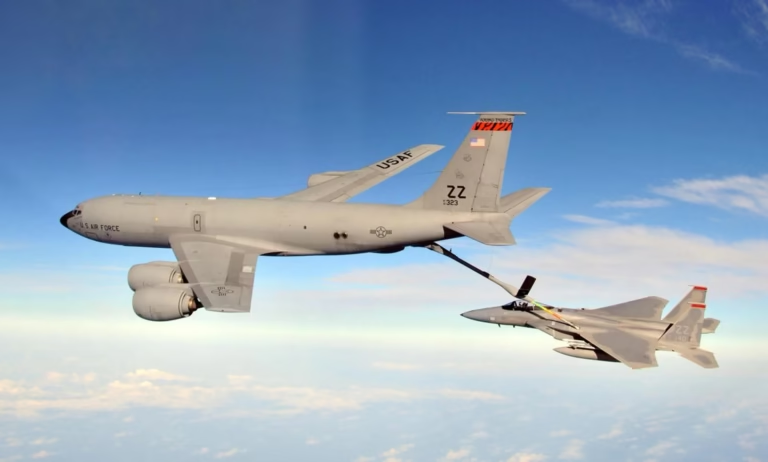
Abuja, Nigeria — At least 33 people have been killed after Islamic militants launched simultaneous attacks on a district in northwest Nigeria, according to the police.

The attack took place on Wednesday in the Biu community of Kebbi state, police spokesman Bashir Usman said in a statement late Thursday night.

The assailants crossed from Sokoto state, parts of which are occupied by the Lakurawa insurgent group, Usman said.

“Preliminary investigations confirm that armed Lakurawa militants entered the area to rustle cattle,” he said, adding that security personnel have been deployed to restore calm and maintain order.

The Lakurawa group operates in parts of northwestern Nigeria, particularly around communities in the northwestern state of Sokoto. The armed group is known to engage in cattle rustling, raids on villages and kidnappings for ransom.

Northern Nigeria is in the grip of a complex security crisis featuring both Islamic militants and armed criminal gangs kidnapping people for ransom.

The West African nation is in security cooperation with the U.S. after initial diplomatic tensions. Earlier this week, the Nigerian military announced the arrival of 100 U.S troops in Nigeria to help train its military in its fight against armed groups.


SOURCE : AP NEWS |  Follow Us: Facebook | Instagram | Twitter | Youtube |
Former Prince Andrew released under investigation after almost 11 hours in police custody

0

London, United Kingdom – Former United Kingdom Prince Andrew Mountbatten-Windsor, the brother of King Charles III, was released on Thursday after being held for almost 11 hours by police for questioning. His arrest was connected to an investigation into alleged misconduct in public office related to the Epstein case.

Thames Valley Police, the agency leading the investigation, released a brief statement on Thursday confirming that they had released a man “in his sixties” under investigation after his arrest in Norfolk, eastern England, on Thursday.

They also announced that they had concluded their inquiries in the area without explicitly identifying the man as Andrew.

However, the former Duke of York, who turned 66 on Thursday, was photographed inside a car leaving the Aylsham police station in Norfolk, eastern England, where he had been questioned by authorities following his arrest at his Sandringham estate that morning.

The photograph, taken almost 11 hours after his detention, shows Andrew reclining in the back seat of the vehicle with wide-open eyes and his hands clasped.

Thames Valley authorities, the police force whose jurisdiction includes Windsor (where Andrew lived until the recent forced abandonment of his Royal Lodge mansion) indicated that the investigation into several properties in the Berkshire region is still ongoing.

After learning of the arrest, King Charles III issued a brief statement expressing his “deepest concern” over his brother Andrew’s detention. Nevertheless, he backed the authorities, defended that “the law must take its course,” and maintained his public schedule.

The uproar surrounding Andrew Mountbatten-Windsor, who was stripped of all his noble titles and honors by his brother in October, has deepened after emails disclosed by the United States Department of Justice revealed that the former Prince provided Epstein with sensitive government documents during his time as the UK’s special representative for trade and investment.

A few prior to his arrest, Thames Valley Police had reported that they were assessing that information to decide whether to proceed with a criminal investigation.

The scandal of the so-called ‘Epstein Files’ has caused a seismic shock to the UK monarchy, which is experiencing a difficult period, after Andrew became the first high-ranking member of the royal family in modern history to be arrested.

Although he has always denied his involvement in Epstein’s network of child sexual abuse, his mother, the late Queen Elizabeth II, and now Charles III, have taken steps to progressively remove him from public life to mitigate the reputational damage to the monarchy.


SOURCE : EFE. |  Follow Us: Facebook | Instagram | Twitter | Youtube |
Toxic gas leak at mine in Nigeria kills 37 people

0

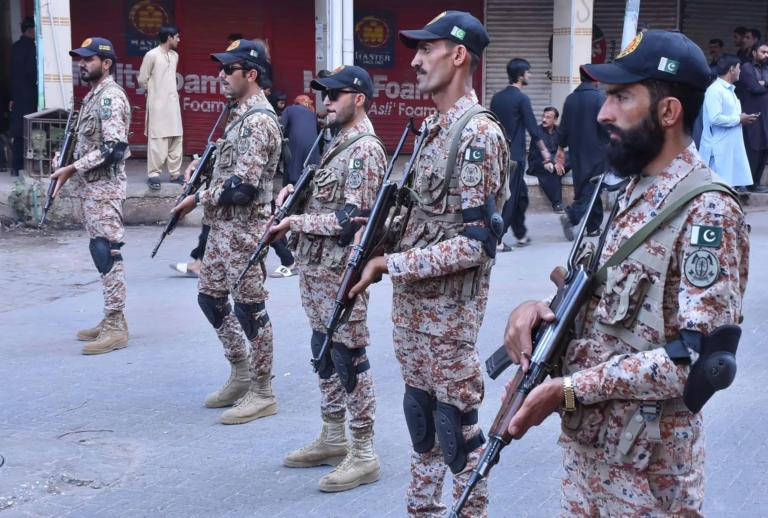
Abuja, Nigeria — A toxic gas leak at a mine in north-central Nigeria killed 37 people and led to the hospitalization of 26 others, according to police.

The incident occurred in the early hours of Tuesday in Kampani Zurak community, located in the Wase area of Plateau state, police spokesman Alfred Alabo said in a statement.

“Preliminary investigation revealed that the miners were affected due to a sudden discharge of lead oxide and other associated gases like sulphur and carbon monoxide which are toxic and poisonous to humans, particularly in a confined or poorly ventilated environment,” he said. “The corpses of the deceased victims have been released to their families for burial according to their religious practices.”

The Nigerian government has closed the mining site and an investigation into the leak is underway.

The miners were unaware of the toxic nature of the emissions and continued their operations, Nigeria’s Minister of Solid Minerals Development Dele Alake said in a statement.

It’s not clear what was being mined at the site and whether the mine was operating legally. Nigeria is trying to rein in illegal gold mining operations across the country that have killed hundreds of people over the years.

Nigeria’s Minister of Solid Minerals Development, Dr. Dele Alake , said the miners were unaware of the deadly nature of the gases and continued working. The government has closed and sealed the mining site , operated under Mining Licence 11810 by Solid Unit Nigeria Limited, and dispatched expert teams to investigate the cause of the disaster.

Preliminary findings suggest the site was an abandoned lead mine , where residual minerals can emit hazardous gases, and villagers entering the tunnels for extraction were caught unaware


SOURCE : AGENCIES |  Follow Us: Facebook | Instagram | Twitter | Youtube |
Macron, Modi Hold Talks to Strengthen France–India Economic and Strategic Partnership

0

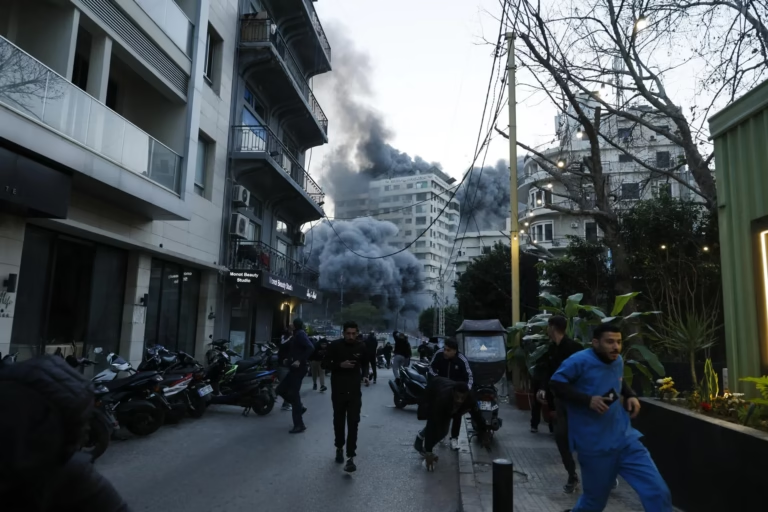
New Delhi/Mumbai, India — Emmanuel Macron and Narendra Modi held high-level bilateral talks on Tuesday, reaffirming their commitment to deepen economic cooperation and strengthen strategic ties amid global uncertainty and shifting geopolitical dynamics.

The meeting in Mumbai highlighted the expanding India–France partnership, which now spans defense, trade, technology, space, nuclear energy, and critical minerals. France has emerged as one of India’s most trusted European partners as New Delhi seeks to diversify supply chains and attract greater foreign investment.

“India–France partnership knows no boundary. In today’s era of uncertainties, this partnership is a force for global stability and progress,” Modi said during a joint press conference.

Defense and Strategic Cooperation at the Core

Defense remains the backbone of bilateral ties. India recently granted preliminary approval for military acquisitions worth nearly $40 billion, including 114 Rafale fighter jets from France. India already operates two Rafale squadrons and last year signed a deal for 26 naval variants for its aircraft carriers.

Maintaining air superiority is critical for India as it navigates complex security challenges along its borders with nuclear-armed neighbors Pakistan and China.

The two leaders also virtually inaugurated a final assembly line for H125 helicopters in Karnataka — a joint venture between Tata Advanced Systems and Airbus — marking India’s first private-sector helicopter manufacturing facility.

Expanding Economic and Technology Partnership

Macron described the relationship as being in a “phase of acceleration” in response to the evolving global order. Key sectors identified for deeper collaboration include:

  • Space and satellite technology
  • Nuclear energy
  • Rare earth and critical minerals
  • Aeronautics and high-speed rail
  • Artificial intelligence and innovation

Macron also voiced support for accelerating negotiations toward a free-trade agreement between India and the European Union.

Bilateral trade crossed $15 billion in the fiscal year ending March 2025, making France India’s third-largest trading partner within the EU, according to Indian government data.

Global Issues and Indo-Pacific Vision

The leaders discussed ongoing global conflicts, including the war in Ukraine. Macron invited Modi to attend the upcoming G7 Summit in Evian in June and urged closer cooperation to push for humanitarian ceasefires.

“As the ceasefire remains difficult to achieve, we could join efforts to secure an immediate and lasting moratorium on strikes against civilians and civilian infrastructure,” Macron said.

Modi reiterated India’s consistent position advocating dialogue and peaceful resolution to conflicts in Western Asia and Eastern Europe.

With shared interests in the Indo-Pacific and a commitment to multipolar global stability, the Modi–Macron meeting underscored a partnership that continues to grow in scale, ambition, and strategic importance.


SOURCE : AGENCIES |  Follow Us: Facebook | Instagram | Twitter | Youtube |
India Hosts High-Stakes AI Summit, Welcomes 20 Global Leaders and Top Tech CEOs

New Delhi, India — India is hosting a major artificial intelligence summit this week, bringing together heads of state, senior policymakers, and leading technology executives for a five-day gathering that underscores AI’s growing global influence.

The India AI Impact Summit marks the first time the high-level forum is being held in the Global South, shifting the spotlight beyond wealthy nations where most advanced AI systems are developed and dominated by major tech corporations. The event comes at a pivotal moment as artificial intelligence rapidly transforms economies, reshapes labor markets, and intensifies debates around regulation, security, and ethics.

From generative AI tools capable of producing text, images, and code to advanced systems powering defense platforms, healthcare diagnostics, and climate modeling, AI has become central to government strategies and corporate investments worldwide.

Previously hosted in France, the United Kingdom, and South Korea, the summit has evolved significantly — expanding from an initial focus on AI safety to a broader global platform addressing innovation, trade, governance, and responsible deployment of emerging technologies.

With participation from nearly 20 world leaders and top tech CEOs, India aims to position itself as a key voice in shaping the future of artificial intelligence in a more inclusive and multipolar digital order.

India aspires to be a rising AI power

India — the world’s most populous nation and one of the fastest-growing digital markets — sees the summit as an opportunity to project itself as a bridge between advanced economies and the Global South.

Officials said the country’s experience in building large-scale digital public infrastructure, including digital identity and payment platforms, offer a model for deploying AI at scale while keeping costs low.

“The goal is clear: AI should be used for shaping humanity, inclusive growth and a sustainable future,” India’s Minister for Electronics and Information Technology Ashwini Vaishnaw said.

The summit begins Monday and will be attended by 20 heads of state and government, including French President Emmanuel Macron and Brazilian President Luiz Inácio Lula da Silva. India’s Prime Minister Narendra Modi will address a session Thursday.

Google’s Chief Executive Sundar Pichai, Qualcomm’s CEO Cristiano Amon, OpenAI’s CEO Sam Altman, Microsoft’s President Brad Smith and AMI Labs Executive Chairman Yann LeCun are also expected to attend.

Indian executives hope the summit will highlight the country’s role as a driver of national capacity, economic resilience, and long-term growth.

“As India advances toward its goal of becoming a developed nation by 2047, AI will play a crucial role in strengthening large-scale systems — from energy and manufacturing to public infrastructure,” said Sumant Sinha, CEO of NASDAQ-listed clean energy firm ReNew.

As in many parts of the world, concerns are growing in India over AI’s potential disruption to jobs across the technology sector and related industries. However, experts stress that large-scale reskilling initiatives can help mitigate the risks.

“There is genuine concern around this issue, and we should not underestimate its impact. But from an Indian perspective, the focus is strongly on reskilling programs. As AI becomes more mainstream, we will also see new job roles emerging,” said Sangeeta Gupta, Senior Vice President at Nasscom, the leading association representing India’s technology industry.


SOURCE : AGENCIES |  Follow Us: Facebook | Instagram | Twitter | Youtube |